Support

Aqaba Fort

About

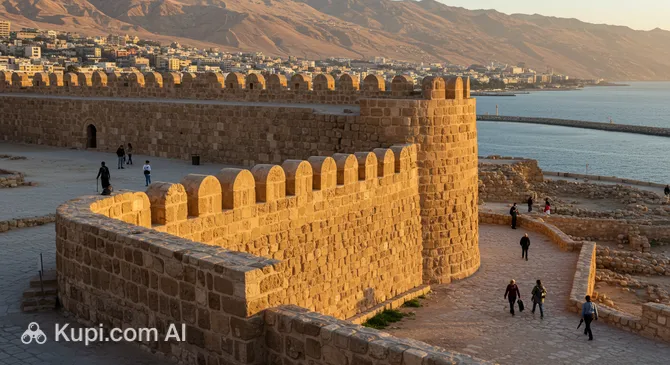
On the Red Sea coast, in the immediate vicinity of the city of Eilat, lies the majestic Aqaba Fortress. This powerful fortification, also known as the Mamluk Fort, is one of the region's main historical gems. Built in the early 16th century, the fortress is a rectangular stone complex reinforced by stern semicircular towers that have guarded local residents and trade routes for centuries.
\n\n
Aqaba Fortress
Aqaba Fortress. Иллюстрация. Источник: Kupi.com AI
\n\n

The internal layout of the fort is striking in its functionality: behind the massive walls lies a two-story complex of rooms that once served as housing for soldiers and pilgrims. Of particular interest is the restored mosque at the south wall, with its preserved mihrab niche indicating the direction of Mecca. This place is literally steeped in the spirit of antiquity, which is felt in every detail — from the Arabic inscriptions from the time of Sultan Qansuh al-Ghawri to the heavy wooden gates.

\n\n

Visiting this site in the country of Israel allows tourists to touch the rich heritage of Islamic architecture. Next to the fort stands the famous giant mast with the flag of the Great Arab Revolt, which has become a recognizable symbol of the city and a beautiful backdrop for memorable photos against the azure sea.

Contacts

For the latest information before your visit or to plan group tours, you can use the official resources. Below are the main contact details for the site:

How to contactContact
AddressG2C2+MRM, Aqaba, Jordan
Websiteaqaba.jo

What to Do

A fascinating journey into the past awaits guests within the walls of Aqaba Fortress. The main highlight is a detailed inspection of the Mamluk architecture. You can explore the powerful towers, walk through the inner passages, and peer into the rooms where caravans stayed hundreds of years ago. Be sure to notice the calligraphic inscriptions above the main entrance — they preserve the memory of the fort's builders.

\n\n

One of the most pleasant parts of the visit is climbing the fortress walls. From here, panoramic views of the endless Red Sea, the busy port, and the city blocks open up. It is an ideal spot for photographers: the contrast of the ancient sandy walls and the bright blue water creates stunning shots, especially in the rays of the setting sun.

\n\n

Complement your walk around the fort with a visit to the square where the enormous mast with the flag of the Great Arab Revolt stands. After touring the historical rooms and the mosque, it's lovely to stroll along the adjacent promenade, enjoying the sea breeze and watching the ships dock, just as people have done in these parts for centuries.

Getting There

Aqaba Fortress occupies a central spot on the coast, and it is easy to find — the main landmark is the giant mast with the flag of the Great Arab Revolt, which can be seen from almost anywhere in the city. If you are in central Aqaba, the walk to the fort along the picturesque promenade will take no more than 5–10 minutes.

For those coming from the city of Eilat, the route usually goes through the Arava border crossing. After crossing the border, it is most convenient to take a taxi or book a transfer, which will take you to the fortress in about 15–20 minutes. Taxis and buses also run regularly from Aqaba Airport (AQJ), taking about 20 minutes.

Public transport in the region is quite well-developed: regular buses arrive in Aqaba from Amman, Petra, and Wadi Rum. Parking is available near the fortress itself, making it convenient to visit this historical site in a rental car.

Ближайший город: Eilat

History & Facts

The history of this place dates back to antiquity. The first fortifications on the Red Sea coast appeared in the Roman era to protect an important trading port. Later, during the Crusades, the fort was restored by knights; however, it acquired its current majestic appearance in the early 16th century. Between 1510 and 1517, by decree of the last great Mamluk sultan, Qansuh al-Ghawri, the fortress was almost entirely rebuilt.

For centuries, Aqaba Fortress played a strategic role, serving as a safe haven and an important stop on the Northern Hajj Route. The fort's walls provided shelter for pilgrims heading to Mecca, protecting them from nomadic raids and the harsh desert environment. Calligraphic Arabic inscriptions, skillfully carved above the entrance and on the inner vaults, serve as reminders of those times.

A new chapter in the fortress's history opened in the early 20th century. In 1917, the fort became the epicenter of the Great Arab Revolt. After the city was captured by Arab forces, the fortress was used as a headquarters and barracks. Today, it is not just an architectural monument but a symbol of national pride, recalling the region's ancient roots, known since antiquity as Elat and Aila.

Time Needed

To explore Aqaba Fortress at a leisurely pace, most tourists need 1 to 2 hours. This is plenty of time to look into every room, study the ancient calligraphy on the walls, and climb the towers to view the surroundings.

About 45 minutes is usually spent on a detailed study of the internal architecture, the mosque, and the exhibits. The remaining time should be dedicated to walking along the massive walls and taking photos against the backdrop of the bay and the giant flagpole. If you plan to combine your visit with a break on the promenade, budget an extra half hour.

Working Hours

Aqaba Fortress welcomes visitors daily, although the schedule varies depending on the day of the week. From Sunday to Thursday, the fort's doors are open from 8:00 AM to 5:00 PM.

\n\n

On weekends — Friday and Saturday — the complex opens slightly later, from 10:00 AM to 5:00 PM. It is recommended to come in the first half of the day to see all the exhibits in natural light.

DayWorking hours
Понедельник8:00 – 17:00
Вторник8:00 – 17:00
Среда8:00 – 17:00
Четверг8:00 – 17:00
Пятница10:00 – 17:00
Суббота10:00 – 17:00
Воскресенье8:00 – 17:00

Nearby

After immersing yourself in the medieval atmosphere of the fort, it is worth paying attention to the modern entertainment and cultural sites located nearby. The fortress's surroundings offer a rich choice of activities: from extreme water parks to cozy city museums, allowing you to create a full itinerary for the whole day.

Exploring nearby locations will help you better feel the contrast between the region's ancient history and its modern resort appearance. Most sites are within a short taxi ride.

NameDistance
Arab Revolt Plaza0.2 km
Sharif Hussein bin Ali Mosque0.6 km
Khubza & Seneya1.1 km
Al-Khamisa Butcher’s & Grill2 km
Saraya Aqaba Waterpark2.3 km
Ayla Oasis2.7 km
Rise Adventure Park2.8 km

Reached the end of the page?

That means the route is fully explored