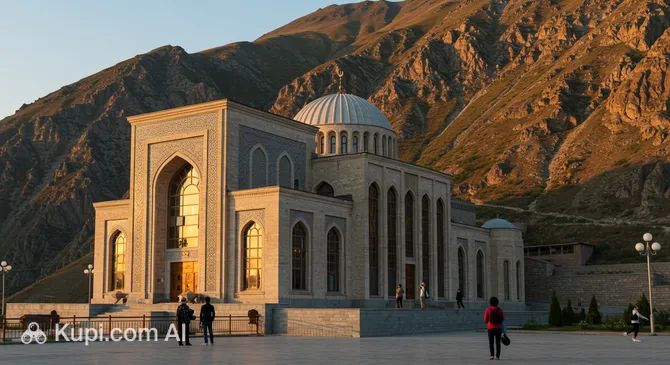
Imagine a museum located right inside a sacred rock—that's exactly what the Sulayman-Too National Historical and Archaeological Museum Complex looks like. It is one of the most unusual structures in Kyrgyzstan, where a modern glass arch contrasts strikingly with the rugged ancient stones of Sulayman-Too Mountain in the city of Osh.
Sulaiman-Too Museum. Illustration.
Source: Kupi.com AI
Traveler photos:
Inside the cave complex, 13 exhibition halls are hidden across two levels. Over 30,000 exhibits are collected here, telling the rich story of the Fergana Valley: from Bronze Age ceramics to traditional Kyrgyz jewelry and musical instruments. Thanks to its unique location within the rock, the museum remains pleasantly cool, while soft lighting creates a mysterious atmosphere of immersion in history.
The status of a UNESCO World Heritage Site adds special significance to this place. The museum is not just a repository of antiquities but part of a vast cultural and spiritual landscape that has been revered by locals as a holy site for centuries.
Contacts
For more information about visiting the museum or organizing tours, you can use the following contact details:
Start your journey through the museum by exploring its archaeological treasures. In the cave halls, you will see ancient manuscripts, coins, and nomadic household items. Be sure to notice the collection of felt products and traditional clothing—these exhibits allow you to feel the spirit of Central Asia's true nomadic culture.
Don't miss the opportunity to visit the Rushan caves on the southern slope, home to the Museum of Spiritual Culture. Here you can see authentic petroglyphs—rock carvings left by people thousands of years ago—and look into the sacred caves that served as retreats for hermits and places of prayer for pilgrims for centuries.
Photography enthusiasts should stop by the famous glass arch. It’s an ideal spot for spectacular shots, especially against the backdrop of the city panorama opening from the height. The visit is also great for families: halls dedicated to the region's nature, featuring taxidermy and minerals, usually spark great interest in young travelers. There is an entrance fee, but it is quite nominal, around 30 som.
Getting There
The museum complex is located right at the foot of the sacred mountain in the very center of the city, so it is easy to find—the majestic silhouette of the rock serves as an excellent landmark. If you are in the central part of Osh, the walk to the museum entrance from the main bazaar will take only 10–15 minutes.
For those who prefer comfort, taxi services are available, including Yandex Go. A trip across the city will cost an average of 20–50 som. You can also reach the mountain via numerous city buses and minibuses (marshrutkas). If you are arriving from the airport, located 10 kilometers from the city, a taxi will take you to the museum in 20–30 minutes, with the fare being approximately 200–300 som.
For drivers, there is a parking lot at the foot of the mountain. From there, well-maintained steps and pedestrian paths lead up to the famous glass arch embedded in the rock, offering scenic city panoramas along the way.
Nearest city: Osh
History & Facts
The history of this unusual place began in 1949, when the city's first local history museum was founded. It took its current unique form in 1978—to celebrate the city's 3,000th anniversary, architects realized an ambitious project, literally "fitting" the museum halls into the natural limestone caves of the rock.
In 1982, all historical and cultural sites on the mountain were combined into a single reserve, and in 2004, the complex received the status of a National Historical and Archaeological Museum. The modern facade in the form of a giant glass arch has become a landmark of the region, symbolizing the harmony between ancient nature and modern technology.
A significant milestone in the history of the complex was 2009, when Sulayman-Too Mountain was officially inscribed on the UNESCO World Heritage List. This highlighted the exceptional value of the site as a spiritual center where various Central Asian cultures and religions have intersected for millennia.
Time Needed
To explore all 13 halls of the main museum without rushing, see the ethnographic collection, and examine the archaeological finds, you will need about 1–1.5 hours. The cave space is organized on two levels, and each hall requires attention to detail.
However, we recommend setting aside 2–3 hours for your visit. This time will allow you not only to visit the main exhibition but also to reach the Museum of Spiritual Culture in the Rushan caves, see the ancient petroglyphs, and climb to the observation decks for panoramic photos of the city. If your time is very limited, a brief look at the main exhibits will take about 45–60 minutes.
Working Hours
The museum is open to visitors six days a week. The main day off is Monday, when the complex is closed for maintenance.
From Tuesday to Sunday, the museum halls operate on a consistent schedule: from 9:00 AM to 6:00 PM. Given that today is Friday, the museum is open and waiting for guests during its regular business hours.
Day
Opening hours
Monday
Closed
Tuesday
9:00 – 18:00
Wednesday
9:00 – 18:00
Thursday
9:00 – 18:00
Friday
9:00 – 18:00
Saturday
9:00 – 18:00
Sunday
9:00 – 18:00
Nearby
The museum's location in the heart of historic Osh allows travelers to easily combine their visit with other iconic sites. A walk around the Sulayman-Too Mountain area will reveal even more facets of Kyrgyz culture and history.