Support

Sughd Region Museum

About

In the heart of the ancient city of Khujand lies one of the region's most significant cultural treasures—the Historical Museum of Sughd Region. This unique site brings history to life within the walls of a reconstructed fortress that recreates the appearance of a medieval mud-brick fortification. The museum is a hallmark of Tajikistan, demonstrating the continuity of generations and the grandeur of ancient civilizations.
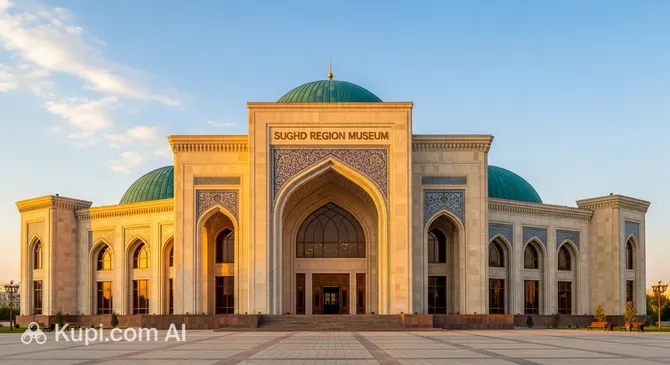
Sughd Region Museum
Sughd Region Museum. Иллюстрация. Источник: Kupi.com AI

The architecture of the building is impressive in its scale: the complex includes two above-ground and three spacious underground halls, where the stages of the region's development are presented in chronological order. The museum's collection boasts over 28,000 exhibits, including rare archaeological finds, ceramics, and unique pieces of applied art.

Of particular value are the hand-woven Tajik carpets, vintage embroidery, and national costumes, which allow visitors to experience the authenticity of the local culture. The museum is surrounded by a well-kept park area, making a visit not only educational but also a pleasant addition to a stroll through the historical city center.

Contacts

To inquire about special exhibitions or arrange group tours, you can use the following contact details:

How to contactContact
Addressкӯчаи Академикҳо Раҷабовҳо 53, Хуҷанд, Таджикистан
Phone+992 92 767 8393
Websitewww.qalai-khujand.tj

What to Do

The journey into the past begins in the underground halls, where each level is dedicated to a specific era. Be sure to visit the "Metal Age" exhibition and the "Aryan Culture" hall, adorned with symbolic panels. One of the main visual highlights is the magnificent mosaic depicting Alexander the Great and the impressive statue of the legendary warrior Temurmalik, who became a symbol of courage in the 13th century.

Ethnography lovers will find it interesting to study the model of a traditional Tajik dwelling and peek into the Khujand "national room" as it would have looked in the 19th–20th centuries. Here, you can examine in detail the intricate wood carvings and patterns that decorated local homes for centuries. Don't forget to also check out the collection of rare minerals and the Saka helmet found during archaeological research.

For those who appreciate detail, the museum offers rare examples of glassware from the ancient period and medieval ceramics. After exploring the indoor halls, it is pleasant to walk around the fortress grounds, take commemorative photos against the backdrop of the massive walls, and relax on park benches while discussing the artifacts seen.

Getting There

Finding the city's main historical gem is easy, as it is located in the very center, within the famous Khujand Fortress. If you are near the renowned Panjshanbe market, the walk to the museum takes only 10–15 minutes. For those who prefer comfort, taxi services are always available, including the popular Yandex Go app, or traditional marshrutkas (minibuses) that run through the main streets.

For travelers arriving from other regions, the journey may start at Khujand Airport, located about 20 kilometers away. A taxi ride from there takes about 20–30 minutes. If you are traveling from Dushanbe, prepare for a long but scenic trip by bus or train, ending at the bus station, from where the fortress can be reached in minutes.

The entrance to the museum is on the southeastern side of the fortress walls. It is worth noting that there are no parking spaces directly inside the fortress, so if you are traveling by private car, it is best to leave it at one of the adjacent parking lots within walking distance.

Ближайший город: Khujand

History & Facts

The history of this collection of antiquities began over a century ago, in 1909, through the initiative of local resident Mirzokhodzha Sobirov, known as Khoja Antika. He spent years collecting rare artifacts and bequeathed his collection to the state to preserve his ancestors' heritage for future generations. Officially, the local history museum in Khujand opened on July 1, 1931, making it the oldest museum institution in Tajikistan—it was established three years before the national museum in the capital.

Over the decades, the exhibition moved several times, from one historical building to another. Between 2003 and 2006, a modern building styled after a medieval fortification was constructed for the museum. It seamlessly integrated into the southeastern part of the Khujand Fortress, whose foundations date back to the 6th–5th centuries BCE. Significant state funds were allocated for the construction, creating a modern space for these priceless collections.

The museum's rich collection is largely thanks to the large-scale archaeological excavations of the North Tajikistan Expedition, conducted in the second half of the 20th century. Thanks to the work of outstanding scientists like M.E. Masson and V.V. Barthold, visitors today can see objects that for centuries lay hidden within the cultural layers of ancient Khujand—a vital hub on the Great Silk Road.

Time Needed

To leisurely explore all levels of the museum and see the main collections, most visitors need 1.5 to 2 hours. This is enough time to walk through the three underground halls, examine the archaeological finds, and look at the details of traditional costumes.

If you plan to also walk through the adjacent park, take photos by the fortress walls, and enjoy the atmosphere of the historic center, it’s worth setting aside about half a day. The museum is well-organized, and info panels help visitors navigate the different historical eras.

Working Hours

The museum welcomes visitors on a standard schedule: the doors are open from Tuesday to Sunday. The working day begins at 08:00 and ends at 16:00.

Please note that Monday is a day off. Before planning a visit on public holidays, it is recommended to check the official website or call, as opening hours may vary slightly.

DayWorking hours
понедельникЗакрыто
вторник08:00–16:00
среда08:00–16:00
четверг08:00–16:00
пятница08:00–16:00
суббота08:00–16:00
воскресенье08:00–16:00

Nearby

Its location in the historical heart of the city allows tourists to enjoy more than just the museum. A walk along the ancient walls of the fortress and the adjacent park areas will reveal many monuments reflecting different eras of the region's life—from antiquity to the Soviet period.

The surroundings are rich in monumental sculptures and sites associated with the names of great enlighteners and warriors. Here is a list of attractions in the immediate vicinity:

NameDistance
Somoni Park1.1 km
Panjshanbe Bazaar1.4 km
Saray Turkish Cafe1.5 km
Zaytun Tajik Cuisine Restaurant2.3 km

Reached the end of the page?

That means the route is fully explored