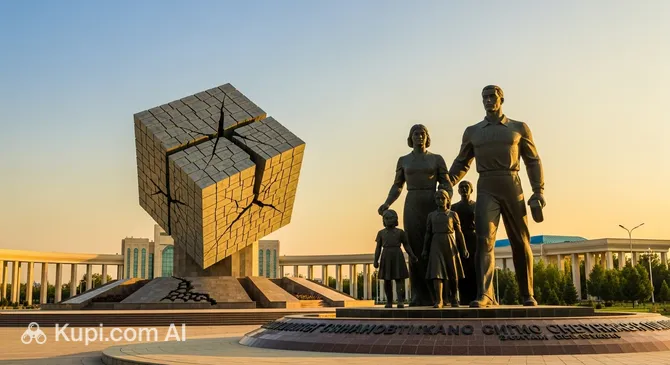
The Monument of Courage is a majestic memorial complex that has become one of the main symbols of the people's resilience and unity. Located in the heart of Tashkent, this historical monument was erected in memory of the events of 1966, when a devastating earthquake changed the face of the capital but did not break the spirit of its residents.
Monument of Courage. Illustration.
Source: Kupi.com AI
Traveler photos:
The central piece of the composition is a black granite cube, split by a crack symbolizing the earth's rupture. The date and exact time the tremors began are carved into it. Nearby stands a bronze sculpture group: a man shielding a woman and child—an image embodying the protection of family and hope for the future. Uzbekistan carefully preserves the memory of that era when people from all corners of the world came to help rebuild the city.
Behind the figures, 14 steles with bas-reliefs fan out in an arc, capturing scenes of creative labor and the assistance provided by brotherly republics. This site is considered a must-visit for those who want to understand the soul of modern Tashkent, which rose from the ruins even more beautiful and grand.
Contacts
To clarify information about public events or professional tours, it is recommended to contact the city's tourist information centers.
Once at the monument, be sure to notice the granite fracture stretching from the black cube toward the sculpture group. It is a visual representation of the natural disaster that creates a dramatic and profound effect. Walk along the 14 bronze steles: each is a separate work of art telling the story of the city's restoration through symbols and ornaments from different regions.
This is an ideal spot for a memorable photo session. The powerful figures of the city's defenders against the backdrop of modern Tashkent look very striking at any time of day. Thanks to recent reconstruction, the area surrounding the complex has been transformed into a landscaped park with convenient paths and benches where you can rest in the shade of the trees.
Visitors often come here just to walk and feel the special energy of this place. In the evening, when the soft lighting is turned on, the atmosphere becomes even more solemn. You can combine a visit to the memorial with a walk along the Anhor Canal or a visit to the neighboring Museum of Olympic Glory.
Getting There
The monument is located in the very heart of the city at the intersection of Sharaf Rashidov Avenue and Abdulla Kadiri Street. If you prefer public transport, the most convenient way to get there is by metro. The nearest stations are “Alisher Navoi” (Uzbekistan Line) or “Pakhtakor” (Chilanzar Line), from which the monument is a 15–20 minute walk at a relaxed pace.
For those who value comfort, ride-sharing apps such as Yandex Go or inDrive are ideal. A trip from the central districts will take about 10–15 minutes, and from the international airport, about half an hour depending on traffic. There is also a "Sharaf Rashidov" public transport stop nearby, served by buses and minibuses No. 3, 10, and 92.
Due to its central location, the monument is easily accessible on foot from popular tourist spots such as Amir Temur Square or Chorsu Bazaar. The walk will allow you to better feel the architectural rhythm of the modern metropolis.
Nearest city: Tashkent
History & Facts
The history of this place is inextricably linked to the tragic morning of April 26, 1966. At 5:24 AM local time, Tashkent was shaken by a devastating earthquake with a magnitude of over 8. The epicenter of the catastrophe was at a depth of ten kilometers directly beneath the city's central districts. The disaster practically wiped old adobe buildings off the face of the earth, leaving thousands homeless.
The city's restoration became an unprecedented example of unity: builders and volunteers from all republics came to help. It was during this period that the unique style of "seismic modernism" emerged, transforming the ruined city into a modern metropolis with wide avenues and monumental architecture. Ten years after the tragedy, on May 20, 1976, the memorial complex was ceremoniously opened at the site of the epicenter.
The project was created by the renowned sculptor Dmitry Ryabichev and architects S. Adylov and V. Ganiev. Interestingly, the bronze figures for the main composition were cast in the workshops of Moscow and Leningrad (St. Petersburg). The monument symbolizes not so much grief for what was lost, but the triumph of the human spirit and the solidarity of people during difficult times.
Time Needed
A thoughtful inspection of the monument itself and an examination of the reliefs on the steles usually takes about 30 to 45 minutes. This is quite enough time to take high-quality photos and read the inscriptions on the commemorative signs.
If you plan to combine your visit to the memorial with a walk along the embankment of the Anhor Canal or a visit to the Museum of Olympic Glory located nearby, you should set aside 1.5–2 hours in your schedule. The location invites leisurely relaxation, so many tourists linger here longer to enjoy the atmosphere of tranquility.
Working Hours
The Monument of Courage is a public space and is open to visitors 24 hours a day. There are no entrance gates or tickets, so you can come here early in the morning or late at night.
24-hour access allows tourists to see the monument in different lighting; however, there are no official websites with event schedules for the site itself. It is recommended to visit the complex during daylight hours for a detailed look at the bas-reliefs or after sunset when the city illumination is turned on.
Open 24 hours
Nearby
Its location in the city center makes the memorial an excellent starting point for further exploration of the Uzbek capital. A walk through the surrounding parks and recreation areas will allow you to see how harmoniously history and the modern entertainment industry blend together.