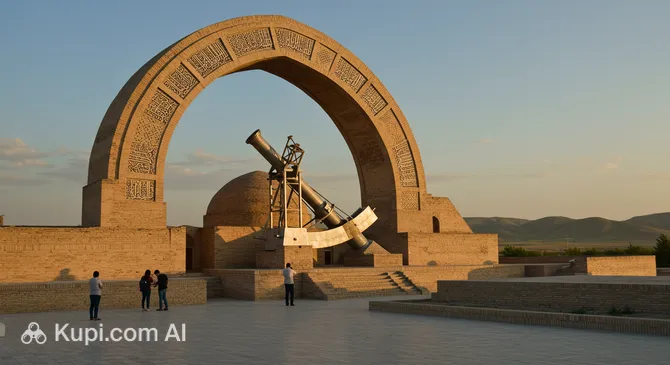
On the northeastern outskirts of the city of Samarkand, on the Kuhak Hill, stands a unique monument of science — the Ulugh Beg Observatory. This site is considered one of the most important astronomical centers of the Middle Ages, making Uzbekistan famous throughout the scientific world. Built in the 15th century by the great ruler and scientist Mirzo Ulugh Beg, it became a symbol of the Golden Age of Islamic science and enlightenment.
Traveler photos:
The observatory's main architectural feature was a grand cylindrical building housing a giant marble sextant. Only the underground parts of this colossal instrument have survived to this day, but even they are impressive in their scale and precision. Today, the site functions as a museum complex where visitors can connect with the history of great discoveries.
The museum's exhibition includes rare models of ancient instruments, vintage photographs of archaeological excavations, and fragments of magnificent glazed tilework. A special place is held by a copy of the famous "Zij-i Sultani" — a star catalog containing the coordinates of 1,018 celestial bodies, which served as a standard for astronomers in Asia and Europe for centuries.