Support

Kalon Tower

About

Imagine a majestic tower rising above ancient terracotta roofs — this is the Kalyan Minaret, a true symbol of the sacred city of Bukhara. Located in the heart of Uzbekistan, this architectural marvel has served for centuries not only as a call to prayer but also as a beacon for caravans traveling along the Great Silk Road.
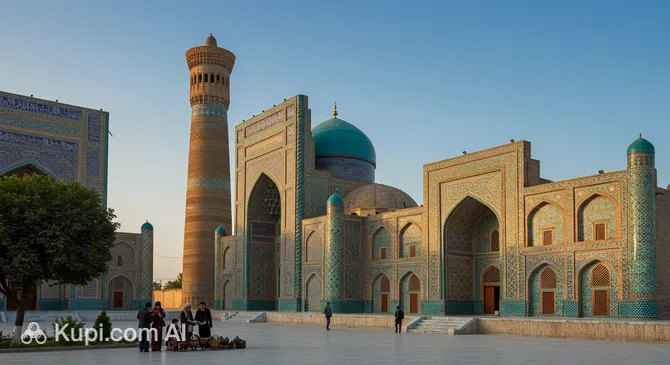
Kalon Minaret
Kalon Minaret. Иллюстрация. Источник: Kupi.com AI

Its name translates from Persian as "great," which is entirely fitting: the tower stands 46.5 meters tall. Built entirely of burnt brick, the minaret is a massive vertical pillar with a foundation reaching 10 meters deep into the earth, ensuring the structure's incredible longevity.

Of particular artistic value are the 12 ornamental bands encircling the minaret's shaft. Each is decorated with a unique pattern created through masterful brickwork. The grand structure is crowned by a rotunda with 16 arched openings and magnificent stalactites, highlighting the greatness of medieval engineering.

Contacts

To plan your visit to this iconic landmark, you can use the address provided in the city's historical quarter. The site is highly rated by travelers, confirming its exceptional significance and popularity.

How to contactContact
AddressKhakikat Str. 9, Buxoro, Buxoro Viloyati, Uzbekistan

What to Do

Visiting the Po-i-Kalyan complex is, first and foremost, an opportunity to touch living history. You can study the minaret's decorative elements in detail, trying to decipher the geometry of each of the 12 unique patterned bands. Look for the surviving ancient inscriptions: three bands record the date of construction (1127), the name of the ruler Arslan Khan, and the name of the master builder, Bako.

The square offers a stunning panorama where the minaret serves as the central vertical axis, uniting the silhouettes of portals and domes. It is an ideal spot for photography, especially at sunset when the burnt brick takes on warm golden hues. A walk through the complex will allow you to see the minaret surrounded by the Kalyan Mosque and the Mir-i-Arab Madrasah, providing a complete impression of the scale of Central Asian Islamic architecture.

Getting There

Finding the minaret is easy — its 46-meter silhouette is visible from almost anywhere in the old city and even from the distant approaches to Bukhara. The landmark is located at Khakikat Str. 9, in the heart of the historical district.

The most convenient way to get there is by taxi or on foot if you are staying in one of the guesthouses in the center. You can also use public transport to reach stops near the Ark Fortress or the central bazaars, followed by a pleasant walk through the colorful streets leading to Po-i-Kalyan Square.

Ближайший город: Bukhara

History & Facts

The history of the minaret began in 1127 by the will of the Karakhanid ruler Arslan Khan. Legend has it that the architect named Bako, after laying the foundation, disappeared for several years to allow the mortar to fully harden and gain strength. He returned only when he was certain the tower would not collapse under its own weight, as had happened with the previous structure on the site.

Remarkably, over nine centuries, the minaret has remained almost unchanged, successfully withstanding numerous earthquakes for which this region is known. Even during Genghis Khan's siege of the city, when much of Bukhara was destroyed, the conqueror was so struck by the tower's grandeur that he ordered it to be left untouched. Thus, the minaret became a silent witness to the changing of dynasties and entire eras.

However, in the 20th century, the monument faced serious challenges. In 1920, during the storming of the city, the upper part of the minaret was damaged by artillery fire. It was later carefully restored by specialists, and today we see the Kalyan Minaret in its original splendor, dominating the cityscape and proclaiming the greatness of Islamic architecture.

Time Needed

To leisurely view the minaret itself and examine the craftsmanship of the ancient masons in detail, you will need very little time. However, since the tower is part of a grand ensemble, it is worth planning a more comprehensive visit.

Travelers typically spend about 1–2 hours walking across the square, visiting the adjacent Kalyan Mosque, and viewing the facades of the Mir-i-Arab Madrasah. This time is sufficient for a thoughtful exploration of the architectural details and for capturing striking photos in different lighting conditions.

Working Hours

One of the pleasant features of this landmark is its accessibility to tourists at any time. External viewing of the Kalyan Minaret is possible around the clock, as it is located on an open square in the city's historical center.

The site is open 24 hours a day daily, from Monday to Sunday. We recommend visiting the square not only during the day but also in the evening: modern lighting gives the ancient tower a special monumentality and a mystical charm.

Круглосуточно

Nearby

Bukhara is a museum-city where every step reveals new facets of an Eastern fairy tale. Exploring the area around the minaret will allow you to dive deeper into the atmosphere of ancient Mawarannahr and see how trade routes, spiritual centers, and residential quarters are harmoniously intertwined.

The most important monuments of medieval architecture and famous trading domes, which still live their busy lives, are concentrated around the minaret. Below is a list of nearby sites worth including in your itinerary.

NameDistance
Mir-i-Arab Madrasa0 km
Kalyan Mosque0.1 km
Ulugh Beg Madrasa0.2 km
Ayvan0.6 km
Chor Minor1.1 km
Plov1.3 km

Reached the end of the page?

That means the route is fully explored