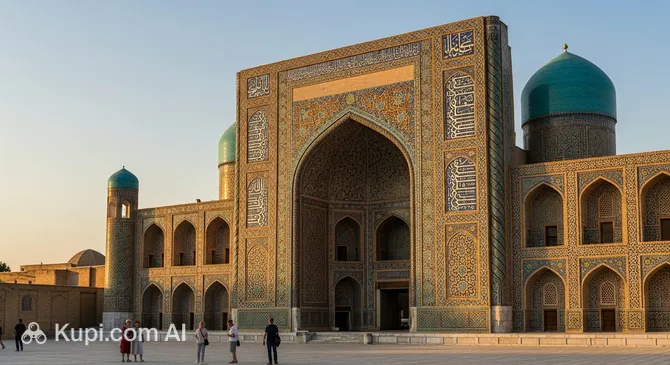
Among the many monuments that ancient Bukhara is famous for, the Ulugbek Madrasah holds a special place. This outstanding monument of Islamic architecture is the oldest surviving higher spiritual educational institution in Central Asia. Built in 1417, it is a living embodiment of the Timurid Renaissance, an era when science and education flourished under the patronage of great rulers.
Ulugh Beg Madrasa. Illustration.
Source: Kupi.com AI
Traveler photos:
The building was erected on the initiative of Mirzo Ulugbek—the grandson of Tamerlane and a prominent astronomer. Compared to later and more opulent buildings, this madrasah is distinguished by its noble simplicity and strict lines. It became the first of three such institutions built by Ulugbek in the region and served as an architectural model for many subsequent structures in Uzbekistan.
The main architectural feature of the monument is its resilience to the tests of time. Thanks to the skill of the architect Ismail ibn Tahir Isfagani, the building has withstood numerous earthquakes over six centuries. Today, guests can admire its pointed arches, 12-sided domes, and exquisite mosaic in shades of blue that decorates the facade, creating the unique look of the ancient school.
Contacts
To clarify the current opening hours or the possibility of organizing an individual guided tour, we recommend contacting tourist information centers or local licensed operators. Finding this historic building in the labyrinths of the old city will not be difficult on your own, guided by its monumental facade.
When traveling through a country as colorful as Uzbekistan, be sure to take the time to study the exterior decoration and internal layout of the Ulugbek Madrasah. Start by examining the main portal—it impresses with its monumentality and geometric precision. Pay attention to the ceramic mosaic and delicate ganch carving, which have retained their vibrant colors after centuries.
Stepping inside, you will find yourself in a cozy rectangular courtyard surrounded by two tiers of cell-hujras. In these small rooms, students once lived, dedicating their lives to the study of philosophy, astronomy, and theology. Walking through the courtyard allows you to literally touch history and imagine the everyday lives of medieval scholars.
This place is a real paradise for photography enthusiasts. The architectural ensemble, of which the building is a part, creates an interesting play of light and shadow, especially at sunset. Professional travelers suggest comparing the restrained style of this madrasah with the rich and complex decoration of the Abdulaziz-khan Madrasah standing directly opposite—this comparison provides a clear idea of the evolution of Bukhara's architecture.
Getting There
The madrasah is located in the heart of the historical center of Bukhara, so the easiest way to get here is on foot while walking through the old city. The site is in close proximity to the Po-i-Kalyan ensemble and the famous trading domes. From the popular Lyabi-Hauz Square, it can be reached in just 5–10 minutes at a leisurely pace.
If you are in a more remote area of the city or have arrived from the airport, which is about 6 kilometers away, it is most convenient to use a taxi. Yandex Go and Uber services operate reliably in the city, and the cost of a trip from the center or the station will be only about 1–2 USD. The trip from the airport will take about 15–20 minutes.
For those traveling by their own or a rented car, parking spaces are provided near the entrance to the historical zone. However, we recommend leaving your vehicle outside the narrow streets and enjoying the atmosphere of the ancient city, following the route from the main Ark gate towards the Ulugbek Madrasah.
Nearest city: Bukhara
History & Facts
The history of this educational institution began more than six centuries ago, when Bukhara was to solidify its status as the largest scientific center of the Muslim East. The madrasah was erected in 1417 by order of the grandson of Tamerlane, the ruler and prominent astronomer Mirzo Ulugbek. It is noteworthy that the founder himself, busy with state affairs and personal mourning, was only able to visit his creation two years later—in November 1419—generously rewarding local students and learned men with gifts.
The architectural appearance of the building has remained virtually unchanged over the centuries, which testifies to the phenomenal precision of the calculations of medieval architects led by master Ismail ibn Tahir. The only large-scale reconstruction was carried out in 1585–1586. During that period, the modest brick facade was decorated with magnificent glazed majolica in characteristic blue-and-azure tones, giving the structure a solemn and elegant appearance.
The inscription on the entrance door of the madrasah is of particular significance, stating: “The pursuit of knowledge is the duty of every Muslim man and woman.” This saying emphasized the secular orientation of Ulugbek's policy and his desire to make education accessible. For centuries, the madrasah remained a cradle of science, survived many earthquakes, and is still considered the oldest surviving building of its type in all of Central Asia.
Time Needed
Usually 30 to 45 minutes is enough to get acquainted with the Ulugbek Madrasah. This time is quite sufficient to see the majolica on the main portal in detail, enter the inner courtyard, and feel the atmosphere of the educational institution that once hosted the most inquisitive students of its time.
If you decide to visit the site accompanied by a professional guide or plan to combine the tour with the Abdulaziz-khan Madrasah located opposite, it is worth setting aside about 1–1.5 hours for the walk. This will allow you not only to take beautiful photos but also to learn about the peculiarities of the Bukhara architectural school and the history of the Timurids.
Working Hours
Ulugbek Madrasah is usually open for visitors daily from 09:00 to 18:00, including weekends. Since the site is part of a historical heritage and a popular tourist spot, its doors are open to tourists throughout the daylight hours. Nevertheless, before your visit, we recommend checking the information on the city's official tourist portal, as the schedule may change slightly during holidays.
09:00–18:00
Nearby
Exploring the surroundings of the madrasah will allow you to fully experience the grandeur of the ancient capital and see how architectural fashions changed over the centuries. Most of the key monuments are located within walking distance of each other.