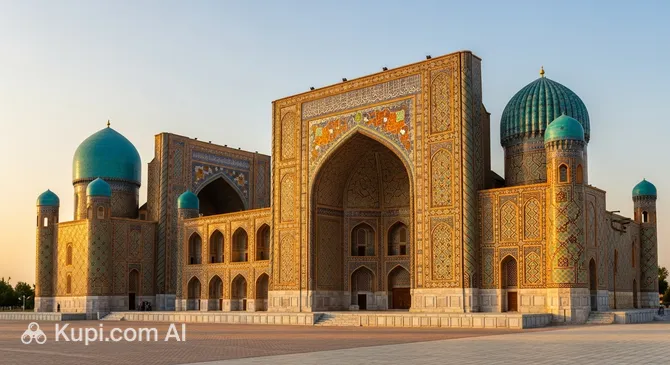
On the eastern side of the legendary Registan Square in the city of Samarkand stands one of the most recognizable buildings that Uzbekistan has given to the world — Sher-Dor Madrasah. This is an outstanding monument of 17th-century Islamic architecture, whose name translates as "Abode of Lions." The site is an integral part of an ensemble recognized by UNESCO as a World Heritage site.
Sherdor Madrasah. Illustration.
Source: Kupi.com AI
Traveler photos:
The main feature of the structure is the unique mosaic on the entrance portal: it depicts fantastic tiger-lions chasing does against the backdrop of a rising sun with a human face. This motif breaks traditional Islamic prohibitions on depicting living beings, making Sher-Dor an exceptional example of Oriental architecture. The building is decorated with ribbed domes and rich ornamentation made of glazed brick.
In its structure, it is a classic educational institution (madrasah) with a square inner courtyard surrounded by hujras — cells where students once lived. Today, Sher-Dor is not just an open-air museum, but a true symbol of Samarkand, embodying the aesthetic ideals of the Great Silk Road era.
Contacts
To clarify current information about visiting the site, you can use the following contact details:
A visit to this architectural monument offers a wealth of visual impressions. First and foremost, it is worth studying the main portal in detail, where the famous mosaic with tigers and the sun is displayed — this image has become a national symbol and is often found on banknotes and souvenirs. Photography enthusiasts will find endless angles here: from wide-angle panoramas to macro shots of delicate floral patterns and Arabic calligraphy.
Inside the madrasah, you can stroll through the quiet inner courtyard. Peek into the former hujras (study cells), many of which have been converted into small craft workshops and souvenir shops today. Here you can purchase unique handmade items: from silk scarves to ceramics with traditional Samarkand patterns.
If you are lucky enough to be at Registan Square in the evening, don't miss the light show. In the rays of the artistic illumination, the turquoise domes and walls of the Sher-Dor Madrasah look particularly magical. Also, museum exhibitions are periodically organized inside the building, telling the story of the lives of medieval scholars and the history of the restoration of this grand complex.
Getting There
The site is located in the heart of the historical center, on Registan Square. If you arrive in the city by train, the journey from Samarkand railway station will take about 10–15 minutes by taxi or about 40 minutes during a leisurely walk through the city streets.
For travelers arriving by plane, the trip from Samarkand International Airport (SKD) to the center will take 20 to 30 minutes. You can use official taxi services or popular mobile apps like Yandex Go and inDrive, which ensure transparent pricing.
Public transport is also well-developed: numerous buses and fixed-route taxis run to the "Registan" stop. After getting off, you only need to walk for about 5 minutes through a well-maintained pedestrian area.
Nearest city: Samarkand
History & Facts
The construction of this grand structure took place between 1619 and 1636. The project was initiated by the influential hakim (governor) of Samarkand, Yalangtush-Bahadur. The construction was entrusted to an architect named Abdul Jabbar, while the master Muhammad Abbas worked on its magnificent decoration.
Interestingly, the building was constructed according to the "kosh" principle — it is a mirror image of the Ulugh Beg Madrasah standing opposite it. To make room for the new site, the dilapidated 15th-century Ulugh Beg khanaka was dismantled, and its materials were used for the foundation and walls of Sher-Dor. Because the ground level of the square had risen over two centuries, the proportions of the new building turned out to be more massive and squat compared to its "mirror" predecessor.
For nearly three centuries, the madrasah functioned as one of the most prestigious higher education institutions in the Islamic world. Up to 40 students lived and studied here simultaneously. Among its prominent graduates is the famous theologian and philosopher Shigabutdin Marjani. In 2001, the monument was included in the UNESCO World Heritage List.
Time Needed
To fully appreciate the majesty of this place and examine the smallest details of the mosaic, a typical visitor needs 1 to 1.5 hours. This time is sufficient to inspect the facade, look into the courtyard, and visit the small shops located in the former cells.
If you plan to explore the entire architectural ensemble of Registan Square, which includes three madrasahs, it is worth setting aside at least 2–3 hours for the walk. It is especially beautiful here during the pre-sunset hours when the light highlights the texture of the azure domes.
Working Hours
Sher-Dor Madrasah is open to tourists daily. You can visit it any day of the week, including weekends and holidays, according to the following schedule:
Monday – Sunday: from 09:00 to 20:00 without breaks.
Please note: opening hours may vary slightly depending on the season or official events held on Registan Square. It is recommended to check for up-to-date information on the city's official tourism portals before your visit.
09:00–20:00
Nearby
Its location in the historical core of the city allows tourists to see many iconic sites without spending much time traveling. Exploring the surroundings of Registan Square will help you dive deeper into the atmosphere of the ancient East and appreciate the scale of the region's imperial past.