Support

Kalan Mosque

About

Imagine a monumental structure where every brick breathes centuries of history: the Kalyan Mosque is the heart of the ancient city of Bukhara and one of the most majestic monuments of Islamic architecture gracing Uzbekistan. As part of the famous Po-i-Kalyan ensemble, its scale and harmony are breathtaking, welcoming thousands of pilgrims and tourists beneath its vaults.
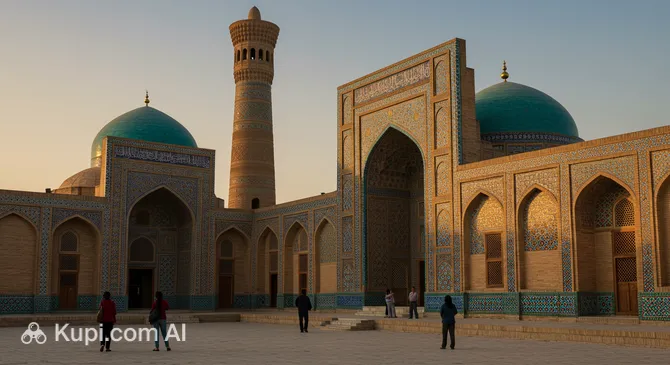
Kalyan Mosque
Kalyan Mosque. Иллюстрация. Источник: Kupi.com AI

The mosque's main feature is its vast courtyard surrounded by covered galleries with 288 domes supported by massive pillars. Two large, bright blue domes crown the building, pointing towards holy Mecca. The facades are adorned with intricate mosaics and calligraphic patterns encoding the names of ancient masters.

Today, it is not just a historical monument but an active religious center with a high reputation among travelers. The majestic Kalyan Minaret, rising 47 meters nearby, serves as a beacon for all seeking to touch the authentic culture of Central Asia.

Contacts

To plan your visit to this architectural complex, you can use the following contact information:

How to contactContact
AddressKalyan Mosque, Po-i-Kalyan, Khodja Nurobobod St, Bukhara, Bukhara Region, Uzbekistan

What to Do

Within the walls of this ancient sanctuary, you should first immerse yourself in the atmosphere of silent grandeur. Stroll through the shaded galleries of the inner courtyard, where rhythmic rows of columns and domes create a mesmerizing play of light and shadow. Be sure to notice the octagonal pavilion — the ta’ratkhana — which serves as a pulpit and stands out with its elegant architecture against the massive walls.

For photography enthusiasts, the complex offers endless angles. The most striking shots are captured with the Kalyan Minaret in the background: study its 12 ornamental bands, each featuring a unique pattern of fired brick. On a clear day, the turquoise glaze of the mosque's domes contrasts perfectly with the terracotta walls and the piercing blue sky of Bukhara.

Beyond visual delight, you can observe the life of a spiritual center and explore the region's Islamic heritage. After touring the mosque, look into the neighboring Mir-i-Arab Madrasa to see how harmoniously the buildings of the ensemble blend together. Historically, the minaret served not only to call for prayer but also as a lighthouse for caravans; looking at it, it’s easy to imagine yourself as a traveler on the Great Silk Road.

Getting There

Finding this architectural masterpiece is easy, as it is located in the heart of the historical center, near the famous Ark Fortress. If you arrive at Bukhara International Airport, the trip to the mosque will take about 15–20 minutes by taxi. The ride will cost approximately 20,000–50,000 soums, depending on the season and your negotiation skills.

From the railway station, which is slightly further from the center, you can take a taxi or use public transport, such as buses No. 2 or No. 3. The travel time is about 20–30 minutes. The minaret, visible from almost anywhere in the old city, will always serve as your landmark.

For those already strolling through the tourist districts, the best way to get there is a walk along Khodja Nurobobod Street. The majestic silhouette of the Po-i-Kalyan complex will appear suddenly, revealing its full beauty around a corner of the ancient streets. For travelers with their own cars, parking spaces are available nearby.

Ближайший город: Bukhara

History & Facts

The history of this site dates back to ancient times, with the first mosques being built here as early as 713. The current Kalyan Mosque was erected in the first half of the 15th century and acquired its final appearance, which survives today, by 1514 during the reign of the Shaybanid dynasty. The architectural style closely mirrors the monumental Bibi-Khanym Mosque in Samarkand, embodying the finest traditions of Timurid architecture.

A true wonder is the Kalyan Minaret, built in 1127 by order of the Karakhanid ruler Arslan Khan. This tower, over 46 meters high, is made of fired brick with such incredible precision that it has survived numerous earthquakes and even the siege of Genghis Khan. Legend has it that the great conqueror was so struck by the minaret's majesty that he ordered it not to be destroyed.

In the 16th century, the ensemble was finalized as the city's spiritual center. In 1542, a unique marble plaque was set into the mosque's portal, featuring a decree by Abdulaziz Khan exempting city residents from certain taxes. Careful restoration in the 20th century has preserved this monument not just as a museum piece, but as an active spiritual center that continues to play a vital role in modern Bukhara.

Time Needed

To explore the mosque without rushing and soak in its majestic tranquility, it usually takes between 1 and 2 hours. This is enough time to walk through the courtyard galleries, examine the detailed mosaics, and take impressive photos with the minaret.

If you plan to explore the entire Po-i-Kalyan ensemble in detail, including viewing the Mir-i-Arab Madrasa from the outside and walking through the nearby trading domes, we recommend setting aside about 3 hours. The best time to visit is in the morning or closer to sunset, when the soft light highlights the texture of the ancient brick and the heavenly blue of the domes.

Working Hours

The mosque doors are open to visitors daily. You can plan your visit at any convenient time throughout the week:

Monday — Sunday: from 09:00 to 18:00 without breaks.

9:00 – 18:00

Nearby

The Kalyan Mosque is at the epicenter of historical heritage, and walking around its surroundings will allow you to fully immerse yourself in the atmosphere of the ancient East. Literally every step here reveals new architectural treasures and colorful oriental markets.

NameDistance
Kalon Minaret0.1 km
Mir-i-Arab Madrasa0.1 km
Ulugh Beg Madrasa0.3 km
Ayvan0.7 km
Chor Minor1.1 km
Plov1.3 km

Reached the end of the page?

That means the route is fully explored