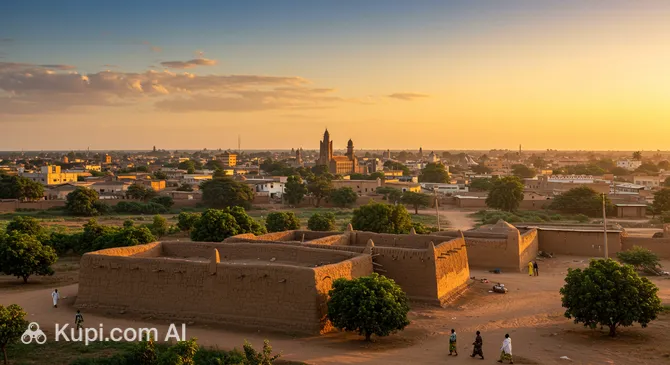
Located in the southern part of Mali, Sikasso welcomes travelers with lush greenery, which is surprisingly abundant for this region, and a vibrant atmosphere. As the country's second-largest city, it serves as a vital administrative and economic hub where West African trade routes intersect. The city's population exceeds 213,000, representing a rich mosaic of ethnic groups, including the Bambara, Senufo, and Malinke.
Sikasso. Illustration.
Source: Kupi.com AI
Unlike the more arid north, Sikasso is famous for its fertility and is considered the agricultural capital of the region. The history of the city is inextricably linked to the Kenedougou Kingdom, for which Sikasso became a stronghold of resistance in the late 19th century. Today, fragments of the once-majestic defensive structures serve as a reminder of its heroic past.
For a tourist, Sikasso is primarily an opportunity to see the authentic, unembellished life of modern Africa. There is no intrusive service here; instead, you'll find an abundance of authentic markets, colorful neighborhoods, and the sincere hospitality of the locals. Visiting this city is an excellent choice for those who want to explore the region's agricultural traditions and enjoy the natural diversity of southern Mali.
Weather Overview
The climate in Sikasso is classic sub-equatorial, defining the entire pace of life in this agricultural region. Unlike the arid northern regions of the country, there is significant rainfall here, which makes the weather in the city more humid and predictable. The year is clearly divided into two seasons: the dry season and the rainy season.
The hottest period falls in April and May, when daytime temperatures can reach 37-38°C. The rainy season starts in June and lasts until October, peaking in August (about 260 mm of precipitation). During this time, the heat subsides to a comfortable 25-28°C, and the surrounding landscapes become incredibly vibrant and green. January and December are the driest months, with pleasant daytime temperatures around 25°C and cool nights when the thermometer can drop to 17°C.
Average monthly temperature
Average monthly precipitation
Interesting Facts
Sikasso is a city with a rich heritage and unique characteristics that make it stand out on the map of West Africa:
The city was proclaimed the capital of the Kenedougou Kingdom in the second half of the 19th century by the ruler Tieba Traoré, who chose this site due to its strategically defensible position.
Sikasso is known as the "fruit basket" of Mali—thanks to abundant rainfall, the lion's share of the country's fruits and vegetables are grown here, providing food even for the remote northern regions.
The region possesses a unique geographical position, bordering three foreign states at once: Burkina Faso to the east, Ivory Coast to the south, and Guinea to the west.
The legendary Tata defensive wall, built to protect the city, was so powerful that French colonial forces were only able to capture Sikasso in 1898 after a long siege.
Founded in the early 19th century as a small village, today Sikasso has grown into the country's second-most populous city, overtaking many historical centers in the north.
How to Get There
The transport accessibility of Sikasso makes it an important hub on the route between Bamako and neighboring Ivory Coast and Burkina Faso. If you are planning a visit, it is useful to study information in advance on how to get to this region, considering the specifics of local transport.
The city's air gateway is Sikasso Airport (IATA: KSS). Although regular flights can be inconsistent, it is the fastest way to get here from the capital. Most travelers prefer ground transport: paved roads lead from Bamako to Sikasso, with regular buses running the route. A bus trip is a great opportunity to see the landscape change from arid savannas to the humid forests of the south.
Railway communication in this part of the country is poorly developed, so the main focus should be on road transport. Intercity bus companies offer various levels of comfort; however, schedules are often more of a recommendation, so tourists are advised to arrive at the station early.
Station
Passenger traffic
Distance
Bobo-Dioulasso railway station
3
149 km
Main Attractions
While Sikasso is not a classic tourist center, it hides several truly unique sites that reflect its glorious past. The city's main pride is the Tata—the remains of an ancient fortress wall that once stretched for about 9 kilometers and protected the capital of the Kenedougou Kingdom from enemy raids. Walking along these historical ruins, you can literally touch the defensive power of 19th-century African monarchies.
In the very center of the city rises the Mamelon—a sacred hill where the palace of the kings of Sikasso once stood. This site serves as an excellent landmark and is the heart of the city, offering a panoramic view of the residential quarters and bustling market rows. For those interested in ethnography, the hill is of particular interest as a symbol of the spiritual and secular power of the Senufo people.
No less fascinating is a visit to the local markets, which in Sikasso turn into attractions in their own right. The Grand Marché is striking with its abundance of fruits, vegetables, and brightly colored fabrics. It is the perfect place to observe the social activity of the local population and feel the rhythm of life in this important West African economic hub.
Local Cuisine
The culinary traditions of Sikasso are closely intertwined with the richness of its land. Thanks to the humid climate, local cuisine abounds with fresh vegetables and fruits, which is atypical for many other areas of Mali. The diet is based on dishes made from rice, millet, and corn, served with rich sauces. Be sure to try Tigadegena—meat in a thick peanut sauce, which is prepared here with exceptional skill.
The region is famous for its juicy mangoes and bananas, which are sold on every corner for next to nothing during the season. Among local drinks, Bissap—a refreshing infusion of hibiscus flowers—and ginger juice, which perfectly quenches thirst on a hot day, are particularly popular. Alcohol can be found in the city, but the culture of consumption remains reserved.
Dining in Sikasso usually involves visiting small street "gargottes" or modest restaurants where the locals themselves eat. A simple and honest gastronomic scene prevails here: food is prepared from the freshest products bought at the market in the morning. Tourists should be prepared for basic service, which is more than compensated for by the rich flavor of authentic African home cooking.
Travel Tips
A trip to Sikasso is an immersion into the real life of an African province, which requires some preparation. These practical tips will help make your journey comfortable and safe.
Clothing and Essentials: Choose clothing made of light natural fabrics (cotton, linen), as the region has high humidity. Be sure to bring comfortable closed shoes for walking and a European-type power adapter (Type C and E). If you plan to visit official institutions or religious sites, cover your shoulders and knees.
Transport: For getting around the city, it is best to use taxis. Negotiate the price before you get into the car. Intercity buses are a reliable way to connect with Bamako, but try to choose daytime trips.
Finance: The official currency is the CFA franc (XOF). Bank cards are only accepted in very large hotels, so always carry cash with you. ATMs are available in the city center, but they do not always work with international cards—keep a supply of Euros for exchange.
Health and Safety: Be sure to use mosquito repellents and sleep under a mosquito net, as the region is endemic for malaria. Drink only bottled water. In crowded places like markets, keep an eye on your wallet and phone.
Communication: The official language is French, but most residents speak Bambara. English is not widely spoken. Learn a few phrases in French or use an offline translator. A local SIM card can be purchased at any kiosk with your passport.
Local Etiquette: Always greet people before asking for anything. A handshake is an important part of communication. If you want to take a photo of someone, be sure to ask for permission, especially in markets.
What to Avoid: You should not photograph military or government buildings—this can lead to problems with the police. Also, avoid night walks in unlit or remote areas of the city.
Extra Tip: Be sure to stop by a local stall for some fruit. Mangoes from Sikasso are considered among the best in the world, and they will be one of the highlights of your trip's gastronomic experiences.
Following these simple rules will allow you to focus on the beauty of the region and the sincere hospitality of the people of Sikasso. Have a great trip!
Entertainment & Nightlife
The entertainment industry in Sikasso is primarily oriented toward local residents, allowing tourists to fully immerse themselves in the authentic atmosphere of an African city. Evening life here is devoid of the pretension and glamour of large capitals, but it is charming in its own way. Most activity after sunset is concentrated in small street cafes and local bars, where residents gather to discuss the news to the rhythmic sounds of Afrobeat music.
For those seeking cultural leisure during the day, Sikasso offers walks through colorful neighborhoods and participation in local festivals, which are often accompanied by traditional mask dances. Night markets are also a vital element of local leisure: here you can not only grab a snack but also observe the evening trade by the light of kerosene lamps or LED flashlights.
Travelers should keep in mind that the city has no large concert halls or chain nightclubs. It is safest to spend time in central districts and use taxi services to return to your hotel late at night. The main entertainment in Sikasso is the interaction with the people themselves and observing their daily life, which flows at a leisurely and friendly pace.
Parks & Museums
The cultural space of Sikasso is concentrated more in the open air than in the halls of classic museums. The main historical monument, replacing any gallery, is the ruins of the Tata defensive wall. This structure speaks of the engineering ingenuity and resilience of the local residents better than any history book. The Regional Museum of Sikasso also operates in the city, housing artifacts dedicated to the life of the Senufo people and the history of the Kenedougou Kingdom.
For outdoor recreation, residents and visitors use public spaces near the Mamelon hill. This area is not a park in the Western sense but serves as an important point of attraction where you can enjoy the shade of trees and socialize with locals. The green outskirts of Sikasso themselves resemble a vast garden: an abundance of mango orchards and citrus plantations creates a unique emerald belt around the city.
Visiting these places will allow tourists to feel a living connection across time. In Sikasso, history is not preserved in display cases; it is organically woven into the landscape and daily rhythm of life, where old defensive moats may sit alongside modern farms.
Getting Around
The transport system of Sikasso is typical for large West African cities and is based on private hire and shared taxis. The main means of transport for residents are minibuses that connect different districts. They do not have a fixed schedule—the vehicle departs as it fills up, so a trip may require some patience and a willingness to handle crowded conditions.
For more comfortable travel, tourists are recommended to use taxis. In Sikasso, they are easily recognizable and available at any time of day. You should always agree on the fare in advance, as taximeters are usually absent. If you plan to move around the city a lot during the day, you can hire a driver for a fixed time—this often turns out to be more economical and convenient.
Walking is possible in the central part of the city, especially around the Mamelon and the markets, but the high humidity and heat should be taken into account. Car or bicycle rentals are poorly developed in the city, so it is better to rely on local carriers or transport organized by your hotel. Be prepared for traffic congestion on main streets during peak hours due to the abundance of trucks transporting agricultural products.
Accommodation
The choice of accommodation in Sikasso is primarily represented by mid-range hotels and guesthouses catering to business travelers and employees of international organizations. It is difficult to find luxury five-star resorts here, but it is quite possible to find a clean and cozy room with basic amenities such as air conditioning and mosquito nets.
The most convenient area to stay is the city center and the neighborhoods along the main thoroughfares, providing easy access to markets and transport hubs. Small family apartments are also popular in Sikasso, suitable for those planning to stay in the region for a longer period to study the local way of life.
Accommodation prices remain quite affordable by international standards. During the peak agricultural season or regional fairs, rooms in the best hotels can fill up quickly, so it is recommended to book a room at least a few days before arrival through international services or by phone.
Nearby Cities
Due to its southern location, Sikasso serves as an excellent base for exploring border territories and neighboring agricultural centers. The region surrounding the city offers many options for those who want to see the diversity of West African landscapes and get acquainted with the lifestyle of neighboring peoples.
One interesting destination is Koutiala—an important trading city known as the center of the cotton industry. If you are ready to cross the border into neighboring Burkina Faso, it is worth paying attention to the picturesque Banfora, famous for its waterfalls and rock formations, or the small, cozy town of Orodara.
City
Population
Distance
Orodara
33 422
91 km
Soubakaniédougou
9 423
118 km
Beregadougou
9 036
119 km
Koutiala
104 927
119 km
Banfora
117 200
124 km
Exploring the surroundings of Sikasso will allow you to better understand the region's economic ties and enjoy the beauty of nature, which becomes increasingly lush as you move south. For trips, it is best to hire a taxi for the whole day or use intercity minibuses.
Shopping & Souvenirs
Shopping in Sikasso is primarily about visiting the famous city markets, which are considered among the busiest in the region. Here you won't find huge air-conditioned malls, but you will immerse yourself in a real whirlwind of colors and sounds. The city's main market offers everything from fresh tropical fruits to handmade crafts.
As souvenirs from Sikasso, it is worth bringing back traditional textiles. Local artisans are famous for making fabrics with unique patterns characteristic of the peoples of southern Mali. Also, look out for wood carvings and ceramics—they are distinguished by their simplicity of form and authenticity. The city's agricultural specialization allows you to buy excellent spices and dried fruits here, which will become a delicious reminder of your trip.
Shops and stalls usually operate from early morning until sunset, with a short break during the hottest time of day. Payment is mostly made in cash in the local currency, CFA francs. Bargaining is expected in the markets: it is not only a way to save money but also an important element of social interaction that is highly valued here.