Support

Tulum

About

Located on the east coast of the Yucatan Peninsula in Mexico, Tulum is a unique archaeological site and a former Mayan port city. Its main feature is its picturesque location on a 12-meter cliff overlooking the turquoise waters of the Caribbean Sea. Originally known as Zama, which means "City of Dawn," Tulum was one of the last cities built and inhabited by the Maya.

Thanks to its strategic location, the city served as an important trade and cultural hub. It was surrounded by massive stone walls on three sides, with steep coastal cliffs protecting the fourth, making it an impregnable fortress. Today, the ruins of Tulum are considered some of the best-preserved Mayan coastal cities, allowing visitors to connect with centuries-old history. The architecture of the buildings is typical of the East Coast: they sit on low platforms with steps leading to narrow doorways.

Visiting Tulum is not just about exploring ancient structures like the famous El Castillo (The Castle) or the Temple of the Frescoes, but also about enjoying breathtaking panoramas. The combination of ancient history and stunning nature makes this place truly special. Right below the ruins lies a magnificent sandy beach where you can head down for a swim after your walk through the archaeological site.
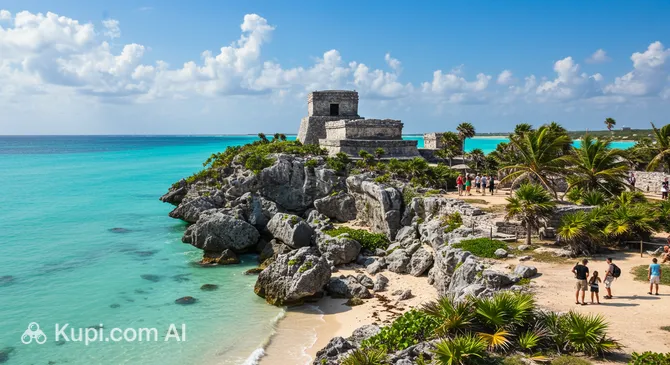
Tulum. Illustration.
Source: Kupi.com AI

Traveller photos:

Contacts

The Tulum Archaeological Zone is a historical site managed by Mexico's National Institute of Anthropology and History (INAH). Therefore, for the most up-to-date information on opening hours and visiting rules, it is recommended to consult official sources. The complex is located at: Carretera Federal Cancún - Chetumal Km 230, 77780 Tulum, Q.R. It can be reached via Federal Highway 307, which runs along the Riviera Maya coast.

How to contactContact
Address5GXP+FV, Caleta Yalku S/N, 77780 Tulum, Q.R., Mexico
Phone+52 983 837 2411
Websitewww.inah.gob.mx

What to Do

The main activity at the Tulum archaeological site is taking a leisurely stroll through the ancient Mayan city. Visitors can explore numerous well-preserved structures, the most prominent being El Castillo ("The Castle"). This majestic building, perched on the edge of a high cliff, once served as a temple and is believed to have been a lighthouse for trading vessels. It is also worth visiting the Temple of the Frescoes, where fragments of ancient murals can still be seen on the walls.

Beyond the history, visitors come here for the incredible views. From the top of the cliffs, there is a spectacular panorama of the turquoise Caribbean waters—one of the most photographed spots in all of Mexico. As you walk through the complex, you will likely notice many iguanas calmly sunning themselves on the ancient stones, adding an exotic touch to the scenery.

What makes Tulum unique is its location right by the sea. After touring the ruins, you will have the chance to descend the stairs to the picturesque beach at the foot of the cliffs. Here, you can swim in the warm waters or simply relax on the white sand, enjoying the view of the ancient fortress. This rare combination of rich historical heritage and unsurpassed natural beauty makes visiting Tulum a must-do on any Riviera Maya itinerary.

Getting There

Getting to the famous ruins of Tulum is quite easy, as the archaeological site is located just a few kilometers from the modern town of Tulum. If you are staying in the town center (Tulum Pueblo) or the hotel zone, you have several convenient options. The fastest way is to take a taxi, which takes no more than 10–15 minutes. For more active travelers, renting a bike is an excellent choice: there is a dedicated bike lane along the main road, making the trip to the ruins a pleasant ride. Some tourists even walk to the entrance, which takes about 30–40 minutes from the hotels closest to the ruins.

For those traveling across the Riviera Maya from other cities, such as Cancun or Playa del Carmen, the main mode of transport is the comfortable ADO buses. They run regularly along Federal Highway 307 and stop right at the entrance to the Tulum archaeological zone. A more budget-friendly alternative is the shared shuttles known as colectivos. These white minivans also follow Highway 307 and can drop you off at the road leading to the ruins, from where it is only a few minutes' walk to the entrance.

If you prefer maximum freedom of movement, renting a car is an ideal option. This allows you not only to easily reach Tulum but also to explore other interesting nearby spots, such as cenotes or other Mayan ruins. There is a large paid parking lot at the complex entrance, though it is best to arrive early to secure a spot. Additionally, many travel agencies in Mexico offer organized tours to Tulum, which often include transfers, guide services, and visits to several attractions in one day, making the trip as convenient and fulfilling as possible.

Nearest city: Tulum

History & Facts

The history of Tulum is shrouded in mystery, and even its founding date is a subject of debate among historians. Some sources suggest the city could have been founded as early as 564 AD. However, most researchers consider Tulum to be one of the youngest cities of the Mayan civilization, which began to develop actively around 900 AD and reached its peak by the 13th century. Its strategic location on a high cliff along the Caribbean coast made it not only an impregnable fortress but also a key hub on the Yucatan Peninsula.

The primary purpose of Tulum was trade. The city served as a major port where maritime and land trade routes from central Mexico and other Central American regions met. Archaeological finds indicate an extensive exchange network: copper items from the Mexican highlands, ceramics, flint, and even gold objects from all over the Yucatan have been discovered here. Salt and textiles were brought to the city by sea and then distributed inland in exchange for goods such as precious feathers and copper items.

The golden age of Tulum ended in the 16th century following the Spanish conquest. Afterward, the city was gradually abandoned by its inhabitants and hidden in thick jungles for centuries, its historical significance almost forgotten. It was only in the 19th century, thanks to the work of archaeologists and explorers who began excavations, that the world rediscovered this amazing city. Today, the ruins of Tulum allow us to peek into the past and touch the rich culture and history of the Maya.

Time Needed

For most visitors, 1.5 to 2 hours is enough to explore the Tulum archaeological site. This is plenty of time to leisurely walk through the area, see the main structures such as El Castillo and the Temple of the Frescoes, and take stunning photos against the backdrop of the Caribbean Sea. The archaeological zone itself is not very large, so the tour will not be tiring.

However, if you want to get the most out of your visit, it is worth planning for more time. One of Tulum's unique features is the opportunity to go down to the picturesque beach right at the foot of the ruins for a swim. If you are planning some beach time, feel free to add another hour or two to your visit. Thus, for a more relaxed visit that includes both the cultural program and swimming, it is best to set aside about half a day. It is also worth noting that a guided tour, which helps provide a deeper understanding of the site's history, usually lasts about an hour and a half.

Working Hours

The Tulum Archaeological Zone is open to visitors daily throughout the year. Typically, the hours are from 8:00 AM to 5:00 PM, with the last entry usually permitted until around 3:30–4:30 PM. To avoid the intense heat and the large tour groups that start arriving around 10:00 AM, it is recommended to arrive right at opening or later in the afternoon. Sundays can be particularly crowded, as entry is free for Mexican citizens on that day.

Advance ticket booking is generally not required; they can be purchased on-site. However, please note that the archaeological site may occasionally close temporarily for maintenance work. Therefore, it is a good idea to check the latest information on opening hours and any potential changes on the official website of Mexico's National Institute of Anthropology and History (INAH) or other reliable sources.

8:00 – 17:00

Nearby

Visiting the famous ruins is just the beginning of discovering what Tulum has to offer. To truly feel the atmosphere of this unique corner of Mexico, it is worth exploring its surroundings. In the immediate vicinity of the archaeological zone, many other interesting places are hidden that will make your trip even more fulfilling and memorable.

Right next to the ancient Mayan city are picturesque beaches, each with its own character, as well as other attractions that offer a glimpse into modern life in Tulum. Exploring these spots will enrich your experience and show how multifaceted this popular Caribbean resort is. Below is a list of some nearby attractions, including their distance from the ruins.

NameDistance
El Castillo (Tulum)0.1 km
Playa Ruinas0.1 km
Playa Pescadores1.1 km
Paradise Beach1.3 km
Las Palmas Beach2 km
M Tulum Hookah & Pool Lounge3.1 km
Tulum Pub Crawl3.1 km

Reached the bottom of the page?

Looks like you know this route inside out