Support

Bab Agnaou

About

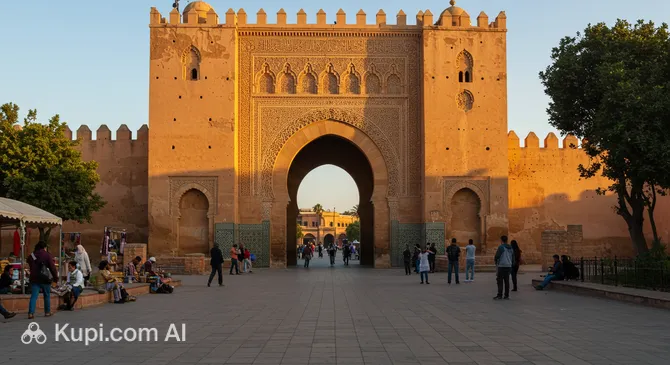
Among the majestic fortifications of the ancient medina of Marrakech, the Bab Agnaou gate holds a special place. Built in the 12th century during the powerful Almohad dynasty, it served as the ceremonial entrance to the royal citadel—the Kasbah. It is not merely a section of the defensive wall, but a true masterpiece of Islamic architecture, symbolizing the grandeur and power of a caliphate that once stretched across Morocco to the shores of Tripoli.
\n\n
Bab Agnaou
Bab Agnaou. Иллюстрация. Источник: Kupi.com AI
\n\n

The gate's construction is impressive in its monumentality: four successive horseshoe arches create a deep relief adorned with exquisite carvings. Unlike most of the city's other gates, which are made of clay, Bab Agnaou is faced with bluish-grey sandstone that has acquired a noble reddish hue over time. The facade is crowned by a frieze of Kufic calligraphy featuring verses from the Quran, emphasizing the sacred status of the entrance to the empire's administrative center.

\n\n

The name of the landmark translates from Berber as \"hornless ram,\" which, according to one version, refers to the absence of the towers that originally flanked the passage. Today, the gate is surrounded by ancient cannons and is one of 19 surviving portals in the 19-kilometer city wall. Thanks to meticulous restoration in the 20th century, this site is a must-visit for all lovers of history and traditional Arabic aesthetics.

Contacts

Since Bab Agnaou is a monumental architectural landmark located directly on a city street, it does not have an official office, telephone number, or administration. Visitors can view the site freely at any time.

\n\n
How to contactContact
AddressRue Oqba Ben Nafaa, Marrakech 40000, Марокко
Websitewww.getyourguide.fr

What to Do

The main reason to visit Bab Agnaou is the opportunity to touch living history. Visitors can examine the intricate stone carvings and the Arabic script framing the entrance in great detail. The gate looks particularly striking in the rays of the setting sun, when the soft light emphasizes every curve of the ornament and changes the shade of the sandstone, creating perfect conditions for artistic photography.

\n\n

After exploring the gate, it is logical to continue further into the Kasbah district. Nearby are the famous Saadian Tombs with their magnificent zellij mosaics and marble halls, as well as the Al-Mansur Mosque. For those who prefer active leisure, Bab Agnaou often serves as an important point on walking and cycling tour routes through the old part of the city.

\n\n

A walk along the fortress walls, which reach a thickness of two meters, allows you to feel the scale of medieval Marrakech's defensive structures. Don't forget to look for the storks that often build their nests right on top of the ancient walls and towers, adding a unique charm to this historical site.

Getting There

Finding Bab Agnaou is easy—the gate is located in the southern part of the historical center (Medina) in the Kasbah district. If you are already in the city center, a pleasant walk from the famous Jemaa el-Fnaa square will take about 15–20 minutes. The gate is also within walking distance of the Bahia Palace; just follow the signs toward the royal quarter.

\n\n

For those traveling from outlying areas or from Marrakesh Menara Airport (RAK), taking a taxi is the most convenient option. The ride takes between 20 and 30 minutes and costs approximately 100–150 dirhams. You can also use bus lines 11 or 29, which run to the edges of the Medina, followed by a short walk.

\n\n

If you arrive by train, you can take a taxi from Marrakech Railway Station or use public transport, heading for the stops near the entrance to the old city. Keep in mind that the streets inside the Medina are very narrow and primarily pedestrian, so transport will drop you off as close to the fortress walls as possible.

Ближайший город: Marrakech

History & Facts

The majestic Bab Agnaou gate was erected in the 12th century during the reign of the Almohad dynasty. During this period, the Berber empire made Marrakech its capital, transforming it into one of the most powerful centers of the Islamic world. The gate served as the main southern entrance to the Kasbah—the fortified citadel that housed the caliph's residence, military barracks, and administrative buildings.

\n\n

Interestingly, the city's defensive system began to take shape even earlier, in 1122–1123, under the Almoravid dynasty. However, it was the Almohads who, after capturing the city, expanded the fortifications and added 19 monumental gates, among which Bab Agnaou stood out for its rich decoration. The architectural style of the gate echoes masterpieces of that era, such as the minaret of the Koutoubia Mosque and the famous Giralda in Seville.

\n\n

For centuries, the gate served as a symbol of the power of the caliphate, whose lands stretched from Andalusia to the territory of modern-day Libya. Although extensive restoration was required in the 20th century, Bab Agnaou has retained its original appearance, allowing modern travelers to touch the imperial past of Morocco.

Time Needed

To carefully inspect the Bab Agnaou gate itself, study the stone carvings, and take commemorative photos, 30–60 minutes is usually sufficient. As it is an open-air site, the length of your visit depends entirely on your interest in the architectural details.

\n\n

However, given its location at the entrance to the Kasbah district, it is worth combining a visit to the gate with a walk around the neighborhood. In this case, it is better to set aside at least 1.5–2 hours to explore the architectural ensemble, nearby tombs, and mosques, allowing you to immerse yourself in the atmosphere of the medieval city at a relaxed pace.

Working Hours

Since Bab Agnaou is part of the public city fortifications and is located in an open street area, it can be viewed 24/7, every day. There are no entrance tickets or turnstiles, allowing tourists to plan their visit at any convenient time.

\n\n

Nevertheless, for the best visual appreciation of the architectural details, it is recommended to visit during daylight hours. Early morning or the hours before sunset are the best times to avoid large crowds of passers-by and to take high-quality photos in natural light.

Круглосуточно

Nearby

The gate's location in the heart of the historic district makes it an ideal starting point for further exploration of the city. A stroll through the surrounding area will allow you to see how different eras intertwine in the architecture and life of Marrakech.

\n\n
NameDistance
Monde des Arts de la Parure Museum0.3 km
El Badi Palace0.5 km
Place des Ferblantiers0.6 km
Koutoubia Mosque0.7 km
La Pergola0.8 km
Le Bistro Arabe0.8 km
Bahia Palace0.9 km

Reached the end of the page?

That means the route is fully explored