Support

Assounna Mosque

About

Imagine an endless forest of hundreds of stone columns rising under the open sky on the high bank of the Bou Regreg river. The Assunna Mosque (historically known as the Hassan Tower complex) is one of the most majestic and recognizable symbols decorating Rabat. This site represents a grand attempt to create the largest religious structure of its time, remaining beautiful in its unfinished greatness.
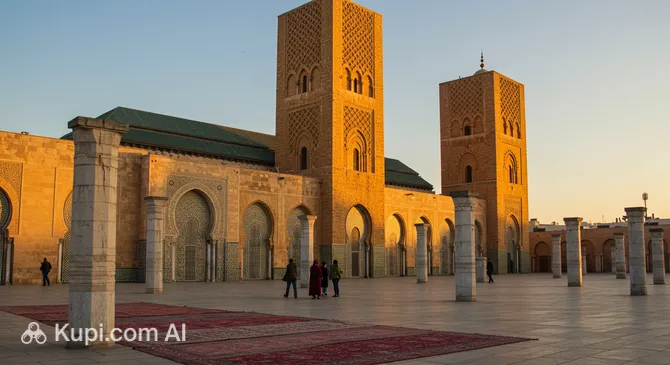
Assounna Mosque
Assounna Mosque. Иллюстрация. Источник: Kupi.com AI

The main feature of the complex is the 44-meter minaret made of rose stone, adorned with exquisite carvings of pointed arches and geometric patterns. Surrounding it stand about 200–360 massive columns that were intended to support the roof of a giant mosque. Today, it is a unique archaeological park where the history of the Almohad Empire meets the modern rhythm of Morocco.

The location of the monument was not chosen by chance: it offers panoramic views of the Atlantic Ocean and the ancient Kasbah des Oudayas. The combination of the rugged power of medieval ruins and the elegance of Moroccan decor makes this a must-visit for anyone wishing to touch the authentic spirit of North African history.

Contacts

The site is located in the heart of the capital and is easily recognizable due to its scale. Official contact details, such as a phone number or website, are not provided to the general public; however, information can be obtained at the city's tourist information centers.

How to contactContact
AddressAv. Mohammed V, Rabat, Morocco

What to Do

The main activity here is a leisurely stroll through the forest of columns. Visitors can take a close look at the craftsmanship of ancient stone cutters and try to imagine the scale of a mosque that was intended to hold an entire army during prayer. The finish of the minaret deserves special attention: its walls change shade depending on the lighting, from soft pink to deep ochre.

Be sure to walk to the edge of the terrace to enjoy breathtaking views of the Bou Regreg River and the white-and-blue walls of the Kasbah des Oudayas. This is an ideal spot for panoramic photos, especially during the "golden hour" before sunset. The complex grounds possess an atmosphere of tranquility, perfect for reflecting on eternity and the passage of eras.

Directly next to the ruins is the Mausoleum of Mohammed V. Tourists can step inside to see the magnificent interiors decorated with zellij mosaics, fine wood carvings, and shimmering crystal chandeliers. Here you can also observe guards in traditional uniforms protecting the entrance to the royal tomb.

After exploring the architectural masterpieces, you can head to the nearby gardens, where resting among orange trees and flowers offers a pleasant escape from the city bustle. The complex is perfect for walking and cultural immersion into Rabat's architectural heritage.

Getting There

Getting to one of the capital's main attractions is quite easy, as the complex is located in the central part of Rabat, on Mohammed V Avenue. If you are staying in the historic center (the Medina), a walk to the site will take about 15–20 minutes. The route passes through colorful streets, allowing you to gradually immerse yourself in the city's atmosphere.

For those who prefer comfort, a taxi is an excellent option. A trip from the city center will take only 5–10 minutes. If you are coming from Rabat-Salé Airport, which is about 10 km away, the taxi ride will take around 20–30 minutes and cost approximately 100–150 Moroccan dirhams.

Public transport is also well-developed: you can take the tram (Line 1 or 2) and get off at the "Kasbah des Oudayas" stop. From there, it is a 5–10 minute walk along the riverbank. For travelers with their own car, there is a free parking lot directly next to the complex.

Ближайший город: Rabat

History & Facts

The history of this site began in 1195 under the ambitious vision of Emir Yacoub al-Mansur of the Almohad dynasty. The ruler wished to erect the most grand mosque in the Islamic world, which would serve as a symbol of his empire's power. The building was planned to cover an area of over 25,000 square meters, and its minaret was intended to be the tallest structure of its time—over 80 meters high.

However, these grand plans were not destined to be fully realized. In 1199, when the emir passed away, construction suddenly stopped. At that point, the minaret had only reached 44 meters, and the main part of the building remained unfinished. Nevertheless, even in this state, the structure captures the imagination with its monumentality and the artistic expression of its rose-colored stone.

In 1755, the region was struck by the devastating Lisbon earthquake. The disaster destroyed many walls and the roof, but the famous tower and hundreds of sandstone columns stood firm, preserving the spirit of a great era. For Moroccans, this place holds sacred significance: in 1956, the complex was officially recognized as a national shrine.

The architectural style of the complex, with its characteristic pointed arches and lattice ornamentation, had a significant influence on subsequent construction in the Maghreb region and even in Spain. It is a living testament to the height of Almohad culture, when Rabat served as a vital outpost on the shores of the Atlantic.

Time Needed

To leisurely explore the complex grounds, take commemorative photos by the famous tower, and walk among the ancient columns, most tourists need between 1 and 2 hours. This is plenty of time to experience the scale of the structure and visit the adjacent Mausoleum of Mohammed V.

If you plan to combine the visit with a stroll through the nearby Kasbah des Oudayas and a rest in the Andalusian gardens, we recommend allocating half a day (about 3 hours) for the area. The best time to visit is during the pre-sunset hours, when the soft light emphasizes the pink hue of the stone, creating perfect conditions for photography.

Working Hours

The complex is open to visitors daily, making it a convenient stop on any tourist itinerary. According to official data, the site is open Monday through Sunday from 00:00 to 23:30. However, it is worth noting that the most comfortable time to view the ruins and the tower is during daylight hours, from dawn to sunset.

If you also plan to visit the Mausoleum of Mohammed V located on the grounds, keep in mind that it is usually open to the public from 09:00 to 17:00. On Fridays, due to religious traditions, the schedule may change, so it is better to plan your visit for the morning or the second half of the day after 14:00. Entrance to the entire complex is free.

12:00 – 23:30

Nearby

Rabat is a city with a rich heritage, and exploring the surroundings of this majestic complex will allow you to better feel the history and culture of Morocco. Just a few minutes' walk away are sites included in the UNESCO World Heritage list, offering completely different experiences: from the silence of ancient ruins to the bustle of modern entertainment parks.

NameDistance
National Museum of Archaeology0.1 km
Mohammed VI Museum of Modern and Contemporary Art0.2 km
Villa des Arts0.2 km
Le Musée Hotel & Restaurant0.3 km
Boho Café0.4 km
Royal Palace of Rabat1 km
Nouzhat Hassan Garden1 km

Reached the end of the page?

That means the route is fully explored