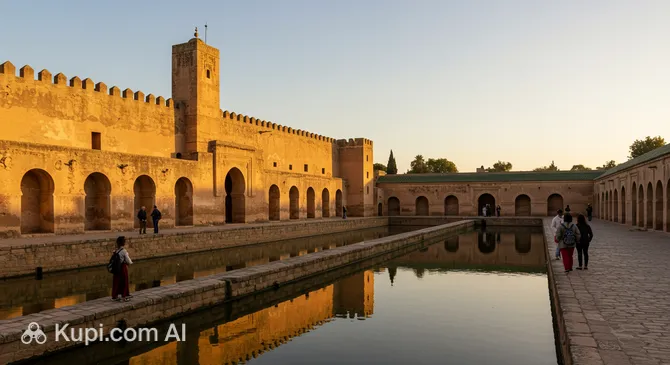
A vast mirror of water stretching between ancient walls—this is the Souani Basin (also known as Sahrij Swani or Agdal). This majestic rectangular reservoir, located in the city of Meknes, was created in the 17th century by order of the legendary Sultan Moulay Ismail. Originally, it served as a giant reservoir for storing water in case of a siege, highlighting the defensive power and foresight of the ruler of Morocco.
The site covers an impressive area of about 4 hectares and is 4 meters deep, and its construction was a true triumph of engineering for its time. Water was brought here through a complex system of irrigation channels from the Middle Atlas Mountains. Bassin Souani. Illustration.
Source: Kupi.com AI
Traveler photos:
Due to its historical significance, the basin and the adjacent Heri es-Souani granary complex were added to the UNESCO World Heritage list in 1996.
Today, the Souani Basin is not just a monument of ancient hydraulic engineering, but also a favorite spot for peaceful walks. The thick walls of the complex create a pleasant coolness even on hot days, while the still surface of the water surrounded by ruins creates an atmosphere of majestic tranquility, transporting visitors back to the heyday of imperial Meknes.
Contacts
To plan your visit to this historical site in Meknes, it’s helpful to have key contact details at hand. Although the site is part of an open architectural complex, official information can help you better navigate the area.
A stroll along the shores of this colossal reservoir is a great way to take a break from the hustle and bustle of the central medina. Here, you can leisurely walk around the area, admiring the play of light on the water and appreciating the impressive scale of the structure. Be sure to notice the walls of the adjacent granary: their four-meter thickness clearly demonstrates the power of the architecture of that time.
Photography enthusiasts will find beautiful views of Moroccan landscapes and austere ruins, which look especially striking in the rays of the setting sun. If you are interested in history, take a look at the nearby ancient stables—they could once accommodate up to 12,000 camels and horses, a fact that still captures the imagination of tourists.
Many visitors come here for a picnic or quiet reflection surrounded by history. You can watch local birds or simply enjoy the panorama of the Heri es-Souani complex, imagining how life bustled here hundreds of years ago as the power of one of the world's most fortified capitals was being forged.
Getting There
Finding your way to the Souani Basin is easy, as it is located southeast of the city center. If you are already walking through the historic center, a pleasant walk from the famous Bab Mansour gate will take about 20–30 minutes. For those who prefer comfort or are short on time, a ride in a local taxi ("petit taxi") from any area of the medina is inexpensive and takes only 5–10 minutes.
For travelers arriving from other regions of Morocco, it is most convenient to use the train or the CTM bus network. Trains from Rabat or Fes arrive at Meknes station, from where the attraction can be reached by taxi in 10–15 minutes. If you are traveling by rental car, this location is an excellent stop on a route through the country's imperial cities, thanks to the availability of parking space nearby.
Nearest city: Meknes
History & Facts
The history of this grandiose structure is inextricably linked with the name of Sultan Moulay Ismail of the Alaouite dynasty. In 1673, he made Meknes the capital of his empire, deciding to turn it into a city capable of rivaling Versailles in its grandeur. The Souani Basin was a key element of this ambitious plan, serving a vital defensive function.
During the Sultan's era, the reservoir served as a strategic storehouse: in the event of a long siege, the water reserves in the basin and grain in the adjacent storehouses were meant to sustain the army and the population for five whole years. Thousands of workers and captives were involved in the construction of such colossal objects, which allowed for the building of massive walls and a complex irrigation system fed by springs from the Middle Atlas mountains.
In 1996, the complex's outstanding engineering achievements and architectural value received global recognition. The Souani Basin, along with the entire historic center of Meknes, was included in the UNESCO World Heritage list as a unique testament to the power and skill of 17th-century builders.
Time Needed
To explore the Souani Basin and take a few memorable photos by the water, 30–45 minutes is usually enough. This time will allow you to appreciate the scale of the reservoir and walk along its massive walls while enjoying the peace and quiet.
If you plan to combine a visit to the basin with a tour of the neighboring Heri es-Souani granary complex and a walk to the Bab Mansour gate, we recommend setting aside about 1–1.5 hours in your schedule. This will allow you to study the engineering tricks of the past without rushing and feel the monumental atmosphere of the ancient city.
Working Hours
According to available data, the Souani Basin is accessible for visiting 24 hours a day only on Mondays. On other days of the week (Tuesday–Sunday), the site may officially be closed for entry to the inner areas of the complex.
However, since the reservoir is part of an open UNESCO architectural ensemble, its exterior outlines and scale can be appreciated at any time. For safety and the best photo opportunities, we recommend planning your visit during daylight hours.
Day
Working hours
Monday
Open 24 hours
Tuesday
Closed
Wednesday
Closed
Thursday
Closed
Friday
Closed
Saturday
Closed
Sunday
Closed
Nearby
Exploring the surroundings of the reservoir allows for a deeper dive into the atmosphere of the city's imperial past, as key historical monuments and picturesque spots for relaxation are located nearby.