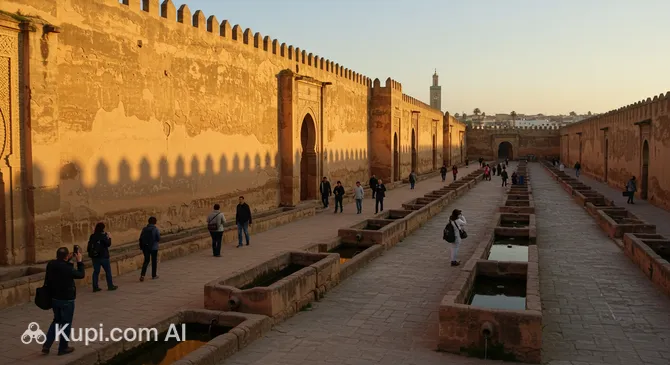
In the heart of the imperial city of Meknes in Morocco lies one of the most impressive monuments of the Alawite era — the Royal Stables. This grand architectural complex, built at the end of the 17th century by order of Sultan Moulay Ismail, continues to amaze with its scale and is considered one of the largest structures of its kind in the world.
Royal Stables of Meknes. Illustration.
Source: Kupi.com AI
Traveler photos:
The stables were conceived as part of an ambitious project to transform the city into the \"Versailles of Morocco.\" Vast vaulted halls were designed to house 12,000 horses, highlighting the ruler's military power and wealth. Today, what remains of its former glory are mostly majestic ruins: endless rows of massive stone arches, now roofless, create a unique geometric labyrinth.
This site is part of the historic ensemble of Meknes, which is inscribed on the UNESCO World Heritage list. Visitors are drawn here by the amazing atmosphere of antiquity and the extraordinary play of light within the arched openings, making the ruins an ideal spot for atmospheric walks and historical discoveries.
Contacts
To confirm current information before your visit, you can use the contact details provided below. We recommend checking availability by phone in advance, as opening hours may vary.
The main highlight of the Royal Stables is a walk through the endless rows of ancient arches. Visitors can literally lose themselves in this forest of stone, imagining thousands of noble steeds once housed here. This place is perfect for quiet contemplation and immersing oneself in the atmosphere of Morocco's historical power.
For photography enthusiasts, the stables are a true paradise. Because many parts of the complex lack a roof, sunlight pours in at various angles, creating dramatic shadows and graphic patterns on the walls. It is best to visit in the morning to capture the softest and most expressive lighting.
Beyond the architecture, the site’s cinematic charm is noteworthy. The stables served as filming locations for famous movies such as 'The Passion of the Christ' and 'Angélique and the Sultan'. After exploring the ruins, a walk to the nearby Agdal reservoir is recommended, where local cultural events and agricultural fairs are often held.
Getting There
The landmark is located in the southern part of the historical center at VCHR+WG9, Meknes. The route from the famous Bab el-Mansour gate takes about 10–15 minutes on a pleasant walk along the fortress walls. This is the simplest way to reach the site, allowing you to experience the scale of the royal quarters along the way.
If you are in the new part of the city or prefer comfort, a taxi is the best option. The ride from Meknes main railway station will take no more than 10–15 minutes. Note that the driver will drop you off as close to the entrance as possible, as some parts of the old city are closed to traffic.
For those traveling by car, parking spaces are available near the complex and the adjacent reservoir. Since public transport in the city is limited, taxis and walking remain the preferred ways for tourists to get around.
Nearest city: Meknes
History & Facts
The history of this site is inextricably linked to the ambitions of Sultan Moulay Ismail of the Alawite dynasty. In 1672, he moved the capital to Meknes and began a grand construction project, aiming to create a city that could rival the Versailles of his contemporary, the French King Louis XIV. Horses were the Sultan’s passion, leading to the construction of this colossal complex for 12,000 stallions.
In its heyday, the stables were part of the vast Dar el-Makhzen palace complex. A clever engineering system supplied the animals with water from the neighboring reservoir, while the massive walls kept the interior cool even in the most intense heat. The architecture reflects the Hispano-Moorish style with its characteristic arches and monumentality.
Unfortunately, most of the vaulted ceilings were destroyed in the mid-18th century during the devastating Lisbon Earthquake. Nonetheless, the surviving rows of arches still vividly demonstrate the power and wealth of imperial Morocco during that era. The entire ensemble of the city's historical sites is listed as a UNESCO World Heritage site.
Time Needed
For a standard tour of the Royal Stables ruins and a walk among the famous arches, most visitors need between 30 to 60 minutes. This is ample time to take beautiful photographs and get a feel for the scale of the structure.
If you choose to combine your visit with a walk around the neighboring reservoir and a visit to the granaries, you should plan for about 1.5–2 hours. The location invites leisurely exploration, especially during the quiet morning or pre-sunset hours.
Working Hours
The official opening hours of the Royal Stables often change, and some sources may list the site as temporarily closed for restoration. Generally, access for tourists is open during daylight hours, starting around 10:30 AM.
To avoid disappointment, it is recommended to check for up-to-date information on-site or by phone before your visit. Also, keep in mind that access to certain sections may be limited for technical reasons.
Nearby
Exploring the surroundings of the Royal Stables allows you to fully immerse yourself in the atmosphere of the imperial past. A walk through this area will reveal grand engineering feats and magnificent monuments that once formed a single architectural ensemble of the Sultan's capital.
Many interesting locations are within walking distance, making this area ideal for walking tours. Below is a list of notable sites worth visiting nearby: