Support

Amsterdam Gate

About

The Amsterdam Gate is a notable architectural monument located in Amsterdam, the capital of the Netherlands. It is situated in the area that once housed the entrance to the courthouse and dates back to the late 19th century. This gate serves as a reminder of the city's historical appearance and its administrative past.
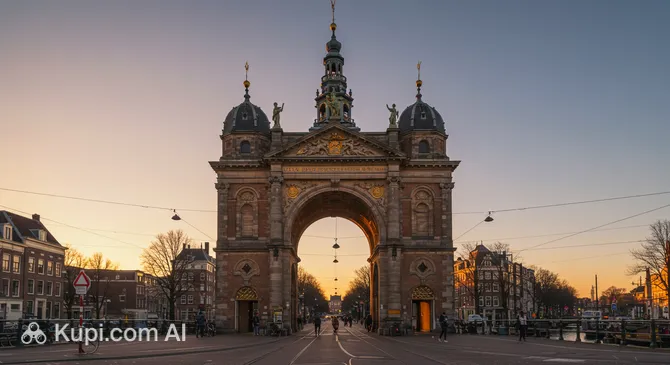
Amsterdam Gate. Illustration.
Source: Kupi.com AI

Traveler photos:

Designed in a style that imitates elements of the Dutch Renaissance, the Amsterdam Gate is, nevertheless, more of a stylization than an exact reproduction of historical examples. Most of its decorative details are a creative reimagining characteristic of the architectural trends of that time. Originally, this compact structure served as a symbolic entrance to the territory of administrative buildings.

Today, the Amsterdam Gate attracts attention as an interesting example of late 19th-century urban architecture. It stands as one of the historical accents against the backdrop of modern Amsterdam, reflecting the urban construction trends of a period when elements of the past were actively reimagined and integrated into new architectural projects. For tourists, it's an opportunity to see a piece of the city's history and appreciate its architectural diversity.

Contacts

The Amsterdam Gate is a historical monument, and as such, it may not have a dedicated visitor contact service. To find the exact location, possible access hours, or information about guided tours, we recommend contacting Amsterdam's tourist information centers or visiting the city's official tourism websites. These iconic sites are often accessible for viewing at any time.

How to contactContact
Address2011 BZ Haarlem, Netherlands

What to Do

Visiting the Amsterdam Gate in Amsterdam offers tourists a chance to touch the city's history and architecture. The main activity here is, of course, viewing the structure itself. You can examine the gate's architectural features in detail, appreciate its scale, and take plenty of memorable photos against the backdrop of this unusual and historically significant site. The gate is a historically significant landmark with interesting architectural details that tell the story of Amsterdam's past and serve as an excellent photo backdrop.

Particular attention should be paid to the design details of the Amsterdam Gate. Look closely at the decorative elements executed in a style reminiscent of the Renaissance, and notice the characteristic symmetry of the facade. These details reveal much about the architectural traditions and aesthetic preferences of that era. Studying such nuances allows for a deeper understanding of the historical context and significance of this monument.

Since the Amsterdam Gate is located in a walkable area, it's easy to include a visit in a walking route through the historical center of Amsterdam. Near the gate, you'll find charming streets that are pleasant to stroll through while enjoying the old town atmosphere. Cozy cafes where you can relax over a cup of coffee and souvenir shops are located in the immediate vicinity. Additionally, exploring the surroundings will allow you to see other interesting architectural monuments in the area.

Getting There

Getting to the Amsterdam Gate is quite simple, as it is located in the central part of Amsterdam. One of the most pleasant and authentic ways to reach it is by walking or cycling. This choice allows you not only to reach your destination easily but also to enjoy the city's atmosphere, as popular tourist routes pass nearby.

If you prefer public transport, the nearest tram and bus stops are within walking distance of the Amsterdam Gate. It is recommended to get off at one of the central stops and then take a short walk through the picturesque streets to fully immerse yourself in the charm of Amsterdam. This is also a great opportunity to see other interesting corners of the city along the way.

For those traveling by car, please note that traffic in the center of Amsterdam is restricted. Nevertheless, there are city parking lots in the Amsterdam Gate area where you can leave your car. However, given the convenience of public transport and the well-developed cycling infrastructure, many tourists prefer these methods of getting around the city.

Nearest city: Amsterdam

History & Facts

The Amsterdam Gate, located in Amsterdam, is an interesting architectural monument from the late 19th century. Originally, it was built not as part of defensive structures, but as a ceremonial entrance to the courthouse. This fact immediately sets it apart from many other historical gates, which often had military or protective purposes.

The architectural appearance of the gate is designed in the Neo-Renaissance style, which was very popular in the Netherlands at the time of its construction. However, it is important to note that many decorative elements are more of a stylistic take on the Renaissance rather than an exact reproduction of historical models. This gives the gate a special charm, demonstrating the creative approach of the architects of that time to the interpretation of classical forms.

From a historical perspective, the Amsterdam Gate played a primarily decorative and symbolic role. It did not carry a serious defensive or practical load, like city walls or customs posts. Its task was to emphasize the importance of the courthouse and decorate the cityscape, which it continues to do successfully to this day.

This gate serves as a wonderful illustration of Amsterdam's characteristic tendency to carefully preserve and stylize historical forms in urban architecture. Thanks to this approach, the city successfully combines old-world charm with modern dynamics, creating a unique atmosphere that attracts travelers from all over the world. The Amsterdam Gate is just one of many examples of this harmony.

Time Needed

When planning a visit to the Amsterdam Gate in Amsterdam, keep in mind that viewing it usually doesn't take much time. If you are just passing by or including it in your walking route through the city, 15–30 minutes will be quite enough to get to know this landmark and its immediate surroundings. This is plenty of time to take photos and appreciate the historical architecture.

During these thirty minutes, you can examine the gate's details, perhaps read the information boards if there are any, and simply enjoy the moment. The Amsterdam Gate is often one of the points on a longer walk through Amsterdam, fitting seamlessly into a plan to discover the cultural heritage of the capital of the Netherlands.

Working Hours

The Amsterdam Gate in Amsterdam is a landmark that can be viewed at any time. According to available information, the gate is outdoors and is open to visitors 24/7. This means you can plan your visit at any time of the day or night that is convenient for you, enjoying the view without any time restrictions.

Since the Amsterdam Gate is an outdoor site with round-the-clock access, special ticket bookings or advance appointments are generally not required. The attraction is accessible year-round, making it easy to include in your travel itinerary through the capital of the Netherlands in any season.

Open 24 hours

Nearby

Visiting such an iconic landmark as the Amsterdam Gate is certainly a highlight. However, to truly feel the atmosphere of Amsterdam and make your trip even more fulfilling, it's worth checking out other interesting places nearby.

Exploring the surroundings will allow you to discover new facets of the city, see it from different angles, and get a more complete picture of its culture and history. Often, it's the smaller, lesser-known sites or natural spots near popular tourist points that offer the most unexpected and pleasant experiences, becoming a perfect addition to your main itinerary.

Near the Amsterdam Gate, you will find several interesting places that are also worth your attention:

NameDistance
Amsterdamse Bos14.5 km
Foodhallen15.1 km
Fabrique des Lumières15.3 km
De Gekroonde Poelenburg Saw Mill15.6 km
De Kat Paint Mill15.6 km
Stedelijk Museum Amsterdam16 km
Surfeiland16.1 km

Have you reached the end of the page?

So the route has been studied inside and out