Support

Royal Palace Amsterdam

About

The Royal Palace in Amsterdam (Koninklijk Paleis) is a magnificent historic building located in the heart of the city on Dam Square. Today, it is one of the official residences of the Netherlands' royal family and represents an outstanding example of 17th-century Dutch Classicism. The palace is open to visitors when official events are not being held, offering a glimpse into the world of royal life and history.
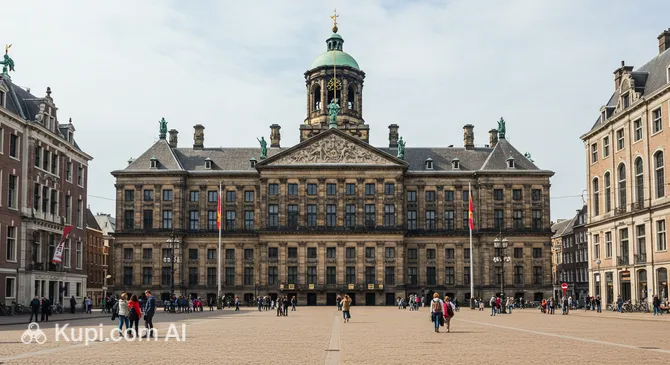
Royal Palace Amsterdam. Illustration.
Source: Kupi.com AI

Traveler photos:

This grand structure was originally built as a city hall during the Dutch Golden Age. For two centuries, it was considered the largest civic building in Europe and was even a candidate for the title of the eighth wonder of the world. Its austere yet elegant design, devoid of lavish ornamentation, reflects the simplicity and rationalism characteristic of Dutch architecture at that time.

The palace's exterior is impressive: the 79-meter-wide facade is decorated with pilasters and a triangular pediment with sculptures. The building is topped with a graceful dome featuring a weather vane in the shape of a ship — an ancient symbol of the city. Inside, visitors will find luxurious halls decorated with marble, artworks, and gilding, with the massive Citizen's Hall taking center stage.

In 1936, the palace officially became the property of the Kingdom of the Netherlands. After extensive restoration from 2005 to 2009, it continues to play an important role in the country's life, hosting state visits and official ceremonies, while remaining one of the capital's most visited attractions.

Contacts

For the most up-to-date information on opening hours, special events, and ticket prices, it is recommended to consult official sources. The main contact details for the Royal Palace are provided below for your convenience.

How to contactContact
AddressNieuwezijds Voorburgwal 147, 1012 RJ Amsterdam, Netherlands
Phone number+31 20 522 6161
Websitewww.paleisamsterdam.nl

What to Do

Visiting the Royal Palace in Amsterdam is an opportunity to immerse yourself in the atmosphere of the Dutch Golden Age and touch the country's history. Walking through its halls, you will see impressive interiors richly decorated with art, marble, and gilding. The monumental frescoes by Ferdinand Bol and Govert Flinck — Rembrandt's talented pupils — decorating the ceilings of some halls are particularly noteworthy. Each room and gallery of the palace holds artifacts and furniture telling the story of its past, from its time as a city hall to its modern role as a royal residence.

The heart of the palace is undoubtedly the grand Citizen's Hall (Burgerzaal). This vast space, over 25 meters high, leaves an unforgettable impression. Its main feature is the marble floor, which displays maps of the Western and Eastern Hemispheres, with a star map between them. This composition symbolized the influence and power of Amsterdam, which in the 17th century was considered the center of the world.

Other notable rooms include the Tribunal Hall, which was used for announcing death sentences. Its walls are decorated with expressive life-sized bas-reliefs depicting three types of sentences: just, wise, and compassionate. To delve deeper into the building's history and learn about the significance of its artistic decor, visitors can use the audio guide available in several languages. The palace is open to the public on days when official royal family events are not being held, making a visit here a truly unique experience.

Getting There

Getting to the Royal Palace in Amsterdam is effortless, as it is located in the heart of the city — on the famous Dam Square. This central location makes it easily accessible from anywhere in the capital. One of the most pleasant ways is a walk from the Central Station (Amsterdam Centraal). The journey takes only 10–15 minutes along the lively Damrak street, allowing you to immediately immerse yourself in the city's atmosphere.

For those who prefer public transport, there are many options. Right by the palace is the "Dam" tram stop, served by numerous routes, including trams No. 2, 4, 12, 13, 14, and 17. This is perhaps the most convenient way to reach your destination from various parts of the city. Additionally, the "Rokin" metro station, served by line 52, is just a few minutes' walk away, making it another excellent alternative.

Of course, you can always take a taxi, though it's worth noting that traffic in the center of Amsterdam can be heavy, especially during peak hours. For full immersion in local life, you can rent a bike — the city's most popular mode of transport. A well-developed network of bike paths will allow you to reach Dam Square quickly and enjoyably, feeling like a true local of the Dutch capital.

Nearest city: Amsterdam

History & Facts

The history of the Royal Palace in Amsterdam is inextricably linked to the Dutch Golden Age, a time when the Netherlands experienced unprecedented economic and cultural growth. Interestingly, this monumental building was not originally built for monarchs. From 1648 to 1665, it was constructed as a new city hall, designed by the prominent architect Jacob van Campen. Built in the Dutch Classicism style, the building was intended to serve as a symbol of the power and wealth of Amsterdam, which at that time was one of the world's leading trade centers.

The construction process itself is a remarkable fact. Due to the swampy soil characteristic of the area, the foundation required driving 13,659 wooden piles. The walls were built of yellow sandstone specially brought from Germany. Jacob van Campen was inspired by Italian architecture, which is reflected in the symmetry of the facades, the use of pilasters, and the grand triangular pediment featuring a sculptural group. The building's plan is a giant square with two inner courtyards, and its entire concept was designed to reflect the maritime and commercial greatness of the Republic.

The building only gained its status as a royal residence much later. It wasn't until 1936 that the palace officially became the property of the Kingdom of the Netherlands. In modern history, a key event was the extensive restoration conducted from 2005 to June 2009. During this work, asbestos that had darkened over time was removed from the facade, restoring the building's original light shade. Since June 14, 2009, the renovated palace has once again opened its doors to visitors, continuing to serve a dual function: as a venue for official royal receptions and as one of the capital's main attractions.

Time Needed

When planning a visit to the Royal Palace in Amsterdam, you should allow for 1–2 hours. This is usually enough time for a leisurely tour of the main halls and galleries open to the public. Although the palace is grand, it is quite compact, making it easy to include in a day spent exploring the city center. The ticket price includes a free audio guide available in several languages, which will lead you through the key rooms and tell you about their history and decor. The standard audio tour takes about 75 minutes.

The duration of your visit may vary depending on your interests. If you choose to skip the audio guide and just soak in the atmosphere, an hour might suffice. However, it is highly recommended to use it, as there are almost no information boards in the palace. For art and history lovers who want to examine the paintings by Rembrandt’s pupils, sculptures, and luxurious Empire-style furniture in detail, it’s worth setting aside about two hours. It is also worth checking the official website for any temporary exhibitions that might require extra time.

Working Hours

The Royal Palace in Amsterdam is open to visitors, though it does not have strictly fixed opening hours throughout the year. In most cases, the palace is open daily from 10:00 to 17:00. However, as it is still used today for official royal receptions, it may be periodically closed to the public. After an extensive restoration, the palace reopened its doors to guests on June 14, 2009. To avoid disappointment, it is highly recommended to check the current calendar and opening hours on the attraction's official website before visiting.

Generally, the palace is open for visits most of the year, rather than just during specific seasons. To guarantee entry and save time, especially during peak tourist seasons, it is recommended to purchase tickets online in advance. This will also allow you to choose a convenient time for your visit and stay informed about any sudden changes to the schedule. The ticket price usually includes an audio guide, which will help make your tour more informative.

Nearby

Visiting the Royal Palace is just the beginning of your introduction to the heart of Amsterdam. Thanks to its location on Dam Square, you are at the epicenter of the city's cultural and historical life. A walk around the surrounding area will allow you to delve deeper into the unique atmosphere of the capital of the Netherlands and see just how multifaceted this city can be.

Just a few steps from the palace, world-famous museums, bustling shopping streets, and iconic landmarks await. Exploring nearby points of interest will not only enrich your experience but also help you create a complete and fulfilling day's itinerary. Many of them are within walking distance, making exploring the center especially pleasant.

NameDistance
Dam Square0.1 km
Madame Tussauds Amsterdam0.1 km
P.G.C. Hajenius0.4 km
Anne Frank House0.5 km
Café Hill Street Blues0.5 km
Rembrandt House Museum0.8 km
The Pantry1.2 km

Have you reached the end of the page?

So the route has been studied inside and out