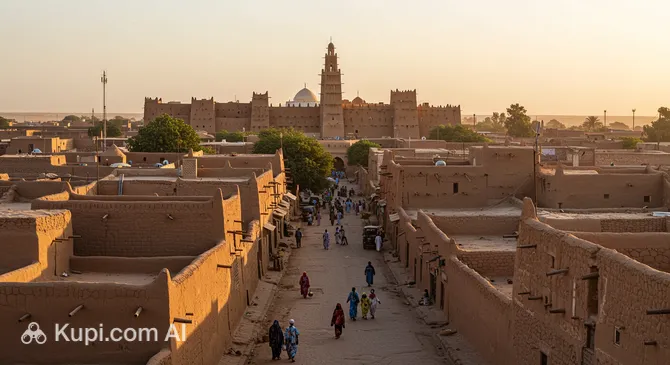
Zinder is a city with a profound historical heritage and a unique character, located in the southern part of Niger. As the country's third-largest city, it attracts travelers not with the glitz of modern skyscrapers, but with the authentic atmosphere of traditional West Africa. Home to approximately 235,000 people, the city serves as a vital administrative and commercial hub for the region.
The city's geographical position at the crossroads of ancient trade routes determined its destiny: it was once the center of the powerful Sultanate of Damagaram, and until 1927, it even served as the first capital of the French colony. The rich history of Zinder still lives on in its mud-brick walls and ancient quarters, creating a sense of a space frozen in time amidst the vast savannas.
Zinder. Illustration.
Source: Kupi.com AI
The main magnets for visitors remain the Sultan's Palace and the labyrinths of the old Birni quarter, where life flows much as it did centuries ago. Visiting this place is a chance to see the genuine, non-touristic way of life of the Hausa people. We invite you to discover this distinctive corner of the world, where the bustle of lively markets meets the silence of ancient traditions.
Weather Overview
The climate of Zinder is classified as tropical savanna, which implies the presence of distinct seasons and high temperatures throughout most of the year. Average annual values fluctuate around +25–28°C, however, daily fluctuations can be quite significant. To ensure your trip is comfortable, it is important to consider what kind of climate of the city awaits you in a specific month.
The year can be divided into three main periods. From October to December, the cool dry season lasts, when the air temperature is most pleasant for walking (+15–30°C). From January to May, the hot period arrives, during which the thermometer often reaches +40°C during the day. During this time, the harmattan often blows from the Sahara—a dusty wind that brings haze and reduces visibility. The rainy season falls between June and September; it brings long-awaited freshness but can complicate travel on the region's unpaved roads.
Expect extremely hot and dry weather in the spring, while August is the wettest month with heavy rainfall. If you are planning a trip in the winter months, it's worth packing a light jacket for the evening hours, as temperatures can drop noticeably at night. Overall, Zinder is a sunny land where rain is a rare but intense phenomenon that transforms the surrounding savanna.
Average monthly temperature
Average monthly precipitation
Interesting Facts
From 1899 to 1927, Zinder was the first capital of the French colony of Niger, before the administrative center was moved to Niamey.
The city grew around the Sultanate of Damagaram, founded in the 18th century, and was long a key point in the trans-Saharan trade of gold, salt, and textiles.
Zinder is the third-largest city in the country, following only Niamey and Maradi, and governs an extensive region covering more than 155,000 square kilometers.
The local airport has the international IATA code ZND, making it an important transport hub connecting the south of the country with other regions.
How to Get There
The transport accessibility of Zinder is due to its role as a major regional center in the south of the country. The fastest and most comfortable way to get here is by using local aviation. Zinder Airport (ZND) receives regular flights from the capital of Niger, Niamey. The flight usually takes just over an hour; however, it's worth noting that flight frequency can be low, so it is better to plan your trip in advance. More details on how to get to the city by various modes of transport can be found in the specialized sections of our guide.
For those who prefer overland travel, the RN1 highway serves as the main artery. A bus or taxi ride from Niamey is a true adventure spanning 861 kilometers, which can take between 12 and 16 hours. The road passes through picturesque savannas, but during the rainy season, some sections can become difficult to navigate. Zinder is also connected to the Nigerian city of Kano (about 240 km away), a journey that takes 4–6 hours, including time for border control.
In Zinder itself, the primary means of transport from the airport to the city center is by taxi. The trip to the main residential areas and hotels usually takes no more than 15–20 minutes. There is currently no railway service in this region, so all passenger traffic is divided between aviation and long-distance buses.
Main Attractions
Even though Zinder is not a typical tourist center, it hides true gems of traditional architecture. The city's primary source of pride is the Sultan's Palace. This historical residence captivates the imagination with elements of traditional Hausa architecture—massive walls and unique decor that emphasize the grandeur of the local authority.
The Birni Quarter, the oldest part of the city, holds a special charm. Walking through its narrow, winding streets among ancient mud-brick houses feels like a journey back in time. Every building here is adorned with traditional patterns, and the atmosphere of the quarter allows you to truly feel the spirit of the ancient Sultanate of Damagaram.
For those who want to feel the pulse of the city's modern life, the Grande Marche—the central market—is a must-visit. It is not just a place of trade, but the true epicenter of life in the region. Here, among endless rows of spices, fabrics, and livestock, you can witness the full diversity of Niger's cultures and get acquainted with the daily life of local residents.
Local Cuisine
Zinder's gastronomic identity is defined by the cuisine of the Hausa people, where the main ingredients are sorghum, millet, and peanuts. If you want to try something truly local, look for jollof rice—a fragrant rice pilaf prepared here with vegetables and succulent meat. No less popular is tuwo—a thick and nutritious millet porridge traditionally served with a rich sauce made from leaves and spices.
Street food lovers should search the markets for kiba—small, crispy pastries filled with minced meat, perfect for a quick snack. When it comes to drinks, there is a cult of tea in Zinder. The local attikane is brewed very strong and served with a lot of sugar; it is not just a drink, but an important social ritual. Dairy-based drinks like funie are also popular and very refreshing in the midday heat.
The food culture in the city is concentrated around the markets and main streets. Here you can find many simple eateries where the locals eat. The most atmospheric place for gastronomic discoveries remains the Grande Marche market, though tourists should exercise caution and choose places with a high turnover of products. Alcoholic beverages are extremely rare in the city due to the region's strict religious traditions.
Travel Tips
Preparing for a trip to Zinder requires attention to detail to ensure your journey through southern Niger is comfortable and safe. These practical tips will help you quickly settle into the unique atmosphere of this ancient city.
Clothing and Dress Code: Choose light clothing made from natural fabrics to better handle the heat. Given the conservative traditions of the region, it is strongly recommended to wear modest clothing that covers the shoulders and knees, especially when visiting mosques and old quarters.
Transport: It is most convenient to move around the city by taxi. Agree on the fare in advance, as meters are not used here. For intercity travel, it is best to choose reputable bus companies.
Finances: The main currency is the CFA franc. Work only with cash, as ATMs are few and may not accept foreign cards. Always carry small bills for the markets.
Health: A yellow fever vaccination certificate is mandatory. Drink only bottled water, use mosquito repellents, and apply sunscreen.
Communication: The official language is French, but most residents speak Hausa. Learning a few basic greetings in the local language helps a lot in winning people over. English is not widely spoken.
Safety: Avoid walking alone at night and in remote neighborhoods. Be mindful of your personal belongings in crowds at the markets, as petty theft can occur.
Etiquette: Always greet local residents before asking for anything. You may only take photos of people and administrative buildings with their explicit permission.
Connectivity: Buy a local SIM card in the city center for internet access, as Wi-Fi in hotels can be unstable.
Following these simple rules will allow you to focus on exploring the rich culture of Zinder and will make your stay in the city truly memorable.
Entertainment & Nightlife
Nightlife in Zinder reflects the conservative and tranquil character of the city. You won't find noisy discos or modern nightclubs here, as the majority of the population adheres to Muslim traditions. Evening entertainment for locals is usually limited to leisurely socializing in cozy open-air tea houses, where strong, sweet attikane tea is served.
The area around the Grande Marche often becomes the center of evening activity. After sunset, the heat subsides, and informal socializing continues in the market squares. For tourists, these gatherings can be an excellent way to observe local life. If you are looking for more familiar European-style bars or clubs, you would need to head to the capital, Niamey, or across the border to the Nigerian city of Kano.
Daytime leisure in the city is focused on exploring its historical corners. We recommend walking through the old Birni quarter accompanied by a local guide who can explain the hidden architectural details. Otherwise, Zinder is a place for those who appreciate contemplative relaxation and immersion into traditional culture far from the hustle and bustle of megacities.
Parks & Museums
In the classical sense, Zinder is not rich in European-style parks or art galleries. The urban layout here is dense and functional, dominated by mud-brick structures that are themselves exhibits in an "open-air museum." The lack of large green zones is compensated for by the unique architectural appearance of the ancient quarters, where every building tells its own story.
The Sultan's Palace serves as the primary cultural and historical landmark. While the city lacks a separate state museum, visiting the palace grounds and the adjacent old town allows you to become acquainted with the artifacts and traditions of the Sultanate of Damagaram. The traditional painted facades and the internal layout of Hausa homes serve as art gallery halls for tourists.
If you are looking for a place to relax in nature, locals often choose open areas in the surrounding savannas. Within the city limits, greenery is minimal, but small squares near the markets serve as important public spaces. The absence of formal museums only highlights that Zinder is living history that should be explored simply by walking through its dusty yet life-filled streets.
Getting Around
The public transport system in Zinder is simple and adapted to the needs of the local population. The main ways to get around the city are taxis and motor-rickshaws. Rides are very inexpensive (usually ranging from 100 to 500 CFA francs), and you can catch a vehicle at almost any point on the central streets. There are no fixed schedules; transport operates on a "fill-and-go" basis.
For travel between markets and distant quarters, bush taxis are often used—minibuses or cars that depart once they are full of passengers. This is the most budget-friendly option, though it may not be the most comfortable due to the cramped conditions. It's worth considering that during peak hours in the Grande Marche area, traffic can slow down, although serious traffic jams are a rarity for the city.
Travelers who value independence might consider renting a car with a driver. This is a convenient way to get to the airport or visit surrounding villages. Walking is also popular in the central part of the city, especially in the old Birni quarter, where the streets are too narrow for cars. When planning your movements, it is important to take into account the high dust levels on the roads and the hot climate, so always carry a supply of water with you.
Accommodation
The choice of accommodation in Zinder is primarily focused on practicality and basic comfort. There are almost no luxury five-star complexes here, but there is an abundance of cozy guesthouses, pensions, and middle-class hotels. Most accommodation options are concentrated along the main city road and in close proximity to the airport, which is convenient for transit travelers.
A typical hotel in the city will offer a clean room with air conditioning or a fan, which is critically important in the local hot climate. Prices for accommodation remain very affordable and usually range from $10 to $50 per night. If you are planning a long stay, you can find small apartments for rent in residential neighborhoods.
Travelers are recommended to book accommodation in advance, especially if your visit coincides with important regional holidays or trade fairs. Although Zinder is not overloaded with tourists, the best value-for-money spots may be occupied by employees of international organizations or trade representatives. To find a suitable option, specialized services or recommendations from local guides are most commonly used.
Nearby Cities
Zinder is an excellent starting point for exploring the southern reaches of the country and getting to know the culture of the border regions. Despite its distance from the capital, the city's surroundings offer travelers the chance to see the life of authentic settlements in the savanna zone.
One of the nearest interesting points is Takeita, located just 51 kilometers to the west. This small settlement allows you to see the traditional rural way of life in Niger. Also worth mentioning is Matameye—an important agricultural center known for its markets and its proximity to the Nigerian border.
City
Population
Distance
Takeita
8 554
51 km
Matamey
58 025
69 km
Mai'Adua
201 178
110 km
Zango
154 743
112 km
Goure
14 639
140 km
For longer trips, you can consider routes toward the town of Goure or even cross the border to visit the Nigerian metropolis of Kano, which is one of the oldest cities in West Africa. Exploring the surroundings of Zinder will give you a unique chance to see how the savanna landscape changes and how closely the trade ties of the peoples inhabiting this region are intertwined.
Shopping & Souvenirs
Shopping in Zinder is not a trip to shopping centers, but an exciting immersion into the world of traditional markets. The Grande Marche is the commercial heart of the city. There are no display windows or price tags here, but there is an abundance of goods that have been transported across the Sahara for centuries: vibrant fabrics with traditional Hausa patterns, aromatic spices, and handmade leather goods.
Special attention should be paid to souvenirs that reflect the region's craft traditions. From Zinder, it is worth bringing back unique pottery with characteristic local ornamentation or lengths of fabric dyed with natural pigments. You can often find blacksmiths and jewelers at the market creating jewelry based on ancient designs. A stroll through the market also offers the chance to see livestock trading—a spectacle that has changed little over the past few centuries.
It is important to remember that in the shops and markets of Zinder, only cash is used (West African CFA francs). Bank cards are rarely accepted, mostly only in the largest hotels. Shops usually operate from early morning until sunset, though many stalls may close for a break during the hottest part of the day. The ability to bargain politely is not only welcomed here but is also a part of the local culture of communication.