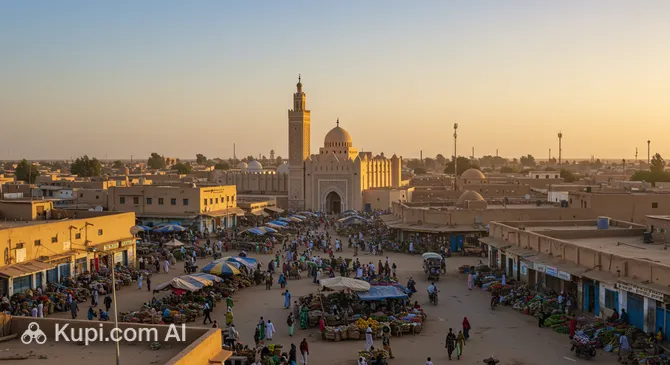
Maradi is a dynamic and colorful city located in the southern part of Niger. Recognized as the country's economic capital, it serves as a vital trade hub on ancient trans-Saharan routes. The city's atmosphere is steeped in the traditions of the Hausa people, whose business acumen and cultural heritage have turned this region into a bustling crossroads of civilizations.
Maradi. Illustration.
Source: Kupi.com AI
Geographically, the city lies just a few dozen kilometers from the border with Nigeria, which largely defines its commercial character. The city's population is approximately 267,000, and the region itself is rightfully called the "breadbasket of Niger" thanks to its fertile lands. By exploring the rich history of the city, one can learn about the ancient sultanates and dynasties that ruled here for centuries.
For the traveler, Maradi reveals itself as an authentic African center where life revolves around bustling markets and traditional industries. It lacks the polish of world capitals but offers the sincerity of everyday life and unique Hausa architecture. We invite you to discover this important logistical and cultural heart of the region to see the real, non-touristic Niger.
Weather Overview
The climate in Maradi is classified as a tropical savanna type, which means a clear division of the year into a very hot dry season and a short rainy period. If you are planning a visit, it is important to consider the city's climate to prepare for extreme temperatures. The hottest months are April and May, when the thermometer often reaches 40–45°C.
Expect dry weather for most of the year with a near-total absence of precipitation from November to May. The rainy season usually lasts from June to September, with the peak humidity occurring in August, when a significant portion of the annual rainfall occurs. During this time, the heat subsides slightly, but the likelihood of dust storms and problems with traveling on unpaved roads increases.
Winter months, such as December and January, are considered the most comfortable for visiting: average daytime temperatures are around 30°C, and nights can be quite cool (down to 14–15°C). During this period, the dry Harmattan wind blows, bringing dust from the Sahara, so the sky often appears hazy. We recommend always having a supply of water and protective accessories against the sun and dust.
Average monthly temperature
Average monthly precipitation
Interesting Facts
The city of Maradi hides many surprising details that help better understand its significance for all of West Africa. Here are a few notable facts about this trading center:
Ancient Crossroads: Maradi emerged at the intersection of caravan routes long before the arrival of colonizers, serving as a key point of exchange for goods between the Sahara and the Gulf of Guinea.
Presidential Homeland: This is the birthplace of Ibrahim Baré Maïnassara, who served as the President of Niger in the second half of the 1990s.
Sultanate in the Modern World: The Durbawa dynasty of sultans still nominally rules in the city, with their history in the region dating back to 1807.
Economic Giant: Despite Niamey being the capital, Maradi maintains the status of the economic capital due to its massive volumes of trade and agriculture.
Agrarian Center: The city is considered the country's main supplier of peanuts and beans, which earned the region its nickname, the "breadbasket."
How to Get There
Transport accessibility to Maradi is due to its strategic position in the south of the country, making it an important link between the capital and neighboring states. The main and fastest way to get here from other regions is by air. If you are planning a visit, it is useful to research in advance how best to get to Maradi considering the current flight schedules.
The city itself is home to Maradi Airport (MFQ), which handles regular domestic flights from the capital, Niamey. The flight time is only about an hour, which is much more convenient than a long overland journey. The airport is in close proximity to the city, so a taxi ride to the center will not take much time.
Land transport is represented by bus routes and taxis following the main A1 highway from Niamey. The 540-kilometer journey can take anywhere from 8 to 12 hours due to road conditions and heavy truck traffic. There are also routes from neighboring Nigeria, particularly from the city of Katsina; the journey from there takes about an hour but requires passing through border formalities.
Station
Passenger traffic
Distance
Zaria Railway station
1
273 km
Main Attractions
Although Maradi is primarily a commercial and administrative center, it boasts several iconic sites that reflect the soul of the region. One of the central landmarks is the Maradi Mosque, which serves as both a religious and a major social point of reference. Its architectural style is woven into the urban landscape, serving as a reminder of the local population's deep Islamic traditions.
Of particular interest to history enthusiasts is the Palace of the Sultan of Maradi (Durbawa). This is the residence of an ancient dynasty that maintains its symbolic influence today. Walking near the palace, you can notice elements of traditional Hausa architecture with characteristic ornaments that tell the story of the times of the Katsina Sultanate and the Sokoto Caliphate.
The heart of urban activity is found in its central markets and large public buildings, such as the Stade Maradi. While there are no conventional museum exhibitions here, the market squares themselves are a living museum of trade and crafts. Visiting these places allows you to see Maradi in all its diversity: from vibrant fabrics to aromatic spices and the creations of local leatherworkers.
Local Cuisine
The culinary traditions of Maradi are closely intertwined with the region's agricultural status and the culture of the Hausa people. The diet is based on grains, particularly millet and sorghum, which are used to prepare hearty porridges and couscous. The city's gastronomic scene is simple and functional, offering guests a chance to experience the authentic flavors of the savanna.
Be sure to try the local tajine—fragrant meat stewed with vegetables and spices—as well as various dishes made from cowpeas and peanuts, which are grown here in abundance. Street food is popular in the city's markets: charcoal-grilled meat and freshly baked flatbreads. These simple but nutritious dishes form the basis of the daily menu for most residents.
As for drinks, strong tea and various fermented milk products, which are excellent for quenching thirst in the hot climate, are consumed everywhere in Maradi. In some areas, you may find traditional palm wine, though the region's Islamic traditions impose certain restrictions on alcohol consumption. Dining in the city is centered in small local establishments near the markets, where an atmosphere of lively trade and hospitality prevails.
Travel Tips
A trip to Maradi promises to be a unique experience of immersion in the authentic atmosphere of West Africa. To ensure your journey is comfortable and safe, we have prepared several practical recommendations.
Clothing and Essentials: Choose light clothing made from natural fabrics to better handle the heat, which can reach 45°C. Respect local Hausa traditions and try to dress modestly, especially when visiting mosques and the Sultan's Palace.
Transport: The most convenient way to get around the city is by motorcycle taxi (zenga). Be prepared for dust on the roads and always agree on the price of the trip in advance.
Finance: The official currency is the CFA franc (XOF). It is recommended to always carry cash, as credit cards are rarely accepted and ATMs can be unreliable.
Health and Safety: Drink only bottled water and use sunscreen. In terms of safety, Maradi is relatively calm, but avoid the outskirts of the city after dark and keep a close eye on your belongings in the markets.
Communication: The main languages are Hausa and French. English is not widely spoken, so it is useful to learn a few basic phrases in French or Hausa to communicate with vendors.
Local Etiquette: Traditional greetings are very important in Hausa culture. Do not rush straight to business; first, ask about the health and well-being of the person you are speaking with.
What to Avoid: Do not photograph government buildings, military sites, or people without their explicit consent. This can cause serious dissatisfaction or problems with the authorities.
Additional Tip: Plan important tasks for the morning hours before the heat becomes exhausting, and keep in mind that during the rainy season (June–September), roads can become difficult to navigate.
Following these simple rules will help you enjoy the hospitality of Maradi and discover the real life of Niger.
Entertainment & Nightlife
Evening leisure in Maradi differs significantly from typical European standards and has a quiet, provincial character. Nightlife as such is practically non-existent, and most activity winds down after dark. Locals prefer to spend time with their families, in small traditional tea houses, or at religious gatherings.
For sports fans, the main center of attraction is the Stade Maradi, which periodically hosts football matches and large-scale city celebrations. This is the best place to witness the passion and energy of the residents during their time away from trade. Cultural life is also represented by public spaces such as the Bibliothèque Point d'Interrogation, where the city's youth and intellectuals gather.
If you are looking for more vibrant entertainment, clubs, or bars, keep in mind that they are extremely difficult to find within the city itself. Tourists usually limit themselves to dining at hotel restaurants or taking evening walks along the central, well-lit streets. For full-scale nightlife, travelers most often head to the capital or cross the border into Nigeria, where the rhythm of life in major cities is significantly more dynamic.
Parks & Museums
In Maradi, there are practically no classic urban parks or museums in the Western sense, which is explained by the arid savanna climate and the city's historical focus on trade. Instead of organized green zones, residents and visitors find rest in the shade of trees around significant architectural sites. The main open spaces are concentrated in the center, where life bustles around the market squares.
The only notable green accents can be found near the Sultan's Palace and the administrative quarters, where planted trees provide necessary coolness on hot days. These places serve as unofficial relaxation zones where one can sit and observe the city's unhurried rhythm. The lack of large park areas is compensated for by the proximity to agricultural lands outside the city limits, which turn into a green carpet during the rainy season.
The city's cultural heritage is presented not in museum display cases, but in living architecture and daily traditions. The markets and historical quarters effectively function as museums here, where every house and every shop tells a story of crafts. Despite the absence of specialized galleries, the spirit of Maradi's history is felt in every element of traditional Hausa construction and in the way of life of the local sultanates.
Getting Around
The transport system in Maradi reflects its status as a bustling trade center where population mobility plays a key role. Public transport here is represented mainly by informal types, among which motorcycle taxis, known to locals as "zenga," lead the way. This is the fastest and most affordable way to move through the city's dusty and often crowded streets, allowing for easy maneuvering between trucks and carts.
In addition to motorcycle taxis, bicycles and tricycles (auto-rickshaws) are popular in the city and its surroundings, transporting both people and goods. Buses are much less common and mainly run between the city center, the airport, and remote districts. It is worth noting that roads in the city are often unpaved, and a lot of dust rises in the air during the dry season, so traveling in open transport can be a specific challenge for the unprepared tourist.
For long-distance travel, travelers usually use private taxis or intercity minibuses. There is no unified payment system or travel passes—the cost of the trip is negotiated with the driver in advance and paid in cash. During peak hours near major markets, traffic jams can occur, created mainly by freight transport, so you should plan your trips around Maradi with a bit of extra time.
Accommodation
The hotel infrastructure in Maradi is primarily functional, as most visitors to the city are trade representatives, government officials, or employees of humanitarian missions. You won't find luxury five-star complexes here, but the city offers decent mid-range options. Most hotels are concentrated in the central district and near the airport, which is convenient for transit travelers.
Typical accommodation in the city consists of small hotels and guesthouses where service is focused on basic needs: air conditioning, a bed, and breakfast. Accommodation prices remain quite affordable, but keep in mind that comfort levels can vary. For expats working in the agricultural sector, apartments for long-term stays are often available.
Travelers are recommended to book accommodation in advance, especially during major regional fairs or national holidays when demand spikes. Most bookings are made directly or through local services, as international booking systems may not display all available options. When choosing a place to stay, look toward the central neighborhoods to ensure easy access to markets and administrative buildings.
Nearby Cities
Thanks to its location in the south of the country, Maradi is an excellent starting point for exploring border territories and neighboring agricultural areas. The city's surroundings allow you to see rural life in Niger and get acquainted with the lifestyle of Hausa village communities. A journey through nearby locations will provide a more complete understanding of the diversity of this African region.
Just 47 kilometers away is the town of Gidan Roumdji, known for its traditional markets and agrarian lands. Also of interest is a trip across the border to the Nigerian city of Katsina, which is just over an hour's drive away. This ancient city in Katsina State is famous for its rich sultanate history and majestic architecture, making it a wonderful destination for a day trip.
Exploring the surroundings of Maradi requires some preparation and knowledge of local road conditions, but in return, it offers a unique experience of immersion in the authentic atmosphere of the Sahel. Whether it's a trip for fresh produce at a regional market or a visit to historical monuments in neighboring states, every such journey will enrich your understanding of the culture and traditions of West Africa.
Shopping & Souvenirs
Shopping in Maradi is, above all, an immersion in the element of traditional African markets, which are the main trading hubs of the region. There are no modern shopping centers with escalators here, but there is a vast selection of goods coming from neighboring Nigeria and surrounding farms. The entire trading process is concentrated in the central part of the city, where labyrinths of stalls offer everything from provisions to unique handicrafts.
The main treasures of the local markets are leather goods and fabrics made by Hausa artisans. You can purchase traditional embroidered clothing, durable leather bags, and shoes, which are famous for their quality throughout Niger. Maradi is also famous for its "gold"—peanuts and peanut products—as well as spices and grains, which make excellent gastronomic souvenirs.
Shops and stalls usually operate from early morning until sunset, though activity may decrease during midday hours due to the intense heat. Payments are primarily made in cash using West African CFA francs, and the ability to bargain politely is encouraged and is part of the local communication culture. Visiting the markets of Maradi is not just about buying things, but an opportunity to feel the pulse of the country's economic capital.