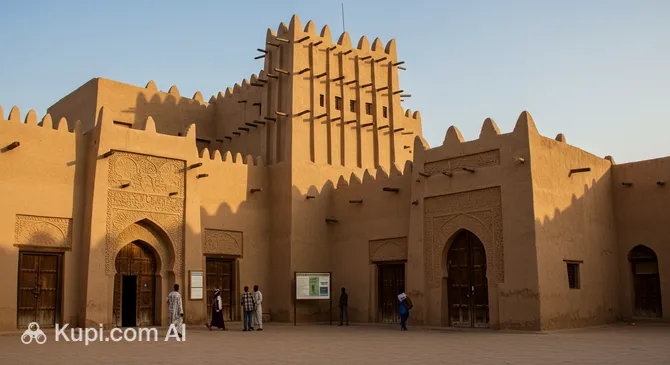
In the heart of one of Africa's oldest cities lies the Gidan Makama Museum — a unique cultural space located in a magnificent 15th-century building. This museum, opened in 1953 in the former residence of the Emir, is rightfully considered a jewel of the city of Kano. Its architecture in the traditional Sudanese style captivates tourists at first sight with its grandeur and authenticity.
Gidan Makama Museum. Illustration.
Source: Kupi.com AI
Traveler photos:
Today, Nigeria carefully preserves priceless evidence of the history and culture of the Hausa and Fulani peoples within the walls of this museum. The exhibition is divided into 11 thematic halls, each opening a new page in the life of the region: from ancient crafts and art to the complex structure of statehood and the economy of past centuries.
Visitors can see not only rare artifacts here but also touch history itself while examining maps of the ancient city walls or giant pots found during archaeological excavations. The museum, which adjoins the Emir's Palace, serves as an important link between the past and present of this vibrant region.
Contacts
For up-to-date information before your visit, you can use the following contact details:
A visit to the museum turns into a fascinating journey through 11 exhibition halls, each dedicated to a specific aspect of life in Kano. You will see unique collections of traditional clothing, ancient musical instruments, kitchen utensils, and religious symbols that defined the daily life of local peoples for centuries. Of particular interest are the drawings of ancient city gates and artifacts from the mysterious Kanawa civilization.
In the museum's courtyard, you will be greeted by impressive giant pots recovered from the depths of archaeological excavations, while the entrance is decorated with the crossed swords symbol — a sign recalling the city's important historical events. Be sure to notice the reproductions of the ancient city walls, which give an idea of the scale of past defensive structures.
After exploring the indoor halls, it is worth lingering in the courtyard to appreciate the anthropological displays that tell the story of the Hausa people. A visit to the museum is perfectly complemented by a tour of the neighboring Emir's Palace or a visit to the Great Mosque, allowing you to gain a complete picture of the region's cultural and spiritual heritage.
Getting There
The museum is located on Emir Palace Rd in the historic district of Kano. It is easy to find, as it sits in close proximity to the city's main landmarks — the Emir's Palace and the Great Mosque. Travelers often choose taxis or traditional public transport to get here from the central part of the city.
If you are heading to the museum from Kano International Airport, the drive takes approximately 20–30 minutes. Keep in mind that the streets of the old city can be quite narrow and busy, so using a local guide or mobile maps is recommended for easier navigation.
The museum's location in the heart of the historic zone makes it easy to include in a walking tour of the old city, combining a visit to the exhibition with a stroll through the famous markets and along the ancient city walls.
Nearest city: Kano
History & Facts
The building that houses the exhibition today is a precious exhibit in its own right. It was built back in the 15th century and originally served as a temporary residence for the Emir of Kano. Over the centuries, the structure fell into disrepair, but in 1953, it was restored and converted into a museum to preserve the region's rich heritage.
The museum's collections span a colossal period of time, starting from Stone Age artifacts and ending with items from the Kanawa civilization era. Here, you can trace the development of statehood and the economy of one of Africa's oldest cities, with settlements existing on this site since the 7th century.
Elements of the defensive system are particularly striking: colonial-era cannons are installed at the entrance to the museum, and detailed materials about the famous city walls, which protected residents from raids for centuries, are presented inside. Gidan Makama Museum is not just a storehouse of objects, but a true architectural monument in the Sudanese style, reflecting the greatness of the Hausa and Fulani peoples.
Time Needed
To unhurriedly explore all 11 exhibition halls and carefully study the exhibits in the courtyard, most tourists need about 2 to 3 hours. This is enough time to soak up the atmosphere of the ancient building and get acquainted with the region's main historical eras.
If you plan to study the anthropological collections in detail or take photos against the backdrop of the magnificent architecture, it is better to allow half a day for your visit. Given the proximity of other attractions, a visit to the museum is easy to combine with a long walk through the old city.
Working Hours
The museum is open to visitors daily, making it a convenient stop on any travel itinerary. The institution's opening hours are: from 08:00 to 18:00, seven days a week (Monday to Sunday).
Despite the stable schedule, it is recommended to check the information on-site or through official resources before your visit, as opening hours may vary slightly on public or religious holidays.
08:00–18:00
Nearby
A stroll around the museum's surroundings will allow you to dive deeper into the atmosphere of the ancient city. The historic center of Kano is full of amazing locations situated within walking distance of each other, creating a unified cultural landscape.
Exploring these places will help you better understand the architectural traditions and daily life of the local people, turning an ordinary excursion into a real journey through time.