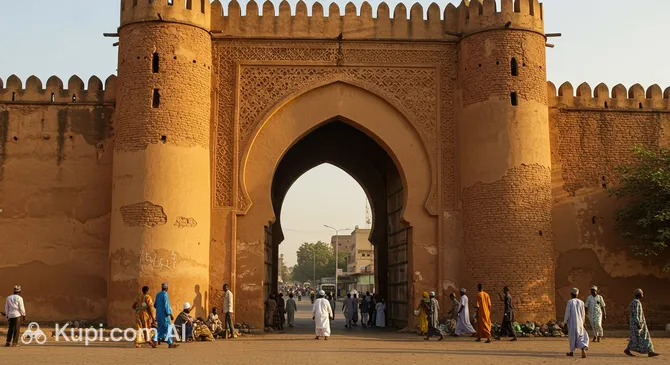
Among the many historical treasures that Nigeria is famous for, the Mazugal Gate (Kofar Mazugal) holds a special place. This majestic site is part of the ancient Kano city walls, which date back to 1118. The gate was built during the reign of Sarki Usman Giji Masu, grandson of the legendary Bagauda, and served as a key element of the defensive system protecting the city from enemy raids.
Mazugal Gate (Kofar Mazugal). Illustration.
Source: Kupi.com AI
Traveler photos:
Today, Kofar Mazugal stands as an impressive example of Hausa engineering. Although the structure has been modernized with concrete over time, it has retained its monumentality and historical significance. These gates are not just an entrance to the old city, but a true symbol of the cultural landscape, closely linked to iconic sites such as the Emir's Palace and the ancient Kurmi Market.
A visit to this landmark allows you to touch an era when the city was a vital commercial hub for the Trans-Saharan trade. The massive forms of the gate and its strategic location on Gwammaja Road clearly demonstrate the skill of local builders and the ancestors' commitment to protecting their home and traditions.
Contacts
To help you plan your visit to this historical site, here is the basic contact information. Although the site is part of the city's public architecture, it has an official address and a contact number.
Once at the Mazugal Gate, the first thing to do is take time to examine its massive structure. Visitors can study the architectural details of this ancient city entrance in depth; despite modern reconstruction, it still retains the spirit of a medieval fortress. It is an excellent spot for atmospheric photos against the backdrop of the grand structures that have become a symbol of Kano's resilience.
A stroll around the gate opens the way into the old city, where travelers can explore a labyrinth of narrow streets and see traditional mud houses built in the Hausa architectural style. Observing the daily bustle of locals passing through the gate allows you to feel the living connection between the past and the present. History buffs will appreciate the scale of the 14-kilometer earthworks that once encircled the entire city.
A visit to Kofar Mazugal is often combined with a tour of other historical gates, such as Kofar Mata, famous for its traditional dye pits. There, you can witness the process of creating indigo cloth using ancient methods. Such a journey through the key points of the city wall offers a full immersion into the cultural heritage and traditions of the region.
Getting There
The historical Mazugal Gate is located on Gwammaja Road in the Kano City district. You can reach this location from the city center by taxi or local transport, following the busy Gwammaja Road. Travelers should keep in mind that the streets in the old city are quite narrow and atmospheric, which adds to the charm but may limit travel speed.
For the most comfortable trip, it is recommended to take a taxi from your hotel or the central districts of Kano. If you prefer using navigation apps, the site is easy to find by its coordinates or name. There are spots near the gate where you can leave a car to continue your exploration on foot.
Many tourists prefer to reach this point as part of a walking tour from other city gates, allowing for a comprehensive study of the ancient city's architectural heritage. While public transport is available in the area, a rented car or taxi is better for a first-time visit.
Nearest city: Kano
History & Facts
The history of the Kano defensive system began in 1112, when the ruler Sarki Giji Masu laid the foundation for the first fortifications. The Mazugal Gate itself was built in 1118, becoming an important link in a massive wall stretching approximately 14 kilometers. These fortifications provided reliable protection for the city's growing population against potential invaders.
During the height of the Trans-Saharan trade, the gates functioned as strategic checkpoints. Trade caravans passed through them, and city authorities carefully monitored the movement of goods and people. The name Kofar Mazugal is associated with an important historical figure of that time, emphasizing the monument's deep connection to the local Habe dynasty.
Over the centuries, the walls were expanded and reinforced, reaching their modern scale by the 16th century. Unlike many other sections of the ancient walls, the Mazugal Gate was modernized with concrete in later periods. This has preserved its functionality and majestic appearance, turning the ancient fortification into a living historical monument integrated into the modern urban landscape.
Time Needed
To inspect the Mazugal Gate, take some memorable photos, and walk around the adjacent neighborhoods of the old city, it usually takes about 1 to 2 hours. This is plenty of time to appreciate the scale of the ancient fortifications and soak in the historical spirit.
If you plan to study the traditional Hausa architecture in the vicinity in detail or visit neighboring gates of the city wall, it is worth setting aside half a day for your walk. This approach will allow you not only to see the landmark but also to observe the authentic rhythm of local life without any rush.
Working Hours
Since the Mazugal Gate is part of the city's infrastructure and a key thoroughfare into the historical district, it is available for viewing 24 hours a day. You can see it in the rays of the morning sun or under evening lighting, which gives the ancient walls a special mystery.
The site is open for visitors daily, from Monday to Sunday. Nevertheless, tourists are advised to plan their visit during daylight hours for better visibility and safety, and to periodically check for information about potential cultural events in the area.
Open 24 hours
Nearby
Exploring the surroundings of Kofar Mazugal allows travelers to dive deeper into the atmosphere of the ancient city. Near the gate, you will find majestic palace complexes and monuments that reflect the rich history of the region.
A walk through the old city will reveal unique examples of Hausa architecture and allow you to observe the daily life of locals surrounded by monuments of the past.