Support

Bergen Airport

About the Airport

Bergen Airport (BGO), also known as Flesland, is not just an air harbour, but a true gateway to the realm of the fjords of Norway. Located on the country's west coast, it welcomes travellers ready to embark on an unforgettable adventure through some of the most picturesque places on the planet. Being the second busiest airport in the country, it combines modern infrastructure with famous Scandinavian hospitality. Every year, its corridors see millions of tourists eager to witness the unique northern nature.
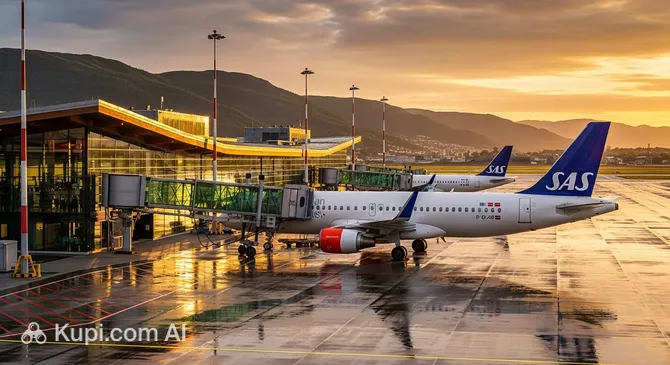
Bergen Airport. Source: Kupi.com Binoculars
IATA Code BGO
ICAO Code ENBR
City Bergen
Distance to centre Approximately 19 km
Status International
Annual Passengers Over 6.3 million (based on 2018 data)
Popular Airlines Scandinavian Airlines, Norwegian Air Shuttle, Widerøe
Schedule "Bergen Airport" online flight board

Bergen Airport is distinguished not only by its strategic location but also by a high level of passenger comfort. A new modern terminal was opened here in 2017, which significantly increased capacity and made the stay at the airport even more pleasant. In addition to serving numerous tourist flights, Flesland Airport plays a key role as a base for helicopter transport to oil platforms in the North Sea. Travellers have access to numerous shops, restaurants, free Wi-Fi, and convenient transport connections to the city centre, including shuttle buses and a light rail system.

Contact Information

Official Website: You will find the most complete and up-to-date information on the official website of the operator Avinor: avinor.no/airport/bergen-airport.

Information Desk Phone: For information by phone, you can call the unified Avinor contact centre at: +47 67 03 00 00.

Airport Address: Flyplassvegen 555, 5258 Bergen, Norway.

Email: A direct email address for general inquiries is not published. It is recommended to use the dedicated contact form on the official airport website for communication.

Social Media: Bergen Airport has official pages on social networks, such as Facebook, where you can follow news, flight status updates, and special announcements.

Lost & Found: If you have lost items on board the aircraft or your luggage has not arrived, you must first contact your airline or its ground handling agent at the airport. Contacts and detailed instructions are available on the airport website in the "Baggage" section.

Passenger Support Services: For most inquiries, including assistance for passengers with reduced mobility, please contact the main information desk phone or use the assistance section on the website.

How to Get to the Airport

Getting from Flesland Airport (BGO) to the centre of Bergen and back can be done in several ways, suitable for any budget and travel style. Transport connections are excellently organised, so you can easily choose the most convenient option for yourself.

Public Transport is a wonderful combination of affordable pricing and the opportunity to see the city's surroundings.

  • Light Rail (Bybanen): The most economical and perhaps the most atmospheric way. Line No. 1 will take you directly from the terminal to the heart of the city in approximately 45 minutes. This is not just a trip, but a small excursion through the picturesque suburbs of Bergen. Tickets can be purchased at Skyss machines at the stop or via the mobile app.
  • Express Bus (Flybussen): A faster option, ideal if you are short on time. The journey to the centre takes 25–30 minutes depending on traffic. The buses are comfortable and equipped with luggage space. To save money, buy tickets online on the carrier's website.

Taxi and Car Rental offer maximum freedom and comfort. A taxi ride to the centre takes about 20–25 minutes, although this is the most expensive method, especially during the evening and night. If you plan a grand journey through the fjords of Norway, renting a car will be the best solution. Offices of all leading rental companies are located at the airport. For those arriving in their own vehicle, short-term and long-term parking zones are available.

Which option to choose? If you are not in a hurry and are travelling light, the light rail will be a great start to your acquaintance with the city. For quick and comfortable trips with luggage, the express bus is more suitable. It is worth noting that although Bergen Airport is the main hub of Western Norway, for trips to some parts of the region, airports in Haugesund or Stord might be convenient.

Terminals and Map

Bergen Airport (BGO) is distinguished by a modern and thoughtful structure, making it very convenient for travellers. In fact, one main terminal operates here for passengers, serving both domestic and international flights. This eliminates confusion and the need to move between different buildings.

The terminal has a simple and logical two-level layout:

  • Ground Floor is the arrival area. Here you will find baggage claim belts, customs control, and exits to the city, where bus stops, taxi stands, and car rental points are located.
  • Upper Level is the departure area. You enter here when arriving at the airport. Airline check-in counters and self-service kiosks are located here, followed by a single security control point.

After passing through security, the passenger flow separates. You enter a general commercial zone with shops and cafés, leading to exits for two different piers: one for domestic flights within Norway, and the other for international flights. Navigation is very clear, with signs in Norwegian and English everywhere, so it is practically impossible to get lost.

Despite the airport not being gigantic, it is worth allocating enough time to complete all formalities. It is recommended to arrive 1.5-2 hours before a domestic flight and 2-2.5 hours before an international one. This will allow you to check in luggage, pass security control calmly, and walk to your boarding gate without rushing.

Airport History

The history of the airport in Bergen, known as Flesland, begins after the Second World War. At that time, it became clear that the existing seaplane base could no longer cope with the region's growing transport needs. The official opening of the new airport took place on October 2, 1955. Interestingly, its construction received significant financial support from NATO, as it was part of a programme to develop key infrastructure on the west coast of Norway.

Bergen Airport. Source: Kupi.com Binoculars

With the development of aviation and the growth of the country's economy, especially after the start of oil and gas extraction in the North Sea, the airport began to expand rapidly. It turned into a key hub for helicopter transport to offshore drilling platforms. The first significant reconstruction was carried out in 1988, when a new terminal was built, which significantly increased passenger flow and improved the level of comfort for travellers.

The most important event in the airport's recent history was the opening of the third terminal in August 2017. This massive project radically transformed the airport, increasing its capacity to 10 million passengers per year. The new terminal features impressive Scandinavian design, thoughtful logistics, and modern technologies. Today, Bergen Airport consistently ranks as the second busiest in the country and is the main transport hub for all of Western Norway.

A curious fact: the airport received its name "Flesland" from the farm on whose lands it was built. The local terrain is quite complex, and to create the runway, engineers had to conduct massive blasting operations to level several hills. At that time, it was one of the most complex engineering projects in Norway.

Services and Amenities

Bergen Airport (BGO) offers passengers modern infrastructure and a full range of services to make waiting for a flight as comfortable and productive as possible. Everything here is thought out to the smallest detail — from dining and shopping to assistance for travellers with special needs.

In the terminal, you will find many cafés and restaurants to suit every taste: from fast food outlets to restaurants where you can enjoy a quiet lunch featuring local and international cuisine. For shopping enthusiasts, stores are open, including a classic Duty Free with a wide selection of perfumes, confectionery, and souvenirs from Norway. Here you can buy a traditional sweater or a troll figurine as a memento of your trip.

Free Wi-Fi is available throughout the airport, allowing you to stay connected or work while waiting for departure. Numerous sockets and USB ports are provided for charging electronic devices. For those who value enhanced comfort, business lounges operate where you can relax in silence, have a snack, and use additional services. Financial matters are easily resolved at bank branches and currency exchange points, as well as via ATMs located in various parts of the terminal.

The airport is well-equipped for passengers with children: there are play areas where young travellers can burn off energy, and nursing rooms for infant care. Travellers with reduced mobility are provided with all necessary assistance — from escorting through the territory to specially equipped restrooms and elevators. It is recommended to notify your airline in advance to receive assistance.

If you have a long layover or an early flight, several comfortable hotels are located in the immediate vicinity of the terminal. For business travellers, the airport offers rental of conference halls and meeting rooms equipped with everything necessary for conducting meetings. Medical assistance can also be obtained at the airport if necessary.

Where to Eat

At Bergen Airport, you won't go hungry, regardless of how much time you have before your flight. There are various establishments here where you can have a quick snack or a substantial lunch. The majority of cafés and restaurants are located in the departure zone (airside), after passing security control, which allows you to enjoy your meal calmly without worrying about screening time. In the public area (landside), the choice is more modest and usually limited to a couple of coffee shops.

For those who want to experience local cuisine, the airport offers an excellent opportunity. Look for dishes featuring Norwegian salmon, such as open sandwiches (smørbrød) or salads, which are excellent options for those seeking Halal-friendly seafood choices. In some establishments, you can find thick fish soup to warm you up in any weather. And for dessert, be sure to try the local celebrity — the cinnamon bun skillingsbolle, which is a culinary symbol of Bergen. It is the perfect complement to a cup of coffee before your flight.

If you have specific dietary preferences, most establishments offer vegetarian and gluten-free dishes — look for the corresponding marks on the menu or simply ask the staff. Vegan options are also becoming increasingly available. Regarding prices, be prepared that they correspond to the general level in Norway. The average bill for a full lunch with a drink starts from 30-40 Euros, while coffee with pastries will cost about 10-15 Euros.

The opening hours of most dining establishments are tied to the flight schedule: they open early in the morning and close after the departure of the last evening planes. For a quick snack, kiosks and coffee shops where you can take a sandwich, yoghurt, or pastry with you are ideal. If you have an hour or so to spare, it is better to settle in one of the restaurants in the departure zone. There you can not only eat deliciously but also relax in a comfortable setting, watching the runway.

Traveller Tips

To ensure your journey through Bergen Airport (BGO) goes as smoothly as possible, make use of these tips. The airport is modern and well-organised, but it can get quite busy during peak hours and the tourist season.

Arrival and Check-in: It is recommended to arrive at the airport at least 2 hours before domestic flights and 2.5-3 hours before international ones. To save time, complete online check-in on your airline's website and, if you are travelling with hand luggage only, head straight to security control. Self-service kiosks for check-in and baggage drop-off also help speed up the process.

Security Control and Seat Selection: At security control, be prepared to present liquids (in containers up to 100 ml, packed in a transparent bag) and remove laptops and other large electronics from your hand luggage. When choosing a seat on the plane, consider that Norway is famous for its landscapes. Ask for a window seat — depending on the route, you may see breathtaking views of fjords, islands, or mountains.

Hand Luggage and Customs: Standard rules for hand luggage apply here: no sharp objects and liquids over 100 ml. When entering the country from outside the Schengen area, you will have to pass through customs control. If you have no goods to declare, feel free to go through the "Green Channel". Remember that strict limits apply to the import of restricted goods such as tobacco products in Norway.

Transfers and Flight Delays: Bergen Airport is quite compact, so transfers usually do not cause difficulties. Follow the "Transfer" signs. In case of a flight delay, up-to-date information is always displayed on the departure boards. Contact your airline representative for details and information about your passenger rights, which include provision of meals or accommodation depending on the wait duration.

Saving Time and Money: The most budget-friendly way to get to the city centre is the Bybanen light rail, a trip on which takes about 45 minutes. Flybussen shuttle buses are slightly faster but more expensive. Prices for food and drinks at the airport, as in all of Norway, are high, so bring an empty water bottle with you — it can be filled with drinking water for free after passing security control.

Reached the end of the page?

That means the route is fully explored