Support

Jasna Góra Monastery

About

Jasna Góra is a majestic Catholic monastery located in the city of Częstochowa, serving as the heart of Poland's spiritual life. The full name of this site is the Sanctuary of Our Lady of Jasna Góra. The monastery belongs to the Pauline Order, who were invited from Hungary by Prince Władysław Opolczyk in 1382. Today, Jasna Góra is not only the country's primary pilgrimage site but also an important historical monument and a symbol of Polish national unity.

The monastery complex is picturesquely situated on a 293-meter-high hill, making it clearly visible from afar. The 106-meter bell tower is particularly prominent, dominating the city skyline and visible from up to 10 kilometers away. The monastery's main shrine is the world-famous icon of Our Lady of Częstochowa, also known as the "Black Madonna." Thousands of pilgrims from all over the world flock to it every year.
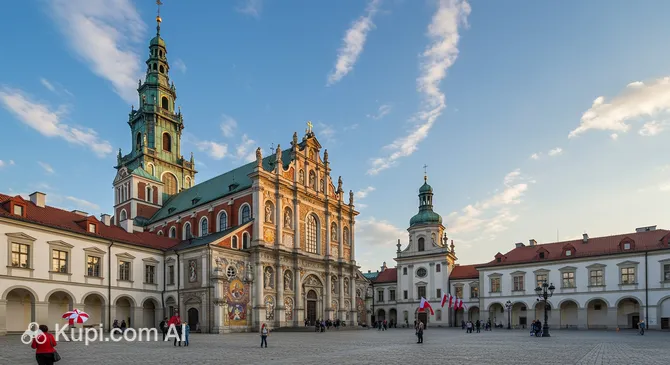
Jasna Góra Monastery. Illustration.
Source: Kupi.com AI

Traveler photos:

In addition to its religious significance, Jasna Góra is an impressive architectural ensemble. The 5-hectare site contains numerous buildings, including the Chapel of Our Lady, where the icon is kept, the Basilica of the Holy Cross and the Nativity of Mary, the Knights' Hall, and the library. In the 17th century, the monastery was enclosed by powerful walls, turning it into a true fortress that played a key role in the country's history. Thanks to its unique cultural and historical heritage, Jasna Góra is a candidate for inclusion in the UNESCO World Heritage list.

Contacts

To plan your visit to the Jasna Góra Monastery, check the schedule, or obtain additional information, you can use the official contact details.

How to contactContact
Addressul. o. A. Kordeckiego 2, 42-225 Częstochowa, Poland
Phone number+48 34 377 77 77
Websitewww.jasnagora.pl

What to Do

The primary activity for visitors to Jasna Góra is undoubtedly encountering its main shrine. Pilgrims and tourists from all over the world arrive here to see the miraculous icon of Our Lady of Częstochowa, also known as the "Black Madonna." This icon, brought by Prince Władysław Opolczyk, is the monastery's focal point. A visit to the Chapel of Our Lady, where the image is kept, allows you not only to connect with an important relic but also to see the historical marks left on it — the scars from saber strikes inflicted by raiders in 1430.

Beyond the spiritual aspect, Jasna Góra offers a wealth of experiences for history and architecture enthusiasts. The entire complex is an impressive fortress surrounded by powerful defensive fortifications built in the 17th century by order of Polish kings. Visitors can walk along the bastions and walls of the "Fortress of Mary," explore the former Arsenal, and imagine how the monastery withstood sieges. It is also worth visiting the Knights' Hall, whose walls are painted with scenes from the monastery's history, and looking into the Treasury, which houses priceless gifts presented to the icon over many centuries.

To complete your experience, do not miss the chance to climb the 106-meter bell tower — the highest point of the complex. After climbing the steps, you will be rewarded with a breathtaking panoramic view of the city of Częstochowa and its picturesque surroundings. This is a wonderful opportunity to appreciate the scale of the monastery and take unforgettable photographs. A visit to Jasna Góra is not just a sightseeing trip, but a multifaceted journey into the heart of Poland's spiritual and historical life.

Getting There

To visit the Jasna Góra Monastery, you first need to reach the city of Częstochowa, located in the southern part of Poland. The city has excellent transport links with major Polish metropolises. The nearest international airport is in Katowice (KTW), about 44 km from Częstochowa, from where you can take a bus or taxi in about an hour. Another major airport is located in Krakow (KRK). Additionally, Częstochowa is easily accessible by train or bus from Warsaw, Krakow, and other cities, making it convenient for travelers.

The monastery itself is situated on a hill and is the city's main landmark, so finding it is quite easy. From the main railway station (Częstochowa Główny) and the bus station, Jasna Góra can be reached in several ways. The distance is only 2–3 kilometers. Many pilgrims and tourists prefer to walk this route along the city's main boulevard — the Avenue of the Blessed Virgin Mary (Aleja Najświętszej Maryi Panny), which leads directly to the foot of the hill.

For those who prefer public transport, city buses run from the stations and will take you to the monastery in just 5–10 minutes. This is the fastest and most economical way to get around the city. Of course, you can always use a taxi, which takes only a few minutes from the city center or the station. Thanks to its status as one of Europe's most important pilgrimage centers, transport accessibility to Jasna Góra is well-organized.

Nearest city: Czestochowa

History & Facts

The history of Jasna Góra dates back to 1382. It was then that the Polish Prince Władysław Opolczyk invited Pauline monks from Hungary to Poland to found a new monastery. A hill near the city of Częstochowa was chosen for the cloister and named "Jasna Góra" (Bright Mountain) after the order's primary church at the time — the Church of St. Lawrence on Jasna Góra in Buda. This act marked the beginning of the centuries-long history of one of Europe's most important spiritual centers.

A key event that determined the fate of the monastery was Prince Władysław Opolczyk's transfer of the miraculous icon of the Virgin Mary from the city of Belz. This event was so significant that it was documented in the ancient manuscript "Translatio Tabulae." A copy of this document, dated 1474, is still carefully preserved in the monastery archives, serving as evidence of the shrine's foundation. With the arrival of the icon, the monastery quickly began to transform into a site of mass pilgrimage.

The 15th century was a time of severe trials for Jasna Góra. On Easter, April 14, 1430, the monastery was attacked by a band of Hussite raiders from Bohemia, Moravia, and Silesia. They not only plundered the cloister but also desecrated the main shrine: the icon was broken into three pieces, and the Virgin's face was slashed with sabers. The restoration of the image was carried out by the finest masters at the court of King Władysław Jagiełło in Krakow. However, despite all efforts, the scars on the Madonna's face mysteriously seeped through the fresh layers of paint, remaining a permanent part of her history.

The challenges did not end there: in 1466, the monastery withstood a siege by the Bohemian army. Contrary to the attackers' expectations, these events only strengthened the fame of the Jasna Góra Monastery. Stories of miraculous salvation and the indelible scars on the icon spread throughout the country, attracting even more pilgrims. This led to the active growth and expansion of the monastery, as well as the construction of a new, more majestic church to house the holy relic.

Time Needed

When planning a visit to the Jasna Góra Monastery, keep in mind that the duration of your stay depends largely on your level of interest in this iconic site. For a general overview, which includes visiting the Chapel of the Miraculous Image of Our Lady of Częstochowa and the main Basilica, 1.5–2 hours is usually sufficient. This provides enough time to feel the spiritual atmosphere and see the main shrines without rushing.

If you wish to explore the entire complex in more detail, it is recommended to set aside half a day (from 3 to 5 hours). During this time, you can not only visit the main churches but also see the exhibitions of several museums on the grounds: the Treasury with its rich collection of votive offerings, the Museum of the 600th Anniversary of the Monastery, and the Arsenal. It is also worth taking a walk along the massive fortress walls that surround the monastery to fully appreciate its historical and defensive significance.

For the most curious travelers, an additional highlight can be climbing the 106-meter bell tower. This takes about 45 minutes, but the reward is a magnificent panoramic view of Częstochowa and the surrounding area. Naturally, if you plan to attend a Mass or other religious services, your stay at the monastery will be significantly longer. Thus, a visit to Jasna Góra can be either a short spiritual stop or a full-day immersive excursion.

Working Hours

The Jasna Góra Monastery in Częstochowa is open to visitors year-round, though the opening hours of individual sites on its grounds may vary. The monastery complex itself is accessible daily from early morning until late evening, typically from 5:30 AM to 9:30 PM. Museums, including the Treasury and the 600th Anniversary Museum, operate on a shorter schedule: in the summer season (March to October) they are open from 9:00 AM to 5:00 PM, and in the winter (November to February) from 9:00 AM to 4:00 PM. It is also worth noting that the monastery's famous tower is only open for climbing during the warmer months, from April to November.

For individual visits and prayer, advance booking is usually not required as entry to the main grounds is free. However, if you plan to join an organized guided tour, it is recommended to book in advance, especially during the peak tourist season. Since Jasna Góra is an active spiritual center in Poland, the schedule of services and access to certain parts of the complex may change during major religious holidays. We strongly advise checking the official monastery website before your visit for the latest information on opening hours and potential special events.

5:30 – 21:30

Nearby

A visit to the Jasna Góra Monastery is undoubtedly a profound and memorable experience. However, to make your trip to Częstochowa even more rewarding, it is worth taking the time to explore other interesting places nearby. A walk through the city will not only allow you to see more but also help you better understand the atmosphere that has formed over centuries around this great spiritual center.

The city offers a variety of leisure options — from cozy restaurants and cafes to unique museums and shopping centers. Exploring the surroundings of Jasna Góra will enrich your impressions and complete the picture of this iconic Polish landmark. Below is a list of nearby attractions that might interest you.

NameDistance
Czekoladowa Nuta0.7 km
Piwiarnia Czestochowa1.4 km
Miedziany Piec – Neapolitan Pizza1.6 km
Krowa Mać Burger's Częstochowa2 km
Museum of Match Production2.1 km
Czestochowa Water Park2.2 km
Galeria Jurajska2.5 km

Have you reached the end of the page?

So the route has been studied inside and out