Support

Monastery of Alcobaça

About

In the heart of Portugal, in the cozy town of Alcobaça, lies one of the country's most majestic architectural treasures — the Monastery of Santa Maria de Alcobaça (Mosteiro de Santa Maria de Alcobaça). This outstanding monument of Gothic art is not only one of Portugal's major assets but also a UNESCO World Heritage site. The monastery impresses with its scale and harmonious austerity, representing the first example of fully Gothic architecture on Portuguese soil.

Founded in 1153 by the first King of Portugal, Afonso Henriques, the monastery was granted to the Cistercian Order and served as a royal pantheon for two centuries. Its history is closely intertwined with the founding of the state itself. Although the cathedral's facade was rebuilt in the Baroque style in the 18th century, the interior retains the impressive simplicity and grandeur of early Gothic, characteristic of Cistercian buildings. The central nave, reaching over 100 meters in length, makes this church the largest in Portugal.
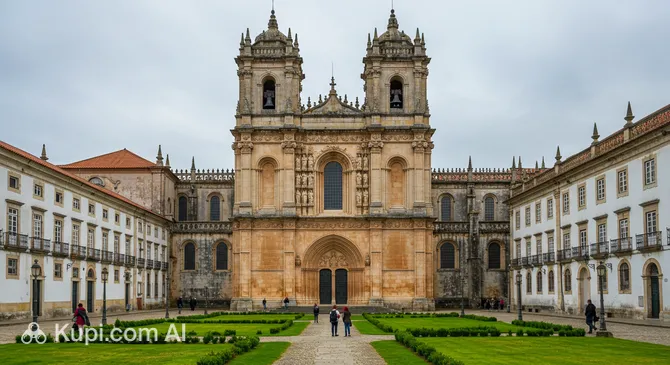
Monastery of Alcobaça. Illustration.
Source: Kupi.com AI

Traveller photos:

Visiting the Alcobaça Monastery is an opportunity to touch centuries-old history, feel the power of medieval architecture, and see the famous tombs of King Pedro I and his beloved Inês de Castro, the protagonists of one of Europe's most tragic love stories. The complex includes not only the church but also several cloisters, a kitchen, and a refectory, allowing for a deeper immersion into the life of the monks who once inhabited these walls. It is a place that leaves a lasting impression due to its monumentality and spiritual atmosphere.

Contacts

To plan your visit and clarify details such as opening hours or visiting conditions, it is recommended to contact the monastery administration directly. All current information can be found on the official website, as well as by phone or email.

How to contactContact
AddressPraça 25 de Abril, 2460-018 Alcobaça, Portugal
Phone+351 262 505 128
Websitewww.mosteiroalcobaca.gov.pt

What to Do

A visit to the Alcobaça Monastery is a true immersion into medieval history. Guests can explore the impressive Gothic interiors, including the main cathedral, the monastic cloisters, the spacious refectory, the kitchen, and the meeting halls. Walking through these spaces, you can enjoy the atmosphere of medieval asceticism typical of the Cistercians and closely examine the architectural details of different eras: from austere Gothic to Baroque and Manueline elements added during subsequent renovations.

Of particular interest to visitors are the tombs of King Pedro I and Inês de Castro — famous figures in Portuguese history. Their tragic love story has become a symbol of eternal devotion, and the sarcophagi, placed opposite each other in the church's transept, are considered masterpieces of medieval sculpture. These are not just tombs, but true works of art, decorated with fine carvings depicting scenes from the lives of saints and the lovers themselves, which you can examine for hours.

The monastery remains active today: it often hosts temporary exhibitions, classical music concerts, and other cultural events. This provides an opportunity not only to learn about history but also to see how the ancient walls become a stage for modern art. Thus, a visit to the monastery in Alcobaça is a multifaceted experience that combines majestic architecture, deep history, and living culture.

Getting There

The Alcobaça Monastery is conveniently located in the center of the town of the same name, about 120 kilometers north of Lisbon. The easiest way to get here from the capital or other major cities in central Portugal is by intercity bus. Operators such as Rede Expressos and FlixBus offer regular services, and the trip takes about two hours. This is a popular and comfortable option for tourists, allowing you to enjoy the country's scenery along the way.

Upon arriving at the Alcobaça bus station, you will be just a few minutes away from your main destination. A walk to the monastery takes no more than 10 minutes on foot, as it is located very close by. The town itself is very compact and cozy, so getting around on foot is a real pleasure.

For those who prefer to travel by car, the trip is also hassle-free. The roads leading to Alcobaça are well-marked, and there are paid parking areas in the immediate vicinity of the monastery where you can leave your car. Additionally, a visit to the monastery can easily be included in a larger itinerary through the historic towns of central Portugal, such as Batalha and Tomar.

Nearest city: Alcobaca

History & Facts

The history of the Alcobaça Monastery is inextricably linked to the birth of Portugal itself. Its foundation in 1153 was the fulfillment of a vow made by the first Portuguese king, Afonso Henriques, which he gave in honor of his victory over the Moors during the conquest of Santarém. The lands were granted to the Cistercian Order, whose monks, known as "white monks," followed the strict Rule of Saint Benedict. Their philosophy focused on asceticism and the rejection of luxury, which was directly reflected in the architecture—majestic yet devoid of excessive ornamentation.

Construction of the stone complex began in 1178, although the monks had arrived in the area much earlier and initially lived in simple wooden structures. The main monastery buildings were completed by 1223, and the consecration of the main cathedral took place in 1253. Over time, the monastery became one of the country's most influential cultural and spiritual centers. It owned vast lands, and its walls housed one of the largest medieval libraries in Portugal, where monks created and transcribed important historical chronicles.

Over the centuries, the appearance of the monastery evolved. During the reign of King Manuel I, in the late 15th and early 16th centuries, the complex was expanded with Manueline style elements. Later, in the 18th century, the facade was significantly rebuilt in the lavish Baroque style, creating an interesting contrast with the austere Gothic interior. Religious life within the walls of Alcobaça ended in 1834 after the dissolution of monastic orders in the country, but its significance as a unique historical and architectural monument was recognized, allowing it to be preserved for future generations.

Time Needed

To explore the Alcobaça Monastery, it is recommended to set aside one and a half to three hours. This will be enough time to leisurely see the main parts of this grand complex, which is a UNESCO World Heritage site. A quick tour, including the church's central nave and the famous tombs, can take about an hour, but to truly feel the atmosphere of this place, it is worth staying longer.

A longer visit of 2–3 hours will allow you to explore not only the cathedral itself but also other important rooms of the monastery in detail. You can walk through the Cloister of Silence (Claustro do Silêncio), look into the Hall of Kings, be impressed by the scale of the old kitchen and refectory, and closely examine the exquisite carvings on the sarcophagi of King Pedro I and his beloved Inês de Castro. If you are passionate about history, architecture, or photography, you may even want to dedicate more time to this site to fully enjoy its grandeur and tranquility.

Working Hours

The Alcobaça Monastery is pleased to welcome guests year-round, but its opening hours depend on the season. During the summer period, from April to September, the complex can be visited from 9:00 AM to 7:00 PM. In the winter season, from October to March, the monastery closes an hour earlier — at 6:00 PM. It is important to remember that the ticket office closes 30 minutes before closing time. The complex is closed on major public holidays: January 1, Easter Sunday, May 1, August 20 (Alcobaça City Day), and December 25.

Special ticket booking for individual tourists is generally not required, but purchasing online can help avoid queues, especially during the peak tourist season. Before your trip, it is always useful to check the monastery's official website to confirm the current schedule, ticket prices, and any temporary changes in operation or scheduled cultural events.

9:00 – 18:00

Nearby

A visit to the majestic monastery is undoubtedly the main event for any visitor to the town of Alcobaça. However, to make your trip truly complete and memorable, it is worth taking time to explore its surroundings. A stroll through the cozy streets, getting to know the local culture, and discovering other sights will allow you to immerse yourself deeper in the atmosphere of this charming corner of Portugal.

Near the monastery, you will find interesting spots to diversify your itinerary. From small gardens and museums to authentic restaurants—everything is within walking distance and helps you get to know the town better. Below is a list of nearby attractions and establishments with their distances from the monastery.

NameDistance
South Wing Café & Bar0.1 km
António Padeiro0.2 km
Garden of Love0.3 km
Alcobaça Wine Museum1.2 km
O Cabeço Restaurant1.8 km
Real Abadia Congress & Spa Hotel2.1 km

Reached the bottom of the page?

Looks like you know this route inside out