Support

Masjid al-Haram

About

Al-Haram Mosque, also known as the Grand Mosque, is the main and largest mosque of the Islamic world, located in the holy city of Mecca in Saudi Arabia. It is the most important shrine, at the heart of which lies the Kaaba—a cubical structure toward which Muslims all over the world turn in prayer. A visit to this mosque is the pinnacle of pilgrimage for millions of believers.
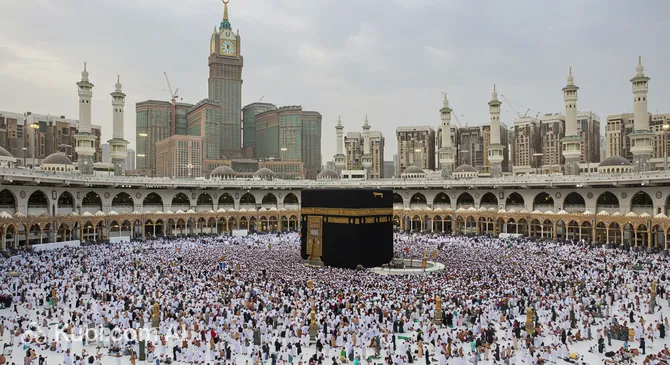
Masjid al-Haram. Illustration.
Source: Kupi.com AI

Traveller photos:

The architectural complex of the mosque is striking in its scale. Its area is about 357,000 square meters, allowing it to accommodate a huge number of believers at once—up to 900,000 people, and up to 4 million during Hajj. The majestic appearance of the mosque is shaped by nine minarets reaching a height of 95 meters and more than 500 elegant marble columns. The complex has numerous entrances for the convenient access of the massive flow of pilgrims.

Despite its centuries-old history, Masjid al-Haram is a modern facility equipped with everything necessary for visitors' comfort. A pleasant temperature is maintained inside thanks to a powerful air conditioning system, and escalators are installed for ease of movement between different levels. It is a unique place where spiritual depth is combined with infrastructure thought out to the smallest detail, creating an unforgettable atmosphere of peace and reverence.

Contacts

All matters related to the Al-Haram Mosque are managed by a special state body—the General Presidency for the Affairs of the Grand Mosque and the Prophet's Mosque. For the most accurate and up-to-date information on visiting rules, pilgrim services, and schedules, it is recommended to contact this agency directly. You can also find answers to frequently asked questions on the official website.

How to contactContact
AddressAl Haram, Makkah 24231, Saudi Arabia

What to Do

The main reason believers come to Mecca is to perform the fundamental rites of Islam within the walls of the Al-Haram Mosque. Here, pilgrims perform the rituals of Hajj and Umrah, as well as participate in daily congregational prayers. The key action is Tawaf—the ritual sevenfold circumambulation of the holy Kaaba. Many strive to touch the Black Stone, which is embedded in one of the corners of the Kaaba, as it is considered a special blessing.

Besides religious rituals, visiting the mosque in Saudi Arabia is an opportunity to experience the unique atmosphere of unity among millions of pilgrims from around the world. While here, you can spend hours observing people and getting to know the unique architecture, which reflects elements of different eras and styles. The grandeur of the marble halls, the elegance of the minarets and domes, and the scale of the entire complex leave a lasting impression on every visitor.

For the convenience of believers, there are separate areas for ablution and prayer on the mosque grounds, divided for men and women. Modern technologies, such as navigation and security systems, help orient visitors in the vast space and ensure order. Even if you are not participating in the main rituals, simply contemplating the communal prayer that unites hundreds of thousands of people becomes a powerful and memorable spiritual experience.

Getting There

Al-Haram Mosque is located in the very heart of Mecca, making it the main point of attraction and easily accessible from any part of the city. For most international travelers, the journey begins at King Abdulaziz International Airport in Jeddah. From there, the holy city can be reached in several ways: by taxi, rental car, or bus. One of the fastest and most modern options is the Haramain High Speed Railway, which will take you from Jeddah to Mecca in about an hour, and from the airport in just 30 minutes.

Upon arrival in Mecca, getting to the Grand Mosque is easy. It is within walking distance of many hotels and central areas, including the famous Abraj Al-Bait complex. Additionally, the city has an extensive public transport network, including 12 bus routes that cover the main districts and lead to the mosque. It is important to remember that during peak periods, especially during Hajj and Ramadan, traffic in the center may be restricted. At these times, it is recommended to plan your route in advance and leave with extra time to avoid delays.

Nearest city: Mecca

History & Facts

The history of the Al-Haram Mosque spans many centuries and began shortly after the birth of the Islamic community. The first structure on this holy site appeared in 638 AD. It was a modest building with an open space for prayer and wooden columns, which was quite different from today's grand complex. This initial design laid the foundation for future expansions and transformations that occurred throughout history.

The first significant reconstruction took place as early as the 7th century. During this period, the wooden columns were replaced with more durable and majestic marble ones, and the inner prayer hall was expanded for the growing number of believers. It was then that the mosque's first minarets appeared, becoming an integral part of its architectural appearance and a symbol of the call to prayer.

Significant changes that brought the mosque closer to its modern look occurred in the 16th century. However, the most extensive modernization was carried out in the late 20th century under the leadership of King Fahd. During this reconstruction, new buildings were erected, a monumental main entrance—the King Fahd Gate—was built, and new minarets were added. In addition, the complex was equipped with modern engineering systems to ensure comfort for the millions of pilgrims who visit the main shrine of the Islamic world in the city of Mecca, Saudi Arabia every year.

Time Needed

Planning how much time to spend visiting the Al-Haram Mosque largely depends on your goals. For a simple visit, including prayer and a general look at the majestic architecture, a few hours may be enough. However, if your goal is to perform a minor pilgrimage (Umrah), which includes the ritual circumambulation around the Kaaba (Tawaf) and walking between the hills of Safa and Marwa, then more time will be required. On average, Umrah can take between two and four hours, but this time varies greatly depending on the number of pilgrims.

Keep in mind that the duration of your stay at the mosque can increase significantly during peak periods, such as the holy month of Ramadan or the days of Hajj. During these times, due to the massive flow of believers, even simple actions, such as the sevenfold circumambulation around the Kaaba, can take much longer than usual. Therefore, if you plan a visit during one of these periods, it is recommended to set aside at least half a day or even a full day for visiting the mosque to complete all necessary rituals without rushing and to soak in the special spiritual atmosphere of this holy place.

Working Hours

One of the main advantages of the Al-Haram Mosque is its round-the-clock accessibility for believers. The shrine is open 24 hours a day, 7 days a week, allowing pilgrims to perform prayers and rituals at any convenient time. This rule applies year-round, so whenever you come to Mecca, the doors of the world's main mosque will be open to you.

For a standard visit and daily prayers in the Grand Mosque, no advance reservation or ticket purchase is required—entry is free for all Muslims. However, it is worth noting that a special permit obtained through official channels is required to perform Hajj. While booking for a simple visit is not necessary, during peak periods, such as Ramadan, additional rules may be introduced to organize the flow of people. For the most up-to-date information on access rules, it is recommended to check official resources, especially before your trip.

Open 24/7

Nearby

Visiting the Al-Haram Mosque is a deep spiritual experience, but exploring its surroundings can further enrich your journey. In close proximity to the main shrine are places inextricably linked with the history of Islam and key events in the life of the Prophet Muhammad. Each of them holds its own unique story, allowing pilgrims and city guests to immerse themselves deeper into the atmosphere of holy Mecca.

A walk through these iconic sites is not just a sightseeing tour, but an opportunity to touch a living heritage. Many of them are within walking distance of the Grand Mosque, making them easily accessible for visits between prayers or after completing the main rituals. Below is a list of nearby attractions that will help you better plan your time.

NameDistance
Zamzam Well0.2 km
Safa and Marwah (Sa'i)0.3 km
Al Salam Gate0.3 km
Abraj Al Bait Towers0.5 km
Clock Tower Restaurant0.6 km
Mecca Museum3.1 km
Cave of Thawr4.4 km

Reached the bottom of the page?

Looks like you know this route inside out