Support

Martin Wickramasinghe Folk Museum traditional transport gallery

About

Immersing yourself in the authentic atmosphere of the southern coast should begin with a visit to the Martin Wickramasinghe Museum of Folk Culture. This unique cultural complex, located in the town of Koggala, is dedicated not only to the life of the "father of modern Sinhalese literature" but also to the rich folk heritage that Sri Lanka is famous for.

The centerpiece of the complex is the Traditional Transport Gallery, which houses an impressive collection of vehicles from a bygone era: from massive wooden bullock carts to elegant horse-drawn carriages and authentic fishing boats. This site is a must-visit for those who want to see the "real" island beyond the tourist glitz.
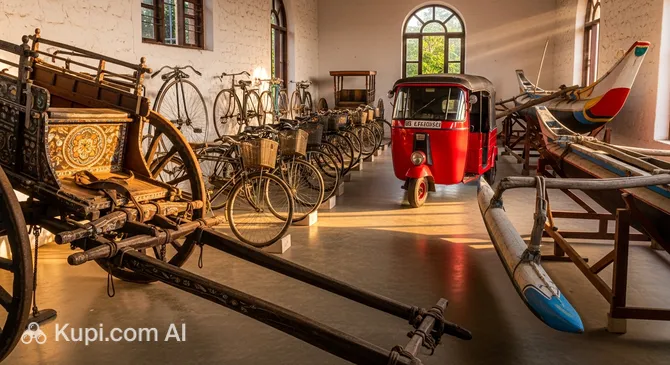
Martin Wickramasinghe Folk Museum – Traditional Transport Gallery
Martin Wickramasinghe Folk Museum – Traditional Transport Gallery. Иллюстрация. Источник: Kupi.com AI

The museum collection includes the writer's restored colonial house with his personal belongings and furniture, as well as extensive exhibits dedicated to agriculture, pottery, and metalworking. Here, you can see rare Buddhist artifacts and everyday household items that have shaped the culture of the Sri Lankan village for centuries. Surrounded by a well-kept tropical garden, the museum provides a rare sense of tranquility and connection to the past.

Contacts

For more information or to organize group tours, you can use the following museum contact details:

How to contactContact
AddressDr Martin Wickramasinghe's Home, Koggala, Шри-Ланка
Phone+94 112 865 543
Websitewww.martinwickramasinghe.info

What to Do

The main reason to visit is the chance to peek into the "Hall of Life," where Martin Wickramasinghe's workspace has been recreated. Here, you can see his antique desk, awards, and rare photographs that help reveal the scale of the author's personality. Ethnography enthusiasts will enjoy exploring the rich collection of traditional masks and costumes used in the ritual dances of southern communities.

Be sure to spend some time in the open-air pavilions. They feature a unique exhibition of agricultural implements and, of course, the collection's main pride — the transport gallery with rare examples of 19th-century bullock carts. It is also interesting to see the authentic clay rice barns (granaries), set on high pillars to protect against pests.

After exploring the exhibits, take a pleasant stroll through the shady garden to the Samadhi — a quiet memorial located in a picturesque spot overlooking the coastal landscapes. In the local bookshop, you can purchase the writer's works in various languages or choose memorable souvenirs reflecting the spirit of Koggala. If you're lucky, you might catch a demonstration of folk crafts, which are held periodically on the grounds.

Getting There

Reaching the cultural center is quite easy, as it is located in Koggala right along the busy Matara Road. If you prefer the railway, the nearest station is Koggala, located on the Coastal Line. Trains run regularly from Colombo towards Matara. From the station to the museum entrance, you can walk in 10–15 minutes or take a colorful tuk-tuk in just a couple of minutes.

For those traveling by bus, any routes following Matara Road are suitable. You should get off at the stop by the Koggala bus depot, from where the museum is a 5–10 minute walk. If you are staying in Galle or Unawatuna, a taxi or tuk-tuk ride will take about 30–45 minutes, offering scenic ocean views along the way.

Travelers from Colombo should expect a 3–4 hour train journey or about 2.5–3 hours by car via the highway. The museum grounds offer convenient parking for private vehicles. It is recommended to plan your trip for the morning or evening hours when the midday heat subsides.

Ближайший город: Koggala

History & Facts

The history of this place is inextricably linked to the name of Martin Wickramasinghe, an outstanding writer born here in 1890. This colonial-style ancestral home was not only his childhood home but also his primary source of inspiration: many of his stories were born beneath these eaves. The building's architecture, with its characteristic whitewashed walls and clay floors, perfectly conveys the spirit of the southern coast in the early 20th century.

The house's fate was at risk during World War II when the area was occupied by the British Royal Air Force (RAF) in 1941. However, the building survived thanks to an Air Force officer who appreciated its beauty and chose it as her residence. It was only in 1962 that the government returned the house to the writer, who by then dreamed of turning it into a center for preserving folk heritage.

After Wickramasinghe's passing in 1976, a special trust was established to manage his legacy. The museum officially opened in 1981. Since then, the exhibition has expanded significantly, growing from a private home into a large-scale cultural complex. Of particular significance is the Samadhi in the garden — a memorial mound where the ashes of the writer and his wife rest, topped with a massive rock brought from the Koggala reef.

Time Needed

To leisurely explore all the galleries and feel the atmosphere of the house-museum, the average visitor will need between 1.5 and 2.5 hours. This is enough time to study the exhibition inside the main building, pay attention to the unique transport collection, and walk through the garden.

It is recommended to allocate time as follows: about an hour for the indoor halls with the writer's personal items and folk artifacts, and another 45 minutes for the outdoor pavilions, the Samadhi memorial, and a visit to the bookshop. If you plan to study the ancient masks in detail or peek at the shores of the lagoon, it's worth allowing a bit more time.

Working Hours

The museum hospitably opens its doors to visitors daily from 09:00 to 17:00. It operates without a lunch break, making it easy to fit a visit into your coastal tour schedule.

Please note that the complex closes for two days in mid-April for the celebration of the Sinhalese and Tamil New Year. It is recommended to check the current schedule on the official museum website before your trip, as changes are possible during public holidays.

09:00–17:00

Nearby

Koggala is famous not only for its literary heritage but also for its picturesque natural spots. A walk around the museum's surroundings will allow you to deeper experience the atmosphere of the southern coast, where quiet lagoons meet the power of the ocean.

NameDistance
Martin Wickramasinghe Folk Museum0.1 km
The Fortress Resort & Spa0.3 km
Surf 'n' Turf0.7 km
Nimal’s Kitchen2.5 km
East Felafel & More2.8 km
Kahanda Kanda3.7 km

Reached the end of the page?

That means the route is fully explored