Support

Dragon and Tiger Pagodas

About

The Dragon and Tiger Pagodas are one of the most iconic and photographed landmarks in the city of Kaohsiung, located in southern Taiwan. This impressive temple complex is situated on the scenic Lotus Pond and consists of two vibrant seven-story towers built in a traditional Chinese style. Each tower is dedicated to its own mythical animal, and together they symbolize harmony, strength, and good luck.
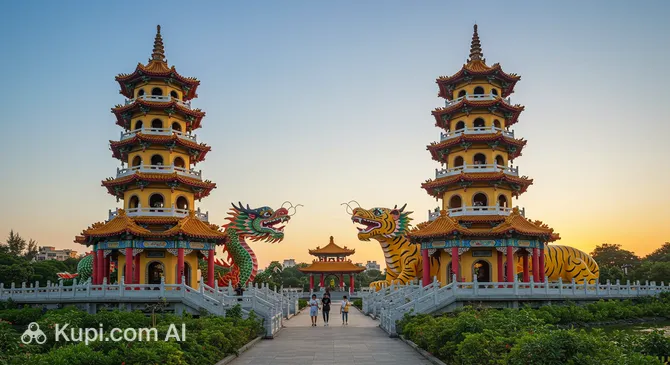
Dragon and Tiger Pagodas. Illustration.
Source: Kupi.com AI

Traveler photos:

The main feature of the pagodas is their entrances, which are shaped like the huge, wide-open mouths of a Dragon and Tiger, reached by a zigzag bridge. There is a popular belief: to attract good luck and rid yourself of misfortune, you must enter through the dragon's mouth and exit through the tiger's mouth. This symbolic ritual turns a visit to the pagodas into more than just sightseeing — it's a real little adventure.

Inside, the towers are decorated with colorful paintings and reliefs depicting scenes from Chinese legends and moral stories. After climbing the spiral staircase to the upper floors, visitors can enjoy panoramic views of Lotus Pond, neighboring temples and pavilions, and the surrounding cityscape. The vibrant architecture and deep cultural symbolism make the Dragon and Tiger Pagodas a must-visit in Kaohsiung.

Contacts

While the Dragon and Tiger Pagodas do not have an official website, you can use the contact details provided on the tourist resources for the city of Kaohsiung to plan your visit. Entry to the complex is free of charge.

Getting to the attraction is easy by public transport: first, take the metro (Red Line) to the Ecological District (R15) station, and then take the Red 35 bus to the Shengli Road stop. The pagodas are just a couple of minutes' walk from the bus stop.

How to contactContact
AddressNo. 9號, Liantan Rd, Zuoying District, Kaohsiung City, Taiwan 813
Phone number+886 7 581 9286
Websitekhh.travel

What to Do

Visiting the Dragon and Tiger Pagodas is not just sightseeing, but participating in a whole ritual. The main thing all guests do is follow the tradition believed to bring good luck: you must enter the complex through the Dragon's mouth and exit through the Tiger's mouth. It is believed that this symbolic route helps cleanse one of misfortune and attract prosperity. This small quest sets the tone for the entire visit and makes it particularly memorable.

Inside, each of the seven-story towers offers its own discoveries. Visitors can climb the spiral staircases to the very top to enjoy the views. On the way up, the walls are decorated with colorful murals and paintings dedicated to Chinese mythology and history. Here, you can see depictions of the twelve magi, the thirty palaces of the Jade Emperor, and scenes from the life of Confucius.

The reward for the climb is impressive panoramic views of Lotus Pond, the surrounding temples and pavilions, and the cityscapes of Kaohsiung. Furthermore, walking along the zigzag bridges leading to the towers is a wonderful opportunity for photos against the backdrop of the vibrant architecture. Many tourists and locals come here towards the evening to admire the picturesque sunset over the water when the complex is beautifully illuminated.

Getting There

Reaching the Dragon and Tiger Pagodas is quite simple, as they are located by Lotus Pond — one of the main tourist areas in Kaohsiung. The primary and most convenient way to get there is via the city metro (Red Line), which will take you almost directly to the attraction.

You need to get off at Zuoying (R16) station. This option is particularly convenient for travelers arriving from other cities in Taiwan, as this same station serves the high-speed trains (HSR). From the metro exit, it's a pleasant 10–15 minute walk to the pagodas. The route runs along the scenic lake, allowing you to immediately soak in the peaceful atmosphere of the area and enjoy the views even before reaching the main entrance.

For ease of travel around the city on public transport, it is recommended to purchase an iPASS or EasyCard. These cards can be bought and topped up at most convenience stores (such as 7-Eleven) and metro stations. They allow for quick payment on the metro and buses, eliminating the need to buy single-use tokens every time. Additionally, you can always take a taxi — drivers know this popular tourist spot well, and a trip from any part of the city won't be an issue.

Nearest city: Kaohsiung

History & Facts

The Dragon and Tiger Pagodas were built in 1976 and quickly became one of the most recognizable symbols of not only Kaohsiung but all of Taiwan. Their construction was part of a major project to landscape the area around Lotus Pond. The architectural style of the pagodas was inspired by the Tang Dynasty era, highlighted by the vibrant colors, roof shapes, and decorative elements. Originally, the project served two purposes: to preserve cultural heritage and to create a powerful tourist magnet, both of which were successfully achieved.

Lotus Pond itself was known and revered long before the pagodas appeared. As far back as the 17th century during the Qing Dynasty, this area, then known as Lingya-Tang, was an important agricultural and cultural center. Gradually, the first temples began to appear around the lake, and in the 1950s, it was significantly expanded and landscaped, turning it into a popular leisure spot. The construction of the Dragon and Tiger Pagodas was the culmination of this area's development, adding a modern and vibrant chapter to its history.

The pagodas are part of an entire ensemble of religious and cultural structures. Nearby are the Spring and Autumn Pavilions, built in 1953 in honor of the god of war, Guan Gong. Another notable attraction is the massive statue of the deity Xuan Wu, as well as Taiwan's largest Confucius Temple, built in the Song Dynasty style. This proximity turns a walk around the lake into a true journey through the region's history and mythology.

Time Needed

When planning a visit to the Dragon and Tiger Pagodas, you should count on approximately 1–1.5 hours. This time is generally sufficient for a thorough and leisurely exploration of the attraction. During this period, you will have time to walk across the famous zigzag bridge, perform the symbolic ritual of entering through the dragon's mouth and exiting through the tiger's mouth, and climb to the top floors of one or both towers to enjoy the panorama and colorful interiors.

Of course, the duration of your visit may vary. If you are into photography and want to capture the pagodas in the best light, especially at sunrise or sunset, it's worth allocating extra time. The recommended visiting time is between one to three hours, which allows for viewing the towers themselves and strolling around the area. The pagodas are part of a larger complex at Lotus Pond, so if you want to visit other neighboring temples, such as the Spring and Autumn Pavilions, it's better to set aside at least 2-3 hours or even half a day for the entire walk.

Working Hours

The Dragon and Tiger Pagodas are open to the public year-round, making them accessible to tourists at any time. The interior of the towers is typically open to visitors daily, approximately from 8:00 AM to 5:30 PM–6:00 PM. However, the exterior of the complex and the area around Lotus Pond can be viewed 24/7. It's important to remember that exact opening hours may vary depending on the season, national holidays, or weather conditions, so it's a good idea to check current information before your visit.

Entry to the pagodas is free, so no advance booking or ticket purchase is required — you can simply show up and enjoy your walk. Given that the attraction has recently reopened after renovation, it is recommended to check the latest details on Kaohsiung tourism websites or at local information centers for a comfortable visit.

8:00 – 17:30

Nearby

Visiting the Dragon and Tiger Pagodas is just one part of an exciting journey around the Lotus Pond area. To truly feel the atmosphere of this place, it's worth spending time in the surrounding areas. Here, within walking distance, you'll find other interesting temples, parks, and entertainment venues that will round out your impression of Kaohsiung.

A walk around the lake is a great way to experience the culture and nature of southern Taiwan on its own. In addition to the famous pagodas, you can find the Spring and Autumn Pavilions, the Confucius Temple, and many other picturesque spots. Exploring these places will allow you to dive deeper into the region's history and make your trip even more fulfilling.

NameDistance
Lotus Wake Park0.4 km
Hanshin Arena Shopping Plaza1.6 km
Many Doors Escape Room Kaohsiung1.7 km
Tan Zuo Ma Li (Kaohsiung Museum of Fine Arts Branch)2 km
Sincere Hotpot Museum2.2 km
Kaohsiung Museum of Fine Arts2.7 km
National Science and Technology Museum5.3 km

Have you reached the end of the page?

So the route has been studied inside and out