Support

Pamukkale

About

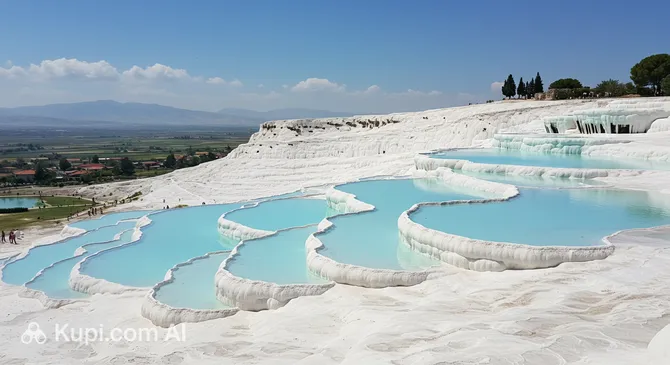
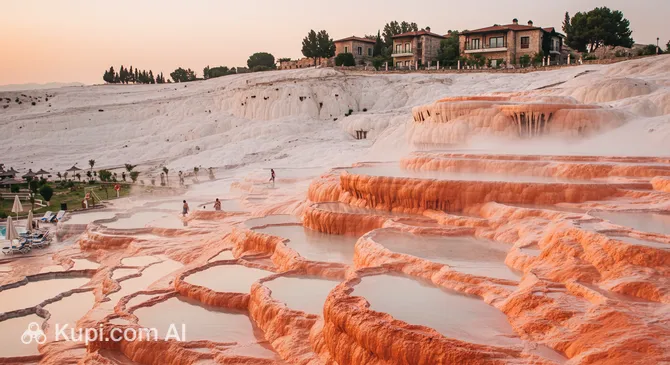
Pamukkale is a truly unique destination that captures the imagination with its ethereal beauty and rich history. It is more than just a settlement; it is a true natural wonder whose name translates from Turkish as "Cotton Castle," perfectly describing its famous snow-white terraces.

Located in southwestern Turkey, in the province of Denizli, Pamukkale attracts travelers from all over the world. The region enjoys a mild climate, making it a pleasant place to visit almost year-round. While Pamukkale itself is a small village, its significance as a tourist destination is immense.

Pamukkale. Illustration.
Source: Kupi.com AI

The crown jewel is undoubtedly the travertine terraces—cascades of limestone deposits formed by thermal springs rich in calcium. These dazzling white formations create a surreal landscape. Atop these terraces lie the ruins of the ancient city of Hierapolis, which are equally impressive: here you can see an ancient theater, a necropolis, Roman baths, and other evidence of past greatness. Another popular attraction is Cleopatra's Pool—a thermal spring where, according to legend, the Egyptian queen herself took baths, and where today you can swim among ancient columns.

A visit to Pamukkale is an opportunity to experience a wonderful blend of natural beauty and ancient history. It is a place that is definitely worth seeing with your own eyes to feel its magical atmosphere and take home unforgettable memories.

You can find more interesting facts on the history of Pamukkale page.

Weather Overview

In Pamukkale, you can expect a climate with distinct seasons: hot and mostly dry summers give way to cool winters with light precipitation. In summer, especially in July and August, the average maximum air temperature can reach 34.9°C, while precipitation in these months is practically non-existent. In winter, for example in January, the average temperature is about 5.1°C (with minimums potentially dropping to 0.5°C), and there is about 2 mm of rainfall spread over roughly 10 days. Spring and autumn months are characterized by milder and more comfortable weather, ideal for sightseeing. For detailed information on monthly weather conditions in Pamukkale, we recommend checking the Pamukkale climate page.

Average monthly temperature

Average monthly precipitation

Interesting Facts

Beyond its world-famous snow-white travertines and the ruins of ancient Hierapolis, Pamukkale holds many amazing secrets. Behind these iconic landmarks lie lesser-known details and stories that make this unique place even more intriguing.

  • Few people know that in the past, the famous Pamukkale travertines were under serious threat. Hotels built directly on the slopes and an uncontrolled flow of tourists led to the pollution and browning of the snow-white terraces. Fortunately, thanks to large-scale restoration work and the demolition of the hotels in the late 20th century, much of their pristine beauty was restored. Now, to preserve the fragile ecosystem, you are only allowed to walk on them barefoot.

  • The ancient city of Hierapolis, which towers over the travertines, was not only a popular ancient resort but also an important religious center. It is believed that one of the twelve apostles, Saint Philip, was martyred and buried here. A Martyrium was erected at the site of his supposed burial, the ruins of which can still be visited today.

  • The famous "Cleopatra's Pool" (Antique Pool), where tourists enjoy swimming among sunken ancient columns, got its name from a beautiful legend. However, it is historically more likely that the columns ended up in the water as a result of a major earthquake in the 7th century AD that destroyed the surrounding portico. The pool itself is a natural thermal spring known since antiquity.

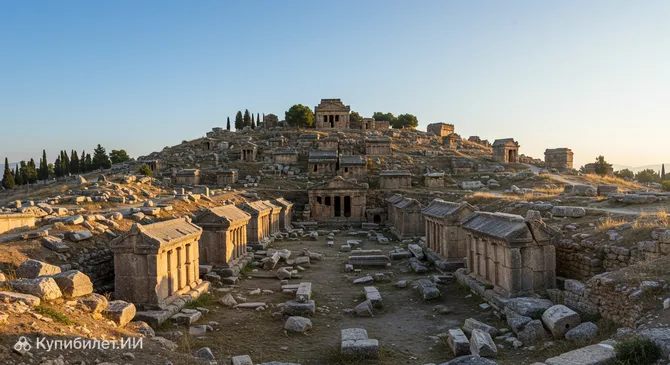
  • The Hierapolis Necropolis is one of the largest and best-preserved ancient cemeteries in Turkey. It stretches for two kilometers and contains more than 1,200 tombs of various types—from simple sarcophagi to impressive family vaults and tumuli (mounds) dating back to the Hellenistic, Roman, and early Byzantine periods.

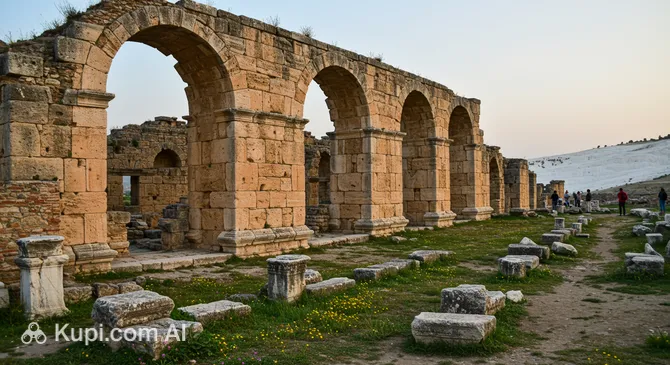
Hierapolis. Illustration.
Source: Kupi.com AI

Traveler photos:

How to Get There

Traveling to the famous travertines requires a bit of planning, as the village itself does not have its own airport or train station. However, the region's transportation system is excellent, and getting here is quite easy. You can find more details on how to get to Pamukkale to choose the best route, and below we look at the main air and land hubs.

The most convenient way to reach the region is to fly into Denizli Çardak Airport (DNZ). This is the closest aviation hub, located about 65 km (or roughly 53 km in a straight line) from Pamukkale. The airport handles domestic flights from Istanbul, making it ideal for connections. The journey from the airport to Pamukkale by special shuttle or taxi takes about 1 hour.

Another popular option, especially for international travelers, is Adnan Menderes Airport (ADB) in Izmir. This is a major international hub receiving flights from all over the world. It is significantly further away, at a distance of about 177 km. The trip from Izmir Airport to Pamukkale by rental car, bus, or train (with a transfer in Denizli) takes 3 to 4 hours, but this route is often chosen due to the higher number of direct flights.

For your convenience, here is summary information on the main airports in the region:

AirportPassenger trafficDistance
Cardak Airport434 85953 km
Isparta Suleyman Demirel Airport76 401110 km
Dalaman Airport5.7 mln136 km
Milas-Bodrum Airport4.4 mln148 km
Zafer Airport43 200160 km

Regarding rail connections, there is no train station in Pamukkale itself, but you can travel to the station in the city of Denizli, which is an important transportation hub. Modern trains from Izmir and Selçuk (Ephesus) arrive here regularly. The Denizli train station is located directly opposite the bus station, from where regular minibuses (dolmuses) depart for Pamukkale. The trip from the station to the travertines by minibus takes only about 20 minutes.

Main Attractions

Pamukkale is a place where nature and history have intertwined to create attractions of global significance. Every corner here is steeped in antiquity and strikes visitors with its unique beauty. Here are several key places you shouldn't miss during your visit to Pamukkale:

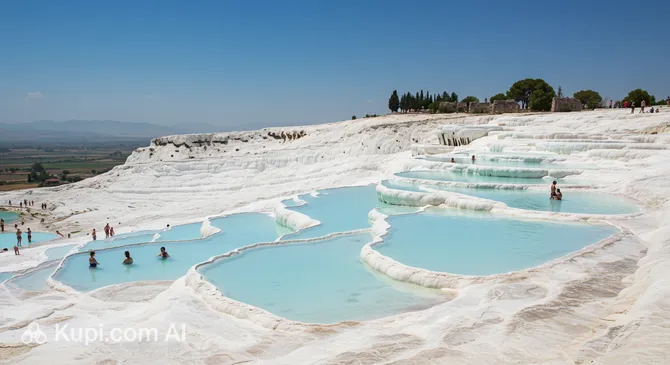
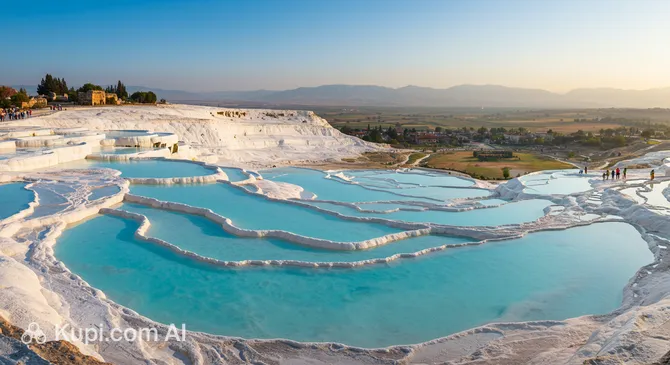
The main reason thousands of tourists come here is, of course, the famous Pamukkale Travertines. Over millennia, these unique geothermal springs have created dazzling white cascades of terraces filled with warm, mineral-rich water. Walking barefoot on these "cotton" slopes, feeling the unusual texture of the travertine under your feet and admiring the alien-like landscapes, leaves unforgettable impressions. This natural wonder is included in the UNESCO World Heritage list.

Pamukkale Travertines. Illustration.
Source: Kupi.com AI

Traveler photos:

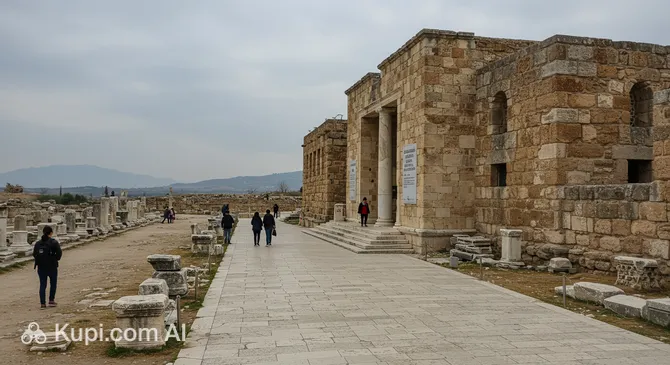
Towering above the snow-white travertines are the ruins of ancient Hierapolis, once a thriving Roman resort and holy city. Founded in the 2nd century BC, Hierapolis was famous for its thermal springs and played an important role in the region. Today, visitors can explore its vast territory, discovering well-preserved streets, temples, city gates, and public buildings that tell a story spanning thousands of years.

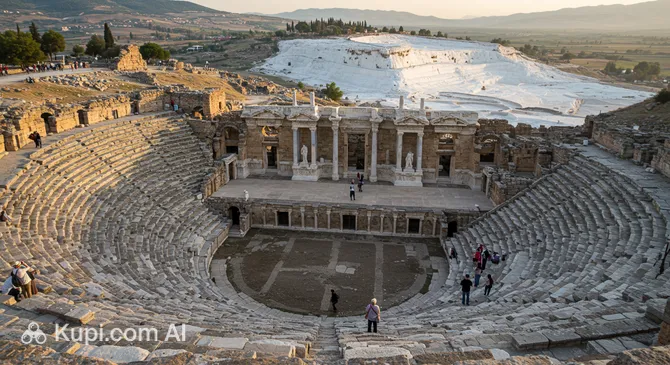
One of the most impressive structures in Hierapolis is the magnificent Antique Theater of Hierapolis. Built in the 2nd century AD during the reign of Emperor Hadrian and later expanded, it could hold up to 15,000 spectators. The theater is remarkably well-preserved, especially its stage (scenae frons) with reliefs and decorative elements. Climbing to the upper rows, you can enjoy not only the view of the ancient arena but also a panorama of the surrounding ruins and travertines.

Hierapolis Ancient Theater. Illustration.
Source: Kupi.com AI

Traveler photos:

Another equally significant landmark is the Necropolis of Hierapolis—one of the largest and best-preserved ancient necropolises in Turkey. It stretches for several kilometers and contains thousands of tombs of various types, from simple sarcophagi to imposing vaults and mausoleums. Exploring the necropolis allows for a deeper understanding of the burial traditions and culture of the inhabitants of ancient Hierapolis.

Necropolis of Hierapolis

For those who want to get a closer look at artifacts found during excavations, the Hierapolis Archaeology Museum is well worth a visit. It is housed in the building of the former Roman baths. Its halls exhibit sculptures, sarcophagi, coins, ceramics, and other items that tell the story of the history and daily life of the ancient city. The museum's collection helps one better imagine the grandeur and cultural wealth of Hierapolis.

Local Cuisine

A gastronomic journey to Pamukkale is an immersion into the rich world of Turkish cuisine, with its vibrant aromas and centuries-old traditions. The local cuisine here, as in all of Turkey, is based on fresh seasonal products, an abundance of vegetables, meat, and fragrant spices. You can expect dishes typical of the Aegean and Anatolian regions, prepared with soul and local flavor.

Traditional Turkish dishes are definitely worth a try. Start with meze—a variety of cold and hot appetizers that are perfect for getting to know the palette of flavors. Among the main courses, various types of kebabs (grilled or spit-roasted meat) stand out for being juicy and aromatic. Don't miss the chance to try gözleme—thin flatbreads with various fillings (cheese, spinach, potato, minced meat), which are often prepared right before your eyes. Also popular are pide—a boat-shaped Turkish "pizza," and various soups, such as lentil soup (mercimek çorbası).

As for drinks in Pamukkale, as throughout Turkey, Turkish tea (çay) is offered everywhere and drunk at any time of day from special tulip-shaped glasses. No less popular is Turkish coffee (Türk kahvesi)—strong and aromatic. To refresh yourself on a hot day, try ayran—a yogurt-based drink. Among alcoholic beverages, it's worth noting the local wine, beer (such as Efes), and of course, rakı—an anise-flavored spirit that is traditionally diluted with water and enjoyed with meze.

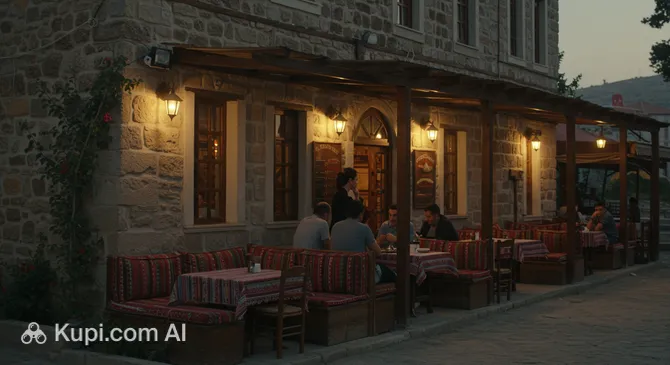
The food culture in Pamukkale caters to both locals and tourists. You will find many restaurants (lokantas and restaurants), cafes, and eateries offering dishes for every taste and budget. Many hotels also have their own restaurants with good cuisine. To try authentic grilled meat dishes, you can stop by, for example, Tıkır Grill House, which serves traditional kebabs and other Turkish specialties. Small family-run establishments where you can enjoy home-cooked meals are also popular.

Tıkır Grill House. Illustration.
Source: Kupi.com AI

Traveler photos:

Pamukkale's culinary scene offers a pleasant addition to exploring its natural and historical wonders. Here, you can not only enjoy the taste of real Turkish food but also experience the famous Turkish hospitality. Simple yet hearty and aromatic dishes prepared with fresh local ingredients will undoubtedly leave warm memories of your trip.

Travel Tips

Planning a trip to amazing Pamukkale? To ensure your journey to Turkey's "Cotton Castle" is as comfortable as possible and leaves only pleasant memories, we have prepared some practical tips. These recommendations will help you better prepare and enjoy every moment in this unique place.

  1. Clothing and Essentials:

    The climate in Pamukkale is Mediterranean, with hot summers and mild winters. In summer (June-August), bring light, breathable clothing made from natural fabrics, a hat, sunglasses, and sunscreen with high SPF. In spring and autumn, the weather is comfortable, but evenings can be cool—a light jacket or sweater will come in handy. In winter, temperatures can drop, so you'll need warmer clothes. A key point is comfortable shoes for walking through the ancient ruins of Hierapolis. No shoes are needed for walking on the travertines (you walk on them barefoot), but bring a bag or backpack to store them in. Don't forget a swimsuit for visiting the thermal pools, like Cleopatra's Pool. Electrical outlets in Turkey are type F, so check if you need an adapter.

  2. Transport in Pamukkale and Surroundings:

    The village of Pamukkale itself is small, and the main attractions—the travertines and the ruins of Hierapolis—are easily reached on foot. For travel between Pamukkale and the nearest large city, Denizli (where the bus and train stations are located), it's convenient to use dolmuses (minibuses) or taxis. If you plan to explore the area more widely, you might consider renting a car in Denizli. However, for exploring Pamukkale itself, public transport or taxis are quite sufficient.

  3. Finances: Currency, Cards, and Tipping:

    The official currency of Turkey is the Turkish Lira (TRY). You can exchange currency at banks or exchange offices (döviz bürosu) in Denizli; in Pamukkale itself, the rate may be less favorable. Credit and debit cards (Visa, Mastercard) are accepted in most hotels, restaurants, and larger shops. However, it is always useful to have some cash on hand for small purchases, dolmus fares, or at markets. ATMs are available. A rough daily budget (excluding accommodation) could be from 50-70 euros per person, depending on your preferences. Tipping is welcomed in Turkey: in restaurants, it's customary to leave about 10% of the bill if service is not included; you can also leave a small amount for hotel housekeepers or porters.

  4. Health and Safety:

    Pamukkale is generally a safe place for tourists. Observe standard precautions: watch your belongings, especially in crowded areas. Pharmacies (eczane) are available in the village, but for a wider selection of medicines or specialized medical care, it is better to go to Denizli. Be sure to get travel health insurance before your trip. In summer, drink enough water to avoid dehydration and be careful on wet and slippery sections of the travertines.

  5. Communication and Internet:

    The official language is Turkish. In Pamukkale's tourist zones, many hotel, restaurant, and shop employees speak basic English. Learning a few simple phrases in Turkish, such as "Merhaba" (Hello), "Teşekkür ederim" (Thank you), and "Lütfen" (Please), will be helpful and appreciated by locals. Wi-Fi is available in most hotels and many cafes. For constant internet access, you can buy a local SIM card (e.g., Turkcell, Vodafone, Türk Telekom) at the airport or in Denizli.

  6. Local Etiquette and Interaction:

    Turkish people are known for their hospitality. A simple greeting and a smile are always appropriate. When visiting shops or markets, don't be surprised if you are offered tea—it's a sign of hospitality. Haggling at markets and souvenir shops is common, but do it politely and with a smile. In public places, try to behave respectfully. Although Pamukkale is a tourist spot, when visiting more conservative areas or mosques (should you find any in the surroundings), women are recommended to cover their shoulders and knees.

  7. What to Avoid:

    The most important rule when visiting the travertines is that it is strictly forbidden to walk on them in shoes. This is to preserve their unique white color and fragile structure. You can only move on the terraces barefoot. Also, try not to photograph locals without their prior permission, especially regarding women or religious ceremonies.

  8. Extra Tip – Best Time to Visit:

    To fully enjoy the beauty of the travertines and avoid large crowds and summer heat, try to visit early in the morning or closer to sunset. At these times, the light for photos will be at its softest and most beautiful, and the experience will be more peaceful. Note that in the morning, the water in the shallow pools on the travertines can be quite cool.

We hope these tips help you plan an unforgettable trip to Pamukkale! This place is truly unique, and we are sure it will give you plenty of bright emotions and impressions.

Entertainment & Nightlife

Pamukkale, known for its natural wonders and ancient history, offers its guests a calm and relaxing evening atmosphere rather than the vibrant nightlife of large metropolises. After a busy day spent on the travertines and among the ruins of Hierapolis, the evenings here are conducive to tranquility and pleasant conversation.

Most evening activity in Pamukkale is centered around hotels and small restaurants located along the village's main street. There are no noisy nightclubs or neon-lit districts here. Instead, you will find cozy bars and restaurants where you can enjoy dinner outdoors, have a glass of local wine, or traditional Turkish tea. The atmosphere is usually very laid-back and perfect for conversation. Many establishments stay open until late evening, especially during the tourist season. The dress code is generally casual—comfortable everyday clothes are perfectly appropriate.

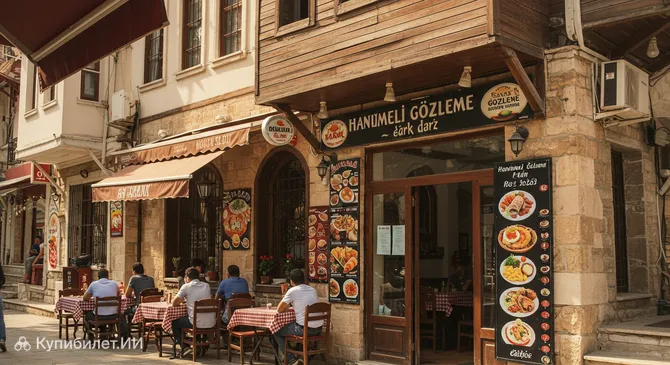
Among the places where you can spend an evening, Hanımeli Gözleme is worth noting, famous for its traditional gözleme pancakes, where you can also enjoy refreshing drinks in a pleasant setting. For a dinner that transitions into a quiet evening, restaurants like Tıkır Grill House, which serves Turkish cuisine, are suitable. Prices in Pamukkale's establishments are generally moderate. It's best to arrive after sunset when the daytime heat subsides.

Hanımeli Gözleme

Regarding safety, Pamukkale is a small and very peaceful village, so night walks are generally safe. It is easy to get around the village on foot. If your hotel is a bit further away, you can always use a taxi, which is available in the evenings as well.

While nightlife is not Pamukkale's main draw, there is plenty to do during the day besides visiting the travertines. Visit the Hierapolis Archaeology Museum to dive deeper into the region's history, or explore the numerous ruins of the ancient city, such as the Antique Theater of Hierapolis. Pamukkale Natural Park itself offers magnificent views and walking opportunities. These daytime activities will perfectly round out your impression of this unique corner of Turkey.

Hierapolis Archaeological Museum. Illustration.
Source: Kupi.com AI

Traveler photos:

Parks & Museums

Pamukkale is not only about world-famous snow-white travertines; it is also a place with a rich cultural heritage and unique natural zones that deserve the attention of every traveler. Here, history comes to life in ancient ruins, while nature provides tranquility and stunning views.

Among the green zones and natural wonders of Pamukkale, the Pamukkale Natural Park stands out. This vast territory encompasses not only the famous travertine terraces but also the ancient city of Hierapolis. The park offers visitors the chance to enjoy scenic walks, discovering the unique geology and flora of the region. It's a great place to admire panoramic views and take a break from the hustle and bustle of the main tourist routes. The Pamukkale Travertines themselves, being a geological phenomenon, also represent an extensive natural area, where a walk (always barefoot!) offers unforgettable sensations. Nearby, in Karahayıt, you will find the Karahayıt Thermal Springs, known for their reddish deposits due to the high iron content in the water, creating an interesting contrast with the whiteness of Pamukkale.

Pamukkale Natural Park. Illustration.
Source: Kupi.com AI

Traveler photos:

Pamukkale's cultural heritage is no less impressive. The ancient city of Hierapolis, majestically sprawling on top of the travertines, is essentially a huge open-air museum. Exploring its ruins, you immerse yourself in the atmosphere of an ancient resort. To get a closer look at the finds made in Hierapolis, it's worth visiting the Hierapolis Archaeology Museum. It is located in the building of the former Roman baths and houses a collection of statues, sarcophagi, and other artifacts that tell the city's rich history.

Hierapolis. Illustration.
Source: Kupi.com AI

Traveler photos:

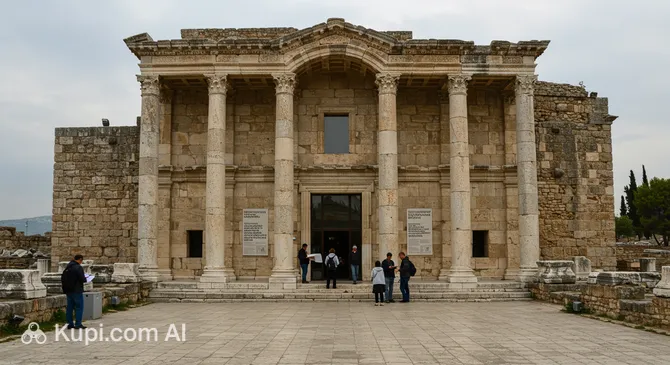
Individual structures within the historical complex of Hierapolis hold a special place. The impressive Hierapolis Necropolis, one of the largest in Turkey, is striking for its variety of tombs and mausoleums. The magnificently preserved Antique Theater of Hierapolis still impresses with its size and acoustics. Also of interest are the ruins of the Hierapolis Basilica, which bear witness to the early Christian period in the city's history.

Hierapolis Basilica. Illustration.
Source: Kupi.com AI

Traveler photos:

Karahayit Thermal Springs. Illustration.
Source: Kupi.com AI

Traveler photos:

Tip for the curious: to feel the authentic spirit of ancient Hierapolis, turn off the main tourist paths and explore the more remote parts of the necropolis. And a walk along the lesser-known trails of Pamukkale Natural Park, especially at sunrise or sunset, will offer you solitude and stunning views of the travertines in soft light.

Getting Around

Getting around Pamukkale itself is quite simple, as the village is small, and the main attractions, such as the famous travertines and the entrance to the ancient city of Hierapolis, are easily reachable on foot from most hotels. However, for trips to the nearby city of Denizli or for more comfortable movement across the vast territory of the archaeological complex, there are some things to keep in mind.

The main form of public transport connecting Pamukkale with Denizli (where the main bus station and train station are located) are dolmuses. These are small minibuses that run quite frequently throughout the day, especially during the tourist season. Fare is paid in cash (Turkish Lira) directly to the driver upon boarding. The cost is usually low. Dolmuses are easy to find—they depart from the center of Pamukkale and from the Denizli bus terminal. Schedules are generally flexible, and the minibuses depart when full.

As an alternative to dolmuses, taxis are always available. They are convenient for faster and more direct trips, especially if you have a lot of luggage or are traveling in a group. However, the cost of a taxi ride will be significantly higher than a dolmus. If you plan to actively explore the surroundings of Pamukkale and the Denizli region, you might consider renting a car. Rental agencies are available both at Denizli Çardak Airport and in Denizli itself. Bicycle rentals in Pamukkale are not very common as a means of transport to the main attractions.

Directly on the territory of the vast Hierapolis archaeological complex, you will mostly have to get around on foot. Keep in mind that the distances between sites (for example, from the entrance to the Antique Theater or the Necropolis) can be significant. Occasionally, paid shuttles or golf carts may be offered on the complex's grounds to cover long distances, especially for visitors with limited mobility. A vital rule: on the travertine terraces themselves, you are permitted to walk exclusively barefoot to preserve their unique whiteness. You will have to take your shoes off and carry them with you.

Accommodation

In Pamukkale, tourists will find a variety of accommodation options to suit different preferences and budgets. Choices range from budget guesthouses and pensions (pansiyon) to comfortable mid-range hotels and more prestigious thermal resort hotels. Apartments are also available for those who prefer more independence during their stay.

Most accommodation options are concentrated within the village of Pamukkale itself, providing easy walking access to the famous travertines and the entrance to ancient Hierapolis. This is especially convenient for those who want to be in the heart of the action and have quick access to the main sights. Another popular area to stay is the neighboring village of Karahayıt, known for its red-water thermal springs and offering many hotels with therapeutic treatments and spa services. The choice of area depends on your priorities: proximity to Pamukkale's main attractions or a desire to enjoy the specific thermal resorts of Karahayıt.

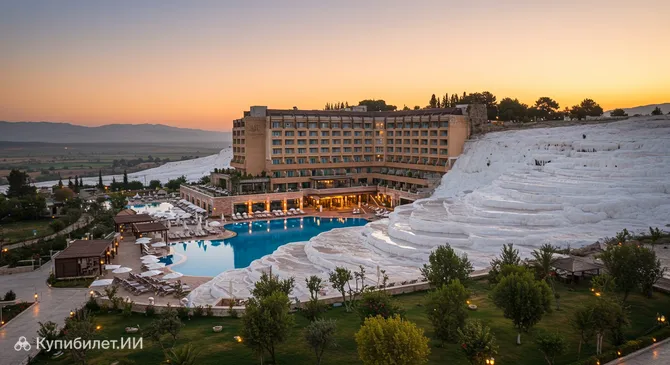
Among the hotels offering a comfortable stay, one can mention, for example, Anya Resort Hotel, located in Pamukkale and offering modern amenities. For those seeking a stay focused on thermal treatments, hotels in the Karahayıt Thermal Springs area can be an interesting option, as they often include access to healing waters and spa complexes. Many hotels in Pamukkale and Karahayıt offer their guests swimming pools, restaurants with local and international cuisine, and other amenities for a pleasant and relaxing holiday.

Anya Resort Hotel

Accommodation prices in Pamukkale range from affordable in small pensions to higher in full-service resort hotels. During the peak tourist season (usually from spring to autumn, especially in the summer months), it is recommended to book accommodation in advance to ensure the best choice and most favorable prices. Reservations can easily be made through popular international online platforms or directly on official hotel websites. Some small family-run pensions may also accept bookings by phone or email.

Nearby Cities

For those who want to explore the surrounding area, Pamukkale serves as an excellent starting point for day trips to several interesting nearby locations:

For example, just 15 km away is Denizli, the administrative center of the province, a large modern city with developed infrastructure, shops, and opportunities to get to know the urban life of the region. It's also worth paying attention to Acıpayam (about 58 km), which offers a glimpse into the life of a typical Turkish town in this region, and Alaşehir (ancient Philadelphia, about 72 km), which will interest history buffs thanks to its ancient heritage. Below is more detailed information on some nearby cities:

CityPopulationDistance
Denizli1 027 78215 km
Saraykoy30 76817 km
Buldan27 24129 km
Çal19 25931 km
Buharkent12 68833 km

These nearby destinations provide an insight into the diverse culture and landscapes of the region.

Shopping & Souvenirs

Shopping in Pamukkale is primarily an opportunity to purchase memorable souvenirs and goods related to this unique natural and historical site in Turkey. The town is not a major shopping center in the traditional sense, like Istanbul or Antalya, and you won't find large shopping malls or designer boutiques here. The main selection is geared toward tourists, with primary items being handmade goods, textiles, and souvenirs that reflect the local character.

Main shopping spots in Pamukkale are concentrated along the main street leading to the entrances of the travertines and the ancient city of Hierapolis. Numerous small shops, stalls, and kiosks are located here. These are not classic shopping districts with a wide choice of brands, but rather tourist streets where you can take a leisurely stroll and pick out something as a keepsake. For more serious shopping and to visit large malls, it's better to head to the nearest major city, Denizli.

As mentioned, there are no large shopping malls directly in Pamukkale. All trade is conducted in small private shops and souvenir stalls. If you are looking for malls with well-known international and Turkish brands, you will need to go to Denizli, which is about 20 kilometers away.

As for markets, there are no large traditional bazaars in Pamukkale like those found in other Turkish cities. However, along tourist routes and at the entrances to attractions, there are often rows of souvenir products that can be considered a kind of mini-market. Here you can find various trinkets and gifts.

Among the typical souvenirs worth bringing back from Pamukkale are:

  • Onyx products: this stone is mined in the region and used to make various figurines, vases, and ashtrays.
  • Textiles: famous Turkish textiles, especially towels, robes, and tablecloths made from cotton produced in Denizli province.
  • Ceramics: painted plates, cups, and vases in traditional Turkish style.
  • Souvenirs depicting the travertines and Hierapolis: magnets, postcards, and miniature replicas of the landmarks.
  • "Evil Eye" (Nazar Boncuk): a popular Turkish amulet against the evil eye.
  • Local sweets: Turkish delight (lokum), baklava, and halva.
  • Natural soap and cosmetics based on olive oil or thermal waters.
Remember that in small markets and souvenir shops, it is customary to haggle—it's part of the local culture.

Shops in Pamukkale, especially those catering to tourists, usually operate daily, including weekends. Working hours may vary, but they are generally open from morning (around 9:00-10:00) until late evening (until 21:00-22:00), especially during the peak tourist season. Cash in Turkish Lira (TRY) is widely accepted for payment. In some larger shops and hotels, credit cards (Visa, Mastercard) may be accepted, but in small stalls, it's better to rely on cash. ATMs for withdrawing cash are available in the village.

Regarding Tax Free (VAT refund), this system operates in Turkey for foreign tourists. If you make large purchases in shops participating in the Tax Free system (they usually have a corresponding sticker), you can request a special refund check upon leaving the country. However, given the nature of shopping in Pamukkale, where souvenirs and relatively inexpensive goods prevail, you might not always be able to use this option, as there is usually a minimum purchase amount required for Tax Free processing.
Nearby cities

Reached the end of the page?

That means the route is fully explored