Support

Pamukkale Travertines

About

The Pamukkale Travertines are one of the most recognizable and striking natural wonders of Turkey. This unique natural complex is located in the Denizli province in the southwest of the country. The name "Pamukkale" literally translates as "Cotton Castle", and this name perfectly describes the dazzling white terraces that from afar resemble endless cotton fields or snow-covered slopes.
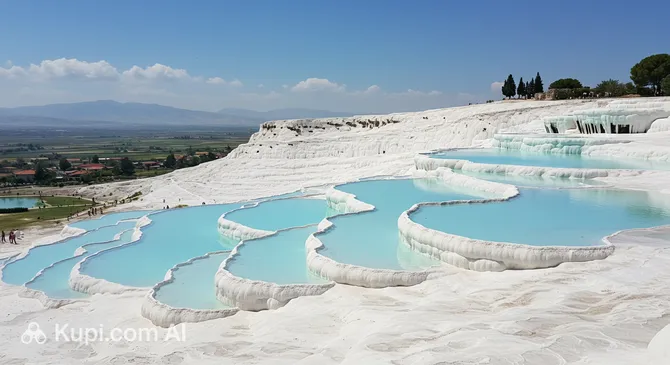
Pamukkale Travertines. Illustration.
Source: Kupi.com AI

Traveler photos:

These stunning landscapes have been forming over millennia. Hot thermal waters saturated with calcium rose to the surface and, evaporating under the sun, left behind deposits of snow-white calcite. This is how the cascades of multi-level basin pools were created, filled with mineral water ranging in temperature from 35 to 100°C. This geological phenomenon makes the city of Pamukkale a world-famous resort.

Today, the Pamukkale Travertines are not just a picturesque spot but also a UNESCO World Heritage site along with the ruins of the ancient city of Hierapolis. The complex attracts travelers from all over the world who wish to see these crystallized cascades with their own eyes and walk through the shallow natural pools. It is truly an unforgettable sight, demonstrating the amazing power and beauty of nature.

Contacts

To plan your visit to the Pamukkale Travertines, it is recommended to use official contact details. The best way to find up-to-date information regarding opening hours, ticket prices, and visiting rules is on the official website of the Hierapolis archaeological site, of which the travertines are a part. Below are the main contact details for communication.

How to contactContact
AddressMerkez, Pamukkale, 20190 Pamukkale/Denizli, Türkiye
Phone number+90 4446893
Websitewww.kulturportali.gov.tr

What to Do

A visit to the Pamukkale Travertines offers a unique experience that combines natural beauty and historical heritage. The main activity here is walking along specially designated paths right on the snow-white terraces. Visitors must take off their shoes to avoid damaging the fragile calcite deposits and can walk barefoot through shallow pools filled with warm mineral water. From here, stunning views of the Çürüksu River valley open up, and the turquoise water against the white cascades creates perfect conditions for unforgettable photos.

The famous Cleopatra's Pool deserves special attention — a thermal spring where, according to legend, the Egyptian queen herself took rejuvenating baths. Here you can swim in warm, carbonated mineral water (+35-36°C) among submerged ancient columns and ruins left after an earthquake. This is a rare opportunity to literally touch history while enjoying the healing properties of water rich in beneficial minerals.

Additionally, the Pamukkale Travertines are inextricably linked to the ruins of the ancient city of Hierapolis, located on the plateau summit. After a walk on the terraces, tourists can explore well-preserved monuments of antiquity. Among them are a majestic Roman amphitheater with a capacity for 12,000 spectators, one of the largest necropolises in Turkey with various tombs and sarcophagi, as well as the ruins of temples and city gates. A visit to Hierapolis complements the experience of the natural wonder with historical immersion.

Getting There

Reaching the Pamukkale Travertines is quite easy, as the main starting point for the trip is the city of Denizli, located just 18-20 km away. Denizli is a major transport hub connected by bus and rail to the main cities of Turkey. Dolmuş (minibuses) and small buses depart regularly from the Denizli Bus Station (Denizli Otogar) to Pamukkale. The trip takes about 30–40 minutes and is the most convenient and budget-friendly way to reach this natural wonder.

If you plan to arrive by plane, the nearest airport to the attraction is Çardak (DNZ), located in Denizli. You can get from the airport to Pamukkale in several ways: by taxi, via a pre-booked transfer, or by special shuttle buses that often wait for passengers after flight arrivals. The journey from the airport to the resort area takes about one hour.

For tourists staying at popular resorts on the Aegean and Mediterranean coasts, such as Antalya, Marmaris, or Bodrum, the easiest option is to purchase an organized excursion. Tour companies offer numerous one-day and two-day tours to Pamukkale, which typically include comfortable transfers, a guide, and visits to all the key sites, saving you the hassle of planning the route yourself.

Nearest city: Pamukkale

History & Facts

The history of the Pamukkale Travertines goes back centuries and is no less impressive than their appearance. Geothermal activity in this region of Turkey has been ongoing for about 600,000 years. Scientists estimate that the formation of the unique snow-white terraces began between 24,000 and 400,000 years ago. The age of these remarkable carbonate deposits has been confirmed using modern uranium-thorium dating, proving their ancient origin.

However, the fame of Pamukkale as a healing resort has not only geological but also deep historical roots. This place was popular as far back as antiquity. The ancient Greeks, and later the Romans, came to these thermal springs to treat various ailments and relax. The fame of the local waters' healing properties spread throughout the Roman Empire, turning Pamukkale into one of the first spa resorts in human history.

An inseparable part of the travertines' history is the ancient city of Hierapolis, whose majestic ruins rise directly above the snow-white cascades. Founded in the 2nd century BC, Hierapolis was a major religious and healing center of the ancient world. Its architectural monuments, including the amphitheater, necropolis, and temples, are well-preserved today. Nowadays, Hierapolis, along with the Pamukkale Travertines, is listed as a UNESCO World Heritage site, representing a unique combination of a natural wonder and cultural heritage.

Time Needed

To fully enjoy all the wonders of the Pamukkale Travertines, it is recommended to set aside 4 to 6 hours for your visit. This will be enough time to explore all the main attractions of the complex without rushing. If you are short on time, you can manage in 2-3 hours, but you will have to choose what to prioritize, and the experience will be incomplete. Many organized tours allocate about 4-5 hours for the entire complex.

The optimal time distribution is as follows: a walk along the snow-white travertines themselves, where you must walk barefoot, will take approximately 1–1.5 hours. This allows you to take stunning photos and feel the warm mineral water. If you plan to swim in the famous Cleopatra's Pool, add at least another hour, considering changing and relaxing in the healing water.

The remaining 2–3 hours should be dedicated to exploring the ruins of the ancient city of Hierapolis, located on the summit of the plateau. The territory of the ancient city is quite extensive and includes an impressive amphitheater, a large necropolis, and the ruins of temples. Therefore, to fully immerse yourself in the atmosphere of this unique place, which combines a natural wonder and the rich historical heritage of Turkey, it is best to plan at least half a day for your visit to Pamukkale.

Working Hours

The Pamukkale Travertines natural complex is open to visitors year-round, but opening hours vary by season. During the summer period (usually from April to October), the site is open from 06:30 to 20:00, allowing tourists to enjoy a walk on the white terraces in the rays of the rising or setting sun. In winter (from November to March), the schedule is shorter, and you can visit the attraction from 08:00 to 17:00.

Advance ticket booking for entry to the complex is generally not required; they can be purchased at the ticket offices at the entrance on the day of the visit. Nevertheless, it is highly recommended to check the current schedule on official resources before your trip, as it may change. It is worth noting that the entrance ticket to the travertines and the ancient city of Hierapolis is combined, but a separate ticket is required for swimming in the famous Cleopatra's Pool.

8:00 – 21:00

Nearby

Visiting the Pamukkale Travertines is, without a doubt, the main highlight for any traveler arriving in Pamukkale. However, to make your trip even more fulfilling and complete, it is worth paying attention to other attractions located in the immediate vicinity. Exploring the surroundings will allow you to dive deeper into the history and culture of this amazing corner of Turkey.

There are many interesting sites near the white terraces: from ancient ruins to picturesque parks and cozy restaurants. Most of them are located within walking distance, making their exploration a convenient and pleasant addition to the main excursion.

NameDistance
Hierapolis0.1 km
Hierapolis Archaeological Museum0.1 km
Hierapolis Ancient Theater0.6 km
Pamukkale South Gate0.7 km
Pamukkale Natural Park0.7 km
Yagmur Bar & Cig Kofte0.8 km
Hanımeli Gözleme0.8 km

Have you reached the end of the page?

So the route has been studied inside and out