Support

Pamukkale South Gate

About

The South Gate of Pamukkale is an impressive historical landmark that greets travelers at the entrance to the ancient city of Hierapolis, located right next to the famous white terraces of Pamukkale in Turkey. This majestic gate stands as a silent witness to the region's rich history and invites you to step into the atmosphere of antiquity.
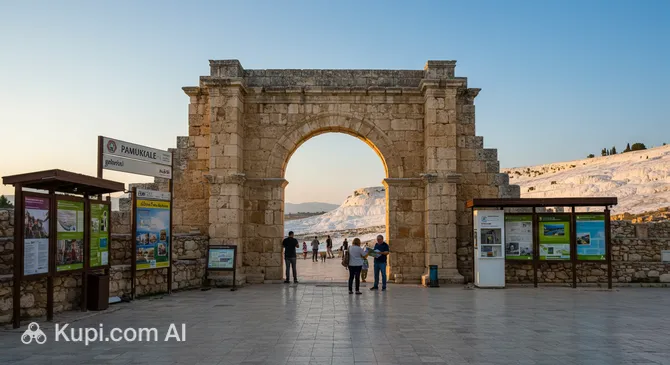
Pamukkale South Gate. Illustration.
Source: Kupi.com AI

Traveler photos:

Built in the 4th century AD, the South Gate of Hierapolis showcases the skill of ancient architects. It is constructed from massive blocks of travertine and marble, which give it a special monumentality. The gate's structure rests on two powerful rectangular towers and is topped with an elegant relieving arch resting on a single monolithic architrave.

This gate is not just an architectural monument but an important part of the grand heritage of Hierapolis, which was once a flourishing Roman resort city. Today, the entire Hierapolis complex, including the South Gate and the unique natural landscapes of Pamukkale, is listed as a UNESCO World Heritage Site, attracting researchers and tourists from all over the world who wish to touch history and enjoy the unique beauty of these places.

Contacts

Since the South Gate of Pamukkale is part of the large Hierapolis historical complex, there are usually no separate contact details for the gate itself. To get up-to-date information about visiting the ancient city of Hierapolis and the famous Pamukkale terraces, including opening hours and ticket prices, it is recommended to contact local tourist information centers. Useful information can also be found on the official tourism portals of Turkey.

How to contactContact
AddressGüney Kapı, Pamukkale, 20280 Pamukkale/Denizli, Türkiye

What to Do

Passing through the South Gate of Pamukkale, you immediately immerse yourself in the atmosphere of ancient Hierapolis. This is your first step toward discovering the rich history and culture of this ancient city. Take your time: get closer to the gate itself to admire its impressive architecture and the details that hold the memory of former greatness. Think about the role it played in the life of the ancient city. Right next to the gate, other witnesses of the past await—the ruins of an ancient theater and ancient temples, which also deserve your attention.

Once inside Hierapolis, you can take a fascinating tour of the ancient city. This is a great opportunity to learn more about its history, significance, and the daily lives of its inhabitants. Special attention should be given to the Hierapolis Theater—one of the best-preserved structures. If you're lucky, you might even catch one of the festivals or cultural events sometimes held on its ancient stage, adding unforgettable memories to your visit.

Besides the historical treasures of Hierapolis, don't forget that Pamukkale is famous for its unique natural travertine terraces and thermal springs. Although the South Gate is your entrance to the world of history, many travelers combine exploring the ancient ruins with the chance to swim in the healing waters or simply admire the snow-white cascades. It is this amazing combination of cultural heritage and natural beauty that makes visiting this place a truly comprehensive and memorable experience.

Getting There

To reach the South Gate of Pamukkale, your first step will most likely be to get to the city of Denizli. This city is a major transport hub in the region, and it is the most convenient starting point for a journey to the famous white terraces and the ancient city of Hierapolis, where the South Gate is located at the entrance.

Buses run regularly from Denizli to Pamukkale, and taxis are also available. The trip usually doesn't take long. Once you are in Pamukkale, finding the South Gate is easy: the ancient city of Hierapolis has clear signs and marked routes that will lead you straight to this historic entrance.

For those traveling by private or rental car, the route from Denizli to Pamukkale follows the D585 highway. The road is generally in good condition, making for a comfortable trip. A nice bonus for car travelers is the availability of parking, typically located near the entrance to the ancient complex where the South Gate is situated.

Nearest city: Pamukkale

History & Facts

The South Gate of Pamukkale, built in the 4th century AD, is an iconic entrance to ancient Hierapolis, the historical heart of modern-day Pamukkale. However, the history of Hierapolis itself began long before these Byzantine fortifications: it was already flourishing as a significant Roman resort town as early as the 2nd century BC. Hierapolis was famous throughout the ancient world for its healing thermal springs and vibrant cultural life, attracting visitors from all corners of the empire.

The construction period of the South Gate coincided with the reign of Emperor Theodosius I (378–395 AD), when Hierapolis was part of the Byzantine Empire. During this time, the city was actively fortified: new Byzantine defensive walls were built, and this gate became an important part of the defensive structures. It not only provided protection but also served as a symbol of the imperial presence and the strategic importance of Hierapolis in the region.

Notably, by the time the South Gate was built, Hierapolis already possessed a rich architectural and cultural heritage. For example, the magnificent Hierapolis Theater, which seated thousands for theatrical performances and gladiatorial combat, was built long before, in 62 AD. Thus, the appearance of the South Gate marked a new stage in the life of an already established and famous city, adding to its appearance and strengthening its status in the Late Antique period.

Time Needed

The time needed to see the South Gate of Pamukkale largely depends on your plans and interests. If you only want a quick look at the gate itself, appreciate its architecture, and take a few photos, it will take you about 30 minutes to an hour. This will be enough time to get a general impression of this historic entrance to the ancient city.

However, the South Gate is just the beginning of a grand journey through ancient Hierapolis. If you plan not just to see the gate but to immerse yourself in history and explore the entire archaeological complex—including the impressive amphitheater, temple ruins, the necropolis, and other significant sites—you should set aside considerably more time. In this case, it is better to plan at least half a day, if not a full day, for a complete exploration of Hierapolis starting from the South Gate.

Thus, while an hour is sufficient for a brief visit to the South Gate of Pamukkale, be prepared to dedicate a much larger part of your day to fully immerse yourself in the atmosphere of the ancient city and see all its treasures. This will allow you to enjoy all the wonders Hierapolis has to offer without rushing.

Working Hours

The South Gate of Pamukkale is part of the large Hierapolis archaeological complex, and its opening hours usually coincide with those of the entire site. As a rule, Hierapolis is open to visitors daily. In the summer months (approximately from April to October), access is usually open from 8:00 AM to 7:00 PM. In the winter months (approximately from November to March), the hours may be shorter, and the complex is typically open from 8:00 AM to 5:00 PM.

However, these hours may change depending on the season, weather conditions, or special events. Therefore, it is highly recommended to check the current opening hours on the official website of the Hierapolis archaeological complex or at local tourist information centers in Pamukkale. Generally, a single entrance ticket is purchased to visit the Hierapolis complex, including the South Gate, and no separate reservation is required to pass through the gate, though some specific museums or activities on-site may have their own rules.

8:00 – 19:00

Nearby

After exploring the South Gate of Pamukkale, don't be in a hurry to leave this amazing place. Exploring the surroundings of ancient Hierapolis and Pamukkale itself will allow you to dive deeper into the region's history and culture, as well as enjoy its unique natural beauty. There are many other interesting sites near the South Gate that will make your trip even more fulfilling and memorable.

From ancient ruins to natural wonders and cozy local spots, everyone will find something they like here. We suggest you check out some of the attractions located in the immediate vicinity of the South Gate of Pamukkale so you can plan your route in the best possible way.

NameDistance
Hierapolis Ancient Theater0.5 km
Hierapolis0.7 km
Hierapolis Archaeological Museum0.7 km
Pamukkale Travertines0.7 km
Pamukkale Natural Park0.9 km
Hiera Restaurant Coffee & Tea House1 km
Tıkır Grill House1.1 km

Have you reached the end of the page?

So the route has been studied inside and out