The Grand Mosque of Bursa, also known as Ulu Cami (Bursa Ulu Camii), is not only the largest mosque in the city of Bursa but also an outstanding architectural monument of the early Ottoman period. Located in the historical center, it is one of the most significant holy sites in Turkey and a symbol of the former Ottoman capital. Built by order of Sultan Bayezid I between 1396 and 1400, Ulu Cami became the embodiment of the state's power and cultural flourishing. Legend has it that the Sultan promised to build 20 mosques if he won the Battle of Nicopolis but ultimately decided to build one — with 20 domes.
Its appearance harmoniously combines monumentality and grace, with architectural features inherited from the Seljuks clearly visible in its style. It was the first multi-domed structure of such scale in the Ottoman Empire, serving as a model for mosque construction across the country. The building suffered damage several times, including during the 1855 earthquake, after which a French architect participated in the restoration, adding Baroque elements.
Traveler photos:
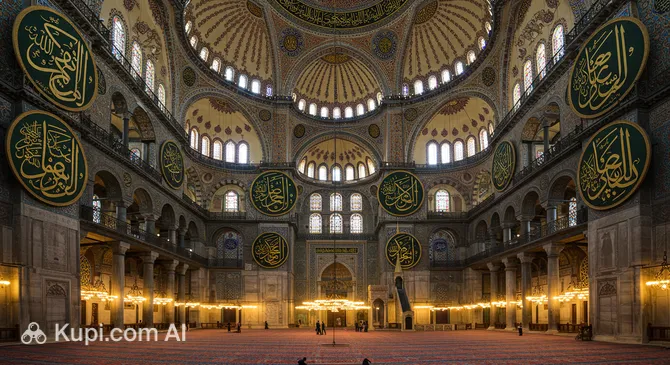
The main feature of the mosque is its unique roof. The building is crowned with 20 domes supported by 12 massive columns, creating an impressive and spacious interior. Two elegant minarets, built at different times, adorn the sides of the complex. Inside, right under one of the domes, is an unusual ablution fountain that plays an important role in the hall's lighting and ventilation. The walls and pillars of the mosque are decorated with 192 calligraphic inscriptions, which are considered outstanding examples of Islamic calligraphy.