Support

Green Tomb

About

The Green Tomb (Turkish: Yeşil Türbe) is one of the most recognizable and significant historical landmarks in the city of Bursa, located in Turkey. This majestic mausoleum serves as the final resting place for the fifth Ottoman sultan, Mehmed I, and members of his family. A visit to the tomb allows you to touch the rich history of the Ottoman Empire and see a magnificent example of its early architecture.
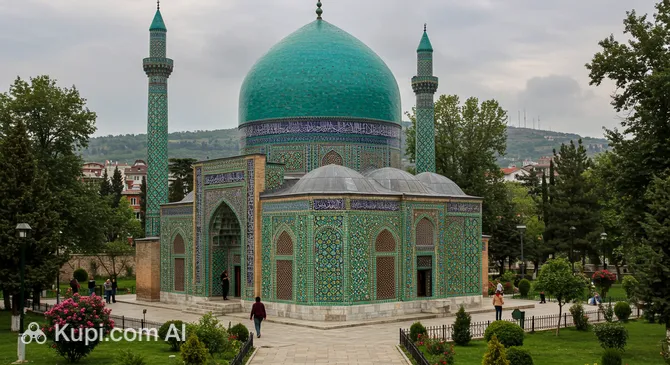
Green Tomb. Illustration.
Source: Kupi.com AI

Traveler photos:

The tomb gets its name from its unique exterior of green-blue tiles, which give it a distinct and memorable appearance. Originally, these tiles were brought from the famous city of Iznik, a center of ceramic production in the 15th century. Although many of the original tiles were lost and replaced after the devastating 1855 earthquake, the building has retained its beauty and the characteristic features of Ottoman architecture. Architecturally, the mausoleum is a monumental hexagonal structure crowned with a hemispherical dome.

The Green Tomb is an integral part of a larger architectural ensemble known as the Green Complex (Yeşil Külliye). This complex also includes the Green Mosque, a madrasa (religious school), a hammam (Turkish bath), and an imaret (charity kitchen). The entire complex is considered one of the three most important architectural ensembles built by the Ottomans in Bursa and represents an outstanding example of urban planning for its time.

Contacts

As an important historical site, the Green Tomb does not have direct contact information; it is recommended to check official tourism resources of Bursa, Turkey, or local information boards at the complex for the most up-to-date visiting information.

You can reach the Green Tomb, which is part of the famous Green Complex (Yeşil Külliye), by public transport heading to the central districts of Bursa or by taxi.

How to contactContact
AddressYeşil, 1. Yeşil Cd. 66-1, 16360 Yıldırım/Bursa, Türkiye

What to Do

Visiting the Green Tomb is a true immersion into Ottoman history and architecture. Once inside the mausoleum, you can see nine burials. In the center lies the sarcophagus of Sultan Mehmed I, and around him rest his sons – Mustafa, Mahmud, and Yusuf, his daughters – Selçuk, Ayşe, Hafsa, and Sitti, as well as his nurse Nana Hatun. This place allows you to feel the greatness and significance of the Ottoman rulers.

The interior of the tomb is striking for its elegance and craftsmanship. Be sure to notice the magnificent domed ceiling and the intricate calligraphy adorning the walls. The famous Iznik tiles covering the walls and sarcophagi are especially admirable. These bright green and turquoise tiles with subtle patterns are a vivid example of Ottoman decorative art and give the mausoleum its unique look.

A tour of the Green Tomb is often combined with a visit to other sites of the Green Complex (Yeşil Külliye), of which it is a part. Located opposite the tomb is the Green Mosque, built by the same architect, Haci Ivaz Pasha, forming a single architectural ensemble with the mausoleum. A stroll through the Yeşil district, where the complex is located, will allow you to further experience the atmosphere of historical Bursa and enjoy its authentic charm.

Getting There

The Green Tomb is conveniently located on a hilltop in the historic Yeşil district of Bursa. If you are already in Bursa, reaching this iconic landmark of Turkey is easy. The simplest way is to use public transport: numerous buses head to the Yeşil district from the city center. You can also opt for a taxi, which will take you directly to the complex entrance for a comfortable and quick trip.

For travelers arriving in Bursa from other cities in Turkey, there are convenient routes. For example, from Istanbul, you can take an intercity bus, and the journey takes approximately 2-3 hours. An alternative is a ferry to the port of Mudanya, from where it is easy to reach Bursa by local bus. If you fly into Bursa airport, regular buses and shuttle taxis run from there to the city center and the Yeşil district where the Green Tomb is located.

Nearest city: Bursa

History & Facts

The history of the Green Tomb is closely linked to the Ottoman dynasty. Its construction was ordered by Sultan Murad II to honor the memory of his father, Sultan Mehmed I, who passed away in 1421. The design and construction of both the tomb and the Green Mosque located opposite it were entrusted to the talented architect Haci Ivaz Pasha, who left a significant mark on Ottoman architecture.

One remarkable fact surrounding the Green Tomb is a tragic irony of fate. Sultan Mehmed I, for whom this grand complex was built, passed away only 40 days after the construction was completed. Thus, the mausoleum, intended as part of his architectural legacy during his lifetime, became his final resting place almost immediately after its creation, adding a poignant historical note to the site.

The fate of the Green Tomb was not without its trials. In 1855, Bursa was heavily affected by a devastating earthquake. This natural disaster caused significant damage to the famous mausoleum: most of the original green-blue tiles that adorned the exterior were damaged. They were subsequently replaced with more modern counterparts, but the restorers took great care to preserve the historical appearance and spirit of this important monument in Bursa.

Time Needed

To visit the Green Tomb itself, it is usually enough to set aside about 30-45 minutes. During this time, you can leisurely explore its impressive interior, admire the famous Iznik tiles decorating the sarcophagi and walls, and soak in the atmosphere of this historical site. This is sufficient time to appreciate the architectural features of Sultan Mehmed I's mausoleum and take memorable photos.

However, it's worth noting that the Green Tomb is part of a larger and more significant architectural ensemble – the Green Complex (Yeşil Külliye). To get a full sense of this historical heritage of Bursa, it is recommended to plan about 2-3 hours for a visit to the entire complex. This will allow you to explore not only the tomb but also the magnificent Green Mosque, the madrasa, and other buildings that form a single whole, revealing the full depth of 15th-century Ottoman architecture.

Working Hours

The Green Tomb in Bursa is generally open to visitors daily. Exact opening hours may vary and often coincide with standard museum hours or may be related to prayer times, as the tomb is considered part of an active religious complex. Entry to such mausoleums is usually free, and no advance ticket booking is required. However, considering potential changes in the schedule due to restoration work, religious holidays, or other events, it is highly recommended to check current visiting hours on the official tourism websites of Bursa or Turkey, or directly on information boards at the entrance to the complex before planning your visit.

As a rule, such iconic landmarks are open year-round, but it is always useful to check information in advance to avoid unexpected closures. This is especially important if your trip coincides with major national or religious holidays. Confirming details on-site or through official channels will help you plan your visit to the Green Tomb in the best possible way.

8:00 – 18:00

Nearby

A visit to the Green Tomb is certainly a highlight, but Bursa is rich with other interesting sites located very nearby. Exploring the surroundings will allow you to immerse yourself deeper in the atmosphere of this historic city and make your journey even more fulfilling and memorable.

Near the mausoleum, you will find many other attractions that will complement your impressions and tell you more about the culture and history of Turkey. A walk through the nearby streets can lead to unexpected discoveries and pleasant surprises, whether it's an ancient mosque, a cozy cafe, or a picturesque bridge.

NameDistance
Güner Hotel0.4 km
Famous Rice Pilaf Engin Usta0.6 km
Bursa City Museum0.7 km
Koza Han1 km
Grand Mosque of Bursa1.1 km
Sultan's Mansion Museum1.2 km
Bazaar West1.2 km

Have you reached the end of the page?

So the route has been studied inside and out