Support

Dolmabahçe Palace

About

Dolmabahçe Palace is one of the most luxurious and significant architectural monuments of the 19th century, located on the European shore of the Bosphorus Strait in Istanbul. This majestic complex is the largest palace in Türkiye and serves as a vivid symbol of the Ottoman Empire's drive toward European standards and modernization. Its name translates as "filled garden," as it was built on the site of a reclaimed bay where imperial gardens were previously located.
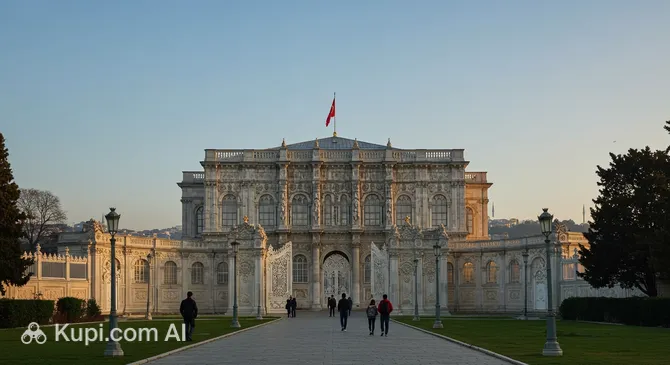
Dolmabahçe Palace. Illustration.
Source: Kupi.com AI

Traveler photos:

Construction of the palace began in 1843 by order of Sultan Abdulmejid I, who wanted to create a residence capable of competing in splendor with the best royal castles in Europe. The architects were representatives of the famous Armenian Balyan dynasty, who created a unique ensemble by mixing several styles. As a result, Dolmabahçe became not only the empire's new administrative center, replacing the old Topkapi Palace, but also the home for the last six Ottoman sultans.

The architecture of the palace is an eclectic blend of European styles — Baroque, Rococo, and Neoclassicism — with elements of traditional Ottoman architecture. The interiors are imaginative in their wealth and magnificence: tons of gold, rare types of marble, and crystal were used for decoration. Visitors can see the famous Crystal Staircase, huge handmade silk carpets, and one of the world's largest crystal chandeliers, gifted by Queen Victoria. Today, the palace functions as a museum, allowing everyone to touch the imperial past and appreciate its grandiose scale.

Contacts

To plan your visit, check current opening hours, ticket prices, and get information about temporary exhibitions, it is recommended to contact the palace administration directly or visit the official website. Below are the main contact details.

How to contactContact
AddressVişnezade, Dolmabahçe Cd., 34357 Beşiktaş/İstanbul, Türkiye
Phone number+90 212 236 90 00
Websitewww.millisaraylar.gov.tr

What to Do

A visit to Dolmabahçe Palace is an opportunity to peek into the ceremonial and private life of the Ottoman sultans. The tour route will lead you through the main parts of the massive complex: the official Selamlık apartments, where state business was conducted, and the secluded Harem, where the Sultan's family lived. You will be able to appreciate the luxurious interiors decorated with tons of gold, crystal, and rare woods, as well as see a rich collection of furniture, paintings, and the famous handmade silk Hereke carpets.

The climax of the visit is the Ceremonial Hall (Muayede), which is breathtaking in its size and splendor. This is where the famous crystal chandelier — a gift from Queen Victoria — is located, weighing nearly 5 tons and featuring 750 lamps, making it one of the largest in the world. The palace also holds great significance for modern Türkiye: it was here that the founder of the Republic of Türkiye, Mustafa Kemal Atatürk, spent his final days and passed away. In his room, all clocks are symbolically stopped at 09:05 — the moment of his death.

In addition to the main halls, there are other interesting sites on the extensive palace grounds. Be sure to stroll through the picturesque gardens that descend right to the Bosphorus, offering magnificent panoramic views. You can also visit the Clock Museum and the Crystal Pavilion here, which house unique exhibits. For a deeper dive into history, use an audio guide, which will explain the purpose of each room and its most valuable treasures.

Getting There

Dolmabahçe Palace is conveniently located in the Beşiktaş district on the European shore of Istanbul, making it easily accessible for tourists. The main transport hub for visiting the palace is the Kabataş pier and tram stop, where many public transport routes converge. From here, the entrance to the palace is just a few minutes' leisurely walk along the waterfront.

One of the most popular ways to reach Dolmabahçe is by using the T1 high-speed tram line (Kabataş-Bağcılar). You need to get off at the final stop, Kabataş, which is especially convenient for those coming from the historical Sultanahmet district. Kabataş pier can also be reached by ferries from the Asian side of the city or other Bosphorus piers. Additionally, from the Taksim Square area, you can quickly descend to Kabataş using the F1 funicular line.

If you are staying near Taksim Square and prefer walking, the route to the palace will take about 20–30 minutes. Of course, you can always take a taxi, which is particularly convenient for small groups or families with children. The entrance to the palace is located on the waterfront side, opposite a busy transport interchange, so you will easily find it arriving by any of the listed methods.

Nearest city: Istanbul

History & Facts

The history of Dolmabahçe Palace is inextricably linked with the Ottoman Empire's pursuit of European luxury and modernity. Its construction began in 1843 by decree of Sultan Abdulmejid I and continued until 1856. The main architects of this grand project were Garabet Balyan, Nigoğayos Balyan, and Evanis Kalfa, prominent representatives of the famous Armenian Balyan dynasty of court architects. It was their talent that allowed for the creation of a residence intended to eclipse the finest palaces of Europe.

Since its completion, Dolmabahçe Palace became the official residence for the last six Ottoman sultans, replacing the old Topkapi Palace in this capacity. It became not just a new home for the rulers, but also a symbol of a new era in the empire's history, demonstrating its openness to Western influences and desire for renewal. Every hall and room in the palace was designed to reflect the greatness and power of the state on the international stage.

After the fall of the monarchy and the proclamation of the Republic of Türkiye, the palace gained new historical significance. It was used as the official residence for the founder and first president of the country, Mustafa Kemal Atatürk, during his stays in Istanbul. It was here that he spent the last days of his life and passed away on November 10, 1938. Today, the room where his heart stopped is open to visitors and is a place of national reverence, while all the clocks in the palace symbolically show 09:05 — the exact time of his death.

Time Needed

When planning a visit to Dolmabahçe Palace, you should expect that a full tour will take between 2 and 3 hours. This time is usually sufficient to explore the main parts of the palace complex without rushing, including the luxurious halls, the famous Harem, and the surrounding park area, without missing important details.

The standard route covers two main parts of the palace: the official Selamlık apartments, where ambassadors were received and state matters were decided, and the private quarters of the Sultan's family — the Harem. Touring these areas, especially using an audio guide, takes about an hour and a half to two hours. Special attention should be paid to the Ceremonial Hall, which is striking for its size and the famous crystal chandelier.

If you want to dive deeper into history and take a leisurely stroll through the picturesque gardens overlooking the Bosphorus, as well as visit the Clock Museum and the Crystal Pavilion, it is better to set aside about 3 hours or even slightly more. It's also recommended to consider that during the high tourist season there may be ticket lines, which can increase the total duration of your visit.

Working Hours

Dolmabahçe Palace is open to visitors daily except Mondays. The museum's standard opening hours are from 09:00 to 16:00, but ticket offices may close earlier. It is important to note that the last entry to the palace is usually allowed one hour before closing. The palace is open year-round but is closed on some national and religious holidays, such as New Year's Day, as well as the first days of Ramadan and Eid al-Adha.

Given the palace's immense popularity, long queues can form at the entrance during the peak tourist season and on weekends. To avoid waiting, it is recommended to arrive by the opening time or plan your visit for a weekday. You should also consider booking tickets online in advance, which often allows you not only to save time but also to use the skip-the-line entrance. Before visiting, it is always helpful to check the latest information on the palace's official website, as opening hours are subject to change.

DayOpening hours
MondayClosed
Tuesday9:00 – 17:00
Wednesday9:00 – 17:00
Thursday9:00 – 17:00
Friday9:00 – 17:00
Saturday9:00 – 17:00
Sunday9:00 – 17:00

Nearby

Visiting Dolmabahçe Palace is an immersion into the world of imperial luxury, but exploring its surroundings can make your journey through Istanbul even more fulfilling. The palace is located in one of the city's most vibrant and prestigious districts — Beşiktaş, which is famous for its colorful atmosphere where history meets modernity. A walk along the Bosphorus embankment after touring the palace will offer you magnificent views and let you feel the dynamic rhythm of this metropolis.

Exploring nearby attractions will enrich your experience, showing different facets of Istanbul life. Just a few steps from the palace gates, you can find both historical monuments and modern entertainment centers, cozy cafes, and trendy restaurants. This is a wonderful opportunity to combine a cultural program with relaxation and shopping without traveling far from one of the city's main gems.

NameDistance
The Bosphorus Restaurant0.3 km
Dolmabahçe Coast0.4 km
Hotel Istanbul at the Bosphorus1 km
Park Bosphorus Hotel Istanbul1.1 km
Ciragan Palace1.4 km
Escape Club Istanbul1.6 km
Maiden's Tower2 km

Have you reached the end of the page?

So the route has been studied inside and out