Support

Basilica Cistern

About

The Basilica Cistern, also known by its Turkish name Yerebatan Sarnıcı, is one of the most impressive and well-preserved ancient underground reservoirs in Istanbul. Located in the city's historic center, just 150 meters from the famous Hagia Sophia, it earned the nickname «Подводный дворец» due to its majestic and mysterious beauty. This place is a true gem of Turkey, hidden underground.
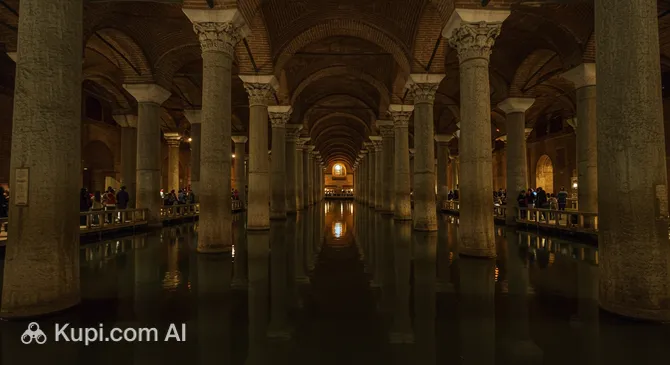
Basilica Cistern. Illustration.
Source: Kupi.com AI

Traveler photos:

Visitors are greeted by a grand space of about 9,800 square meters, capable of holding up to 100,000 tons of water. The cistern's vault is supported by 336 eight-meter columns, arranged in 12 straight rows. These columns, brought from various ancient temples, differ in style: most are in the Doric style, but 98 are in the more refined Corinthian style, giving this place even more uniqueness.

Walls nearly five meters thick and a special waterproof mortar on the floor ensured the reliability of this strategically important site in the past. Today, walking along wooden walkways over the water in the twilight, illuminated by soft light, creates a truly mystical atmosphere. The Basilica Cistern is not just a historical monument, but an amazing journey through time that leaves a deep impression on every visitor.

Contacts

For the most up-to-date information on opening hours, ticket prices, and special events, it is recommended to contact the museum administration directly. All necessary details can be found on the official website or clarified by phone.

How to contactContact
AddressAlemdar, Yerebatan Cd. 1/3, 34110 Fatih/İstanbul, Türkiye
Phone number+90 212 512 15 70
Websiteyerebatansarnici.com

What to Do

A visit to the Basilica Cistern is an opportunity to immerse yourself in the atmosphere of ancient Constantinople and enjoy unique Byzantine architecture. Walking along specially equipped wooden walkways over the water allows visitors to see hundreds of majestic columns and their diverse capitals up close, reflected in the calm surface. Soft, mysterious lighting and water dripping from the ceiling create a truly mystical setting, transporting you back many centuries.

The main highlight and a must-do for every guest is finding two special columns that have stone heads of Medusa Gorgon at their base. One is upside down, and the other is turned on its side — this unusual placement has given rise to many legends and theories. These mysterious sculptures are considered one of the main attractions of the cistern and invariably attract the attention of tourists wanting to take memorable photos.

Inside the cistern, a small amount of water is still maintained, helping to preserve the special atmosphere and humidity. To make your journey into the underworld even more educational, consider visiting with a guide. A professional storyteller will help reveal all the secrets of this amazing structure, tell you about its complex history, and explain the meaning of hidden details.

Getting There

Reaching the Basilica Cistern is quite simple, as it is located in the heart of the historic center of Istanbul — the Sultanahmet district. Thanks to this convenient location, visiting it is easy to combine with other iconic sites like the Hagia Sophia and the Blue Mosque, which are just a few minutes' walk away. The most convenient way to get here by public transport is the T1 high-speed tram (Kabataş-Bağcılar). You need to get off at the "Sultanahmet" (Sultanahmet) stop, from which it is only a 5-10 minute walk to the cistern entrance.

Besides the tram, you can reach Sultanahmet Square by one of the many city buses. If you prefer comfort, you can use taxi services or order a car through a mobile app. However, it is worth remembering that the historic center of Istanbul is famous for its narrow streets and heavy traffic, especially during peak tourist season, so a car trip may take longer than public transport.

Nearest city: Istanbul

History & Facts

The history of the Basilica Cistern dates back to the 6th century, during the reign of the Byzantine Emperor Justinian I. The construction of this grand underground structure was completed around 532. The cistern earned its name — "Basilica" — for a reason: it was built on the site of an ancient basilica that previously existed there. This fact links its history to one of the most significant periods of Constantinople's development.

The primary purpose of the cistern was to provide a continuous water supply to the Great Palace of Constantinople and other key buildings in the city. It served as a strategic reservoir filled with water from the sources of the Belgrade Forest, located nearly 20 km from the city, via a complex system of aqueducts. In case of drought or a long siege of Constantinople, the water reserves in the cistern became vital for its residents. This engineering marvel demonstrates the highest level of Byzantine architecture and construction technology of that time.

After the conquest of Constantinople in 1453, the reservoir was used for a while to supply the Topkapi Palace but was later abandoned and practically forgotten. It was rediscovered only in the mid-16th century when locals noticed they could catch fish through holes in the floors of their houses. Today, only a low level of water is maintained in the cistern, allowing visitors to walk along specially built bridges and admire the majesty of the columns. The Basilica Cistern has become one of the most visited historical attractions in Istanbul, attracting tourists who want to touch the secrets of Byzantine history.

Time Needed

When planning a visit to the Basilica Cistern, you should expect that a tour will take an average of 30 to 60 minutes. This time is quite enough to immerse yourself in the mysterious atmosphere of this underground palace without rushing, walk along the wooden walkways, and fully enjoy its unique architecture. During this period, you will have time not only to walk through the entire space but also to take impressive souvenir photos.

If you prefer a deeper immersion into history, you can use the services of a guide or an audio guide. In this case, the visit may take a bit longer as you learn interesting facts about the cistern's construction, its purpose, and the mysterious Medusa heads. However, even an independent walk will allow you to fully appreciate the greatness of this ancient structure and find all its key features.

Working Hours

The Basilica Cistern is open to visitors year-round, making it accessible for a visit in any season. According to current information, the attraction is open daily from 09:00 to 22:00. This accessibility allows you to easily fit a visit to this unique location into any, even the busiest, tourist itinerary through Istanbul.

Given the high popularity of this site, especially during peak tourist season, it is strongly recommended to purchase tickets online in advance. This will allow you to avoid long queues at the entrance and save precious time for other discoveries in Turkey. Although tickets can be bought on-site, pre-booking guarantees a more comfortable and planned visit. For the latest information on opening hours or possible schedule changes, it is always useful to check the cistern's official website.

9:00 – 18:30, 7:30 – 22:00

Nearby

Visiting the Basilica Cistern is just one part of an exciting journey through the historic heart of Istanbul. Thanks to its unique location in the Sultanahmet district, you find yourself at the epicenter of cultural and architectural treasures, all reachable on foot within a few minutes. Exploring the surroundings will allow you to dive deeper into the city's centuries-old history, where Byzantine masterpieces stand alongside Ottoman mosques and bustling markets.

A stroll through the nearby streets after the mysterious coolness of the underground reservoir will offer completely new impressions. You can not only see world-famous landmarks but also discover cozy cafes, restaurants, and picturesque parks. Literally every step in this area is an opportunity to connect with different eras and feel the unique atmosphere of a city standing at the crossroads of Europe and Asia.

NameDistance
Hagia Sophia Grand Mosque0.2 km
GRACE Rooftop Restaurant0.4 km
Hidden Garden0.5 km
Topkapi Palace Museum0.6 km
Lotiz Lounge & Hookah1.7 km
Salt Galata1.8 km
Galata Tower1.9 km

Have you reached the end of the page?

So the route has been studied inside and out