Support

Abu Dhabi International Airport

Airports in the city

About the Airport

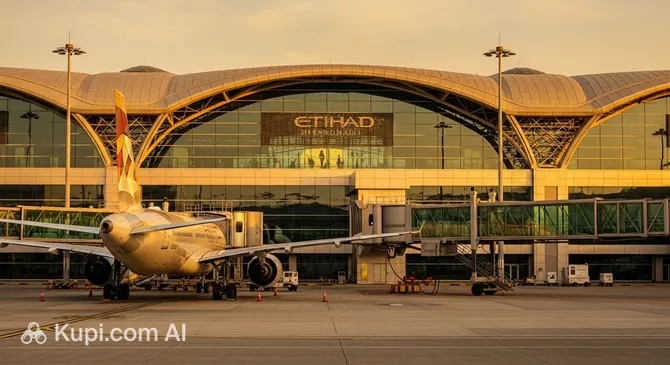
Abu Dhabi International Airport. Source: Kupi.com Binoculars

Abu Dhabi International Airport, also known as Zayed International Airport, is not merely an air harbour but a futuristic gateway to the capital of the UAE. With its impressive architecture and technology, it reflects the spirit of modern Abu Dhabi, standing as one of the fastest-growing and most significant aviation hubs in the Middle East. The airport serves as the home for the national carrier Etihad Airways and connects dozens of countries across different continents, offering travellers the highest level of comfort and service from their very first minutes in the country.

IATA Code AUH
ICAO Code OMAA
City Abu Dhabi
Distance to city centre approx. 30 km
Status International
Annual Passengers over 29 million (in 2024)
Popular Airlines Etihad Airways, Air Arabia Abu Dhabi, Wizz Air
Schedule Online Flight Information "Abu Dhabi International Airport"

Abu Dhabi Airport is renowned for its innovative approach to passenger service. Opened in 2023, Terminal A is one of the largest in the world and represents a true architectural marvel with undulating roofs resembling sand dunes. Inside the terminal, advanced biometric technologies have been implemented, allowing passengers to pass through all control stages from check-in to boarding as quickly as possible and without unnecessary contact. Travellers can enjoy a vast selection of duty-free shops, exquisite restaurants, luxurious lounges, spas, and even hotels for a comfortable rest between flights. As the base for Etihad Airways, the airport offers exclusive services for premium class passengers, including separate check-in areas and dedicated lounges.

Contact Information

For the most up-to-date information regarding flights, services, and regulations at Abu Dhabi International Airport (AUH), it is recommended to use official communication channels. Below are the main contact details.

Official Website: www.abudhabiairport.ae

Helpline: +971 (0)2 505 5555 (24-hour call centre)

Address: Abu Dhabi, United Arab Emirates

Email: You can contact airport representatives via the feedback form on the official website in the "Contact Us" section.

Social Media: The airport maintains active pages on popular social networks such as Facebook, X (formerly Twitter), and Instagram, where the latest news and updates are published.

Lost & Found:

If you have lost items on board the aircraft, you should first contact your airline's representative office.

If items were lost within the terminal, you need to contact the airport's "Lost & Found" service. Information on the procedure and contacts can be found on the official website in the relevant section.

Passenger Support Service: For general inquiries related to your stay at the airport, you can contact the main call centre number listed above.

How to Get to the Airport

Reaching Abu Dhabi International Airport (AUH), one of the UAE's key transport hubs, is possible via several convenient methods. The choice depends on your budget, time, and comfort preferences. Whether you are travelling from the city centre or another emirate, the transport system offers flexible solutions for every traveller.

Public Transport: Buses

The most budget-friendly way to get to the airport is to use city buses. Special 24-hour routes connect the airport with key points in Abu Dhabi.

  • Route A1: This bus runs from the central bus terminal (Al Zahiyah City Air Terminal) to the airport, passing through the city centre.
  • Route A2: Follows a similar route but is designed for those travelling from the city to the airport.
Buses are equipped with air conditioning and luggage space. The journey takes approximately 45-60 minutes depending on traffic. To pay for the fare, you need a Hafilat transport card, which can be purchased and topped up at machines at bus stops and in shopping malls. The cost of the trip is one of the lowest, usually around 4-5 dirhams.

Taxi and Transfer

A taxi is the most popular and convenient way to travel to the airport. Official city taxis (cream-coloured) are easy to find anywhere in the city and operate on a meter. A trip from downtown Abu Dhabi will take about 30-40 minutes and cost approximately 70-90 dirhams. Car booking services such as Uber and Careem are also widely available. For greater comfort, you can pre-book a private transfer, which is especially convenient for large groups or families with bulky luggage.

Car Rental and Parking

If you prefer independence in your movements, renting a car is an excellent choice. Offices of all leading international and local rental companies are present at Abu Dhabi Airport. Roads in the UAE are of excellent quality, and navigation is straightforward. The airport provides both short-term and long-term parking at all terminals. Parking costs vary depending on duration, but it is a convenient option if you are seeing someone off or leaving your car for the duration of your trip.

Getting There from Other Emirates

Abu Dhabi International Airport is also an important gateway for travellers heading to other parts of the country. For example, you can reach Dubai via special express buses or taxis. This makes it a convenient arrival point, even if your final destination is a neighbouring emirate where other major airports are located, such as Dubai (DXB) or Al Maktoum International Airport.

Terminals and Map

Abu Dhabi International Airport (AUH) has undergone significant changes with the opening of the new, ultra-modern Terminal A. Today, it handles the vast majority of international and domestic flights, while the older terminals (1, 2, and 3) are gradually being phased out of passenger operations. Therefore, modern travellers should focus on the infrastructure of the new terminal.

Terminal A, also known as the Midfield Terminal, is a massive structure in the shape of an "X". This architecture allows for a large number of boarding gates and reduces passenger transit time. Navigation inside is intuitive thanks to numerous signs in Arabic and English, as well as interactive information desks. Since all major airlines, including Etihad Airways, have moved their operations here, the need for transfers between terminals for transit passengers has practically disappeared.

Departure and arrival zones are clearly separated. The Departure Zone is located on the upper levels and includes check-in counters, baggage drop-off points, passport control, and security screening. After completing formalities, passengers enter the spacious central part of the terminal with Duty Free shops, restaurants, and lounge areas, from where galleries lead to the boarding gates. The Arrival Zone is located on the lower levels, housing passport control, baggage reclaim belts, and customs inspection.

One of the key features of Terminal A is the implementation of the Smart Travel biometric system, which allows passengers to pass through many control stages (from check-in to boarding) without presenting a passport and boarding pass, significantly speeding up the process. Despite this, it is recommended to arrive at the airport well in advance — at least 3-4 hours before an international flight departure. This will provide enough time to calmly complete all procedures, shop, and relax before the flight.

For convenient navigation through the vast terminal, follow the signs, check your flight information on electronic boards, and, if possible, use the airport's mobile app. Keep in mind that the walk to some distant boarding gates can take up to 15-20 minutes from the central zone, so do not leave going to your gate until the last moment.

Airport History

The history of Abu Dhabi International Airport (AUH) is inextricably linked with the rapid growth and development of the UAE capital. The official opening of the airport took place in 1982. It was built to replace the old Al Bateen Airport, which could no longer cope with the increased passenger flow amidst the economic boom in the region.

Initially, the airport consisted of a single terminal with a distinctive circular satellite building, designed by the same French architects responsible for Paris Charles de Gaulle Airport. This unique structure became a symbol of Abu Dhabi's air gateway for many years. The first decades of operation were dedicated to systematic development and establishing the route network.

A key moment in the airport's history was the founding of the national airline Etihad Airways in 2003, for which AUH became the main hub. This event gave a powerful impetus to large-scale expansion. In subsequent years, Terminal 2 and Terminal 3 were built and commissioned; the latter was intended primarily for servicing Etihad flights, which significantly increased throughput capacity.

The most significant milestone in development was the launch in 2023 of the new state-of-the-art Terminal A, previously known by the project name Midfield Terminal. This is one of the largest terminal complexes in the world, standing as a true architectural and technological masterpiece. Its opening did not just mark another stage of modernization but elevated the airport to a completely new level, transforming it into one of the leading global aviation hubs. The terminal is capable of serving up to 45 million passengers per year and is equipped with advanced systems, including a fully biometric passenger processing system.

Thus, over its relatively short history, Abu Dhabi International Airport has travelled an impressive path from a modern, yet modest by global standards airport, to a gigantic world-class hub. It is a living testament to the ambition and vision of the future that characterizes the Emirate of Abu Dhabi.

Services and Amenities

Abu Dhabi International Airport (AUH) offers passengers a wide range of services and amenities to make their stay as comfortable and productive as possible. This modern hub is designed with the needs of diverse categories of travellers in mind.

For gourmets and shopping enthusiasts, the airport features a huge selection of restaurants, cafes, and lounges, ranging from fast food outlets to fine dining restaurants where you can taste both international and local dishes. Numerous shops, including an extensive Duty-Free zone, offer a wide assortment of goods: from perfumes and cosmetics to electronics, jewellery, and souvenirs.

For those who value comfort and privacy, premium waiting halls and VIP lounges are available. Here, you can relax in silence, use shower facilities, and enjoy snacks and drinks. Free Wi-Fi is available throughout the airport, and numerous gadget charging stations ensure you always stay connected.

Financial matters are easily resolved thanks to the presence of bank branches, ATMs, and currency exchange points. In case of necessity, passengers can seek qualified assistance at the 24-hour medical centre. Play areas and mother-and-child rooms are provided for travellers with children, while special assistance, ramps, and equipped restrooms are available for passengers with reduced mobility.

If you have a long layover, you can stay at the transit hotel located directly within the airport building, or at one of the numerous nearby hotels served by shuttle buses. For business travellers, business centres and conference rooms equipped with everything necessary for meetings and work are available.

Where to Eat

At Abu Dhabi International Airport, travellers are greeted with an impressive selection of dining venues. From quick snacks before departure to a leisurely dinner while waiting for a connecting flight — there is an option for everyone here. Cafes, restaurants, and takeaway points are conveniently located in all terminals, making the wait for your flight as comfortable as possible.

Abu Dhabi International Airport. Source: Kupi.com Binoculars

Most cafes and restaurants are concentrated in the so-called airside zone, that is, after passing passport and pre-flight control. It is here that the choice is widest. However, the public landside zone (before control) also has several excellent places where you can have coffee with those seeing you off or meet arriving passengers. A huge plus for transit passengers is that many establishments in the departure zone operate 24 hours a day.

If you are short on time, numerous coffee shops and food courts with famous global chains are at your service. Here it is easy to grab a sandwich, burger, or invigorating coffee to go. Those with time to spare should visit one of the full-service restaurants. This is a wonderful opportunity to experience Arabic cuisine: be sure to try traditional mezze appetizers, juicy shawarma, or aromatic coffee with dates. In addition to local dishes, Italian, Asian, and American cuisines are widely represented at the airport.

The airport caters to the needs of a wide variety of passengers. Since it is located in the UAE, all food here is Halal by default. Furthermore, in almost every menu, you will find vegetarian and vegan options. If you have specific dietary requirements, for example, a gluten-free diet, do not hesitate to ask the staff — they will help you select a suitable dish.

Prices in airport establishments are generally higher than in the city, but the range is quite large. You can find both budget-friendly options in food courts and more expensive offers in premium restaurants. Thus, every traveller will be able to find an option that suits their travel budget.

Tips for Travellers

Travelling through Abu Dhabi International Airport (AUH) will be more comfortable if you plan all details in advance. This modern and major aviation hub serves millions of passengers, so good preparation helps avoid stress and save time.

Arrival Time at the Airport: For international flights, it is recommended to arrive at the airport at least 3-4 hours before departure. For domestic flights, 2 hours is usually sufficient. This time is enough to calmly check in, drop off luggage, and pass through pre-flight security and passport control, which may take longer during peak hours or the tourist season.

Check-in and Security Control: To save time, use online check-in for your flight, which usually opens 24-48 hours before departure. Strict but effective security rules apply at Abu Dhabi Airport. Prepare liquids in advance (in containers up to 100 ml, packed in a transparent bag), remove all metal objects from your pockets, and take laptops and other large electronics out of your hand luggage.

Seat Selection: If the airline allows you to select a seat in advance, consider your preferences. Window seats (A, F) offer beautiful views during takeoff and landing. Aisle seats (C, D, G, H) are convenient if you plan to get up frequently. Seats in emergency exit rows offer more legroom but often come at an additional cost and with certain restrictions.

Hand Luggage: It is forbidden to carry sharp objects, flammable substances, and liquids in containers larger than 100 ml in hand luggage. Power banks, electronic cigarettes, and laptops, on the contrary, should be carried specifically in hand luggage, and not in checked baggage. Be sure to check the exact weight and size limits for hand luggage on your airline's website.

Transit Passengers: Abu Dhabi is a major transit hub. Follow the "Transit" or "Connections" signs to proceed to your required boarding gate. Check with your airline whether you need to collect and re-check your luggage — in most cases, when transferring between flights of the same airline or alliance, luggage is transferred automatically.

Customs Control: Upon arrival in Abu Dhabi, you will undergo immigration control, followed by customs. If you have no goods to declare, proceed confidently through the "Green Channel". If you are carrying goods exceeding duty-free limits (for example, large sums of cash, large quantities of alcohol or tobacco), you must pass through the "Red Channel" and declare them.

Saving Time and Money: Book your airport transfer or parking online in advance — this is often cheaper. Bring an empty reusable water bottle to fill after passing security control. Food and drink prices at the airport are high, so bringing a light snack or having lunch before arriving at the airport will help save money.

In Case of Flight Delay: First of all, contact your airline representative for information about the new departure time and your rights. Depending on the length of the delay, you may be provided with vouchers for meals or even hotel accommodation. Abu Dhabi Airport has many shops, cafes, relaxation zones, and free Wi-Fi to help pass the waiting time.

Reached the end of the page?

That means the route is fully explored