Support

Dubai Airport

About the Airport

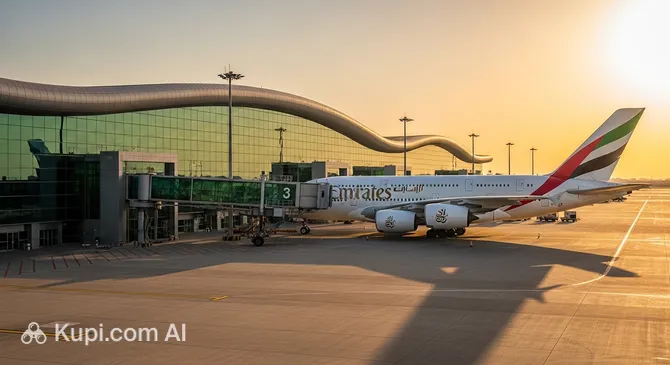
Dubai Airport. Source: Kupi.com Binoculars

Dubai International Airport (DXB) is not just an air gateway to the UAE, but a true city within a city, impressing with its scale and level of service. Located just a few kilometers from the historic center, it is one of the busiest and most technologically advanced aviation hubs on the planet. Every year, millions of travelers begin or continue their journey right here, immersing themselves in the atmosphere of luxury and innovation for which Dubai is famous.

IATA Code DXB
ICAO Code OMDB
City Dubai
Distance to Center About 5–15 km, depending on the destination district.
Status International
Passengers per Year About 87 million (based on 2023 data).
Popular Airlines Emirates, flydubai, Qatar Airways.
Schedule "Dubai" online board

Dubai Airport is renowned for its impeccable infrastructure and wide range of services. Terminal 3, dedicated exclusively to Emirates airline, is one of the largest buildings in the world and offers passengers an unsurpassed level of comfort. Travelers have access to the huge Dubai Duty Free shopping area, numerous restaurants for every taste, luxurious lounges, spas, and even a hotel inside the transit zone. Shuttles and metro trains operate for convenient movement between terminals. The airport also offers special services, such as Marhaba Service, for expedited formalities and personal assistance.

Contact Information

Official Website: You will find the most complete and up-to-date information on the official airport website: www.dubaiairports.ae. Online flight boards, terminal maps, and detailed guides are available here.

Help Desk Phone: For 24/7 support and answers to questions, you can call: +971 4 224 5555.

Airport Address: Dubai International Airport, Garhoud, Dubai, UAE.

Email: The airport recommends using the feedback forms on the official website for most inquiries to ensure your request is directed to the correct department.

Social Media: Follow news and updates on the airport's official pages on Facebook, X (formerly Twitter), and Instagram.

Lost Luggage Information: If you lost luggage during a flight, you should first contact your airline's representative. If an item was lost within the terminal, use the lost property search form in the "Lost & Found" section on the official airport website.

Passenger Support Contacts: In addition to the general phone number, information desks marked "May I Help You?" are located in all terminals of Dubai airport, where staff are ready to assist you with any questions.

How to Get to the Airport

Dubai International Airport (DXB) is one of the busiest and most modern in the world, offering travelers many convenient ways to get to the city and back. The transport system of Dubai, integrated with the airport, allows you to choose the best option depending on your budget, time, and amount of luggage.

Public Transport is the most economical way to travel. The Dubai Metro (Red Line) has stations directly in Terminals 1 and 3. Trains run regularly; they are clean, air-conditioned, and fast. A trip to the city center, for example, to the Downtown area, will take about 25 minutes. To ride, you need a rechargeable Nol card, which can be purchased at ticket offices at stations. Additionally, an extensive network of RTA buses connects all airport terminals with various districts of the city around the clock. This is a great option if your hotel is located far from metro stations.

Taxis and Transfers. Official Dubai Taxi Corporation taxis (cream-colored with a colored roof) are easy to find at designated stands at each terminal. This is a convenient and safe option operating by meter, to which a small airport surcharge is added. A trip to the center will cost more than the metro but ensures "door-to-door" comfort. Ride-hailing services are also popular in the UAE, such as Uber and the local Careem, which can be booked via a mobile app.

Car Rental and Parking. If you plan to travel extensively around the emirate and beyond, renting a car might be the best solution. Offices of all major international and local rental companies are present at the airport. Short-term and long-term parking is available at all terminals, though it is worth noting that the cost of long-term parking can be high.

Although DXB is the city's main hub, it is worth knowing about other air gateways in the region. For example, Sharjah International Airport (SHJ) is located just 17.5 km away, and the newer Al Maktoum International Airport (DWC) is 44.4 km away. Also within reach are airports in Ras Al Khaimah (about 70 km), Fujairah (about 98 km), and Al Ain (about 112 km).

Terminals and Map

Dubai International Airport (DXB) is one of the busiest and most modern aviation hubs in the world, consisting of three main passenger terminals. To navigate this giant complex, it is important to understand its structure and the features of each terminal in advance.

Structure and Purpose of Terminals:

  • Terminal 1 — Serves the majority of major international airlines (except Emirates). It is connected to the modern and spacious boarding area (Concourse D) by a special train that runs in just a few minutes.
  • Terminal 2 — Used primarily by budget airlines (low-cost carriers), charter flights, and flights to Persian Gulf countries and the near region. It is located on the opposite side of the airfield from Terminals 1 and 3.
  • Terminal 3 — Is the exclusive terminal for Emirates and flydubai airlines. It is one of the largest buildings in the world, consisting of three concourses (A, B, and C). Concourse A is specially designed to service giant Airbus A380 aircraft.

Navigation and Transfers Between Terminals:

Navigation at DXB airport is organized at a high level thanks to numerous signs in Arabic and English. Terminals 1 and 3 are located next to each other and are connected by walkways, allowing you to move between them on foot (through the transit zone) or via the Dubai Metro (if you are outside the transit zone). To transfer to or from Terminal 2, you must use the free 24-hour shuttle bus. The trip takes about 20-30 minutes, so always factor this time in when planning connections.

Procedures and Recommendations:

Departure and arrival zones are logically separated. Upon arrival, you proceed to passport control (where counters and fast automated Smart Gates are available), then to the baggage claim area and customs. Upon departure, you pass through check-in, immigration control, and security screening before entering the huge duty-free zones and boarding gates. The time required to complete all formalities varies greatly. During peak hours, queues can be long, so it is recommended to arrive at the airport at least 3-4 hours before an international flight. Main tip: always check which terminal your flight departs from before traveling to the airport, as a mistake can cost precious time.

Airport History

The history of Dubai International Airport (DXB) is a chronicle of the amazing transformation of a modest airfield into one of the largest and most modern aviation hubs in the world. It all began in 1960, when the first airport was opened by the decree of the Ruler of Dubai, Sheikh Rashid bin Saeed Al Maktoum. At that time, it consisted of a small terminal building and a runway made of compacted sand, capable of accepting aircraft the size of a DC-3.

A key moment in the early history was the construction of an asphalt runway in 1965, which allowed for the reception of jet aircraft and opened the way for international air travel. In 1971, a new three-story terminal building with a control tower was opened, which was a real breakthrough for that time and laid the foundation for future growth. The airport began to develop rapidly, attracting more and more airlines.

The real surge in the airport's popularity began with the founding of Emirates airline in 1985, for which DXB became the main hub. This event served as a catalyst for massive expansions. Terminal 2 was opened in 1998, and the Sheikh Rashid Terminal, which is now part of Terminal 1, opened in 2000. These steps were necessary to serve the growing passenger traffic, which by that time already numbered in the millions.

The era of giant construction projects fell in the 2000s. In 2008, the grand opening of Terminal 3 took place, which at that time became the largest building in the world by floor area and was entirely dedicated to Emirates flights. Further development continued with the opening of Concourse A in 2013 — the first facility in the world specially built to service giant Airbus A380 liners. And in 2016, Concourse D was launched, allowing the airport to increase its capacity to more than 90 million passengers per year.

Today, Dubai Airport is not just a gateway to the UAE, but a symbol of ambition and innovation. For many years, it has held the title of the world's busiest airport by international passenger traffic. Its history is a vivid example of how a bold vision and smart investments can turn a desert airfield into a global center connecting continents.

Services and Amenities

Dubai International Airport (DXB) is not just a transit hub, but an entire city created for the comfort of travelers. Every detail here is thought out so that waiting for a flight is as pleasant and productive as possible. Passengers have access to a huge range of services, turning their stay at the airport into part of their great journey through the UAE.

The dining and shopping opportunities at DXB stagger the imagination. Here you will find hundreds of restaurants and cafes for every taste: from global fast-food chains to elite establishments with signature cuisine. Of particular note is the famous Dubai Duty Free, one of the largest in the world. On its shelves, you can find everything — from luxury perfumes and cosmetics to the latest electronics, jewelry, and souvenirs. Many shops and restaurants operate around the clock.

For those who value comfort and silence, the airport provides numerous waiting lounges, including exclusive VIP airline lounges and paid lounges accessible to all passengers. Here you can relax in comfortable chairs, take a shower, have a snack, and work in a quiet environment. Free high-speed Wi-Fi is available throughout the airport, and numerous gadget charging stations will ensure your devices don't run out of power.

Practical issues are also easily solved at the airport. Passengers have access to bank branches, 24-hour currency exchange points, and many ATMs. In case of necessity, you can turn to medical centers and pharmacies, which operate 24/7 and are ready to provide qualified assistance.

DXB is one of the most family-friendly airports. Special play areas are equipped for little passengers, and mother and child rooms with changing tables are available for parents with infants. Passengers with disabilities can count on comprehensive support: special parking spaces, ramps, accessible toilets, and staff assistance at all stages of the journey.

For business travelers and those with a long layover, the five-star Dubai International Hotel is located in the airport's transit zone, allowing you to rest without passing through border control. Additionally, modern business centers operate in the terminals, where you can rent a conference room, use office equipment, or hold a business meeting.

Where to Eat

Dubai International Airport (DXB) is a true paradise for gourmets, offering hundreds of dining options for every taste and budget. Most establishments, especially in transit zones, operate around the clock, so you can refresh yourself at any time of the day or night, regardless of your flight schedule.

For those in a hurry, each terminal features a wide selection of fast-food outlets and coffee shops. You will easily find world-famous chains such as McDonald’s, Burger King, Costa Coffee, and Starbucks. They are ideal for a quick snack before departure and are located both in public zones (landside) and, primarily, in departure zones after passport control (airside).

If you have time for a full lunch or dinner, head to the central parts of the departure halls. In Terminal 1 (Concourse D) and Terminal 3 (Concourses A, B, C), restaurants with à la carte service are concentrated. Here you can enjoy dishes at Giraffe World Kitchen, try the famous burgers at Shake Shack, or immerse yourself in the rock and roll atmosphere at Hard Rock Cafe. To experience local cuisine, look for establishments offering Lebanese and Middle Eastern dishes, such as mezze, kebabs, and hummus.

Finding food that meets special dietary requirements is not difficult. Since this is an airport in the UAE, practically all food here is Halal by default. The menus of most restaurants feature vegetarian, vegan, and gluten-free dishes, which are usually clearly marked. If you have any doubts, the staff is always ready to help with your choice.

The price range is very wide: from budget offers in food courts to more expensive restaurants. On average, the cost of dishes at the airport is higher than in the city, but the variety allows you to find an option for any wallet. For convenience, most dining points are located airside, in the "secure" zone, so you can eat peacefully having already passed all formalities before departure.

Travel Tips

Dubai International Airport (DXB) is one of the busiest and most modern in the world. To ensure your journey through this giant transport hub goes smoothly, follow our tips.

Airport Arrival Time. For international flights, it is recommended to arrive at the airport at least 3 hours before departure. During peak seasons and hours (early morning, late evening), it is better to allow an extra hour. This will give you enough time to pass all formalities without rushing. Completing online check-in in advance will help save time at the counters.

Check-in and Security. Where possible, use self-service kiosks for check-in and baggage drop. A main feature of Dubai Airport is the Smart Gates system. If you are a resident or citizen of a country eligible for this service, you can pass passport control in mere seconds. At security screening, be prepared to place all electronics and liquids in a separate tray.

Choosing a Seat on the Plane. Book seats in advance, especially if traveling with family. Window seats will offer beautiful views during takeoff and landing, while aisle seats provide more legroom and freedom of movement around the cabin during the flight.

Hand Luggage. Standard rules on carrying liquids (no more than 100 ml per container) apply here as well. Be especially careful with medications: some medicines that are sold freely in other countries may be prohibited in the UAE. Always have a doctor's prescription with an English translation with you. Carrying drones without a special permit is prohibited.

For Transfer Passengers. DXB is huge and consists of three terminals. Be sure to check which terminal your next flight departs from. Shuttles and a special train run between terminals. If you have a long layover, numerous shops, restaurants, rest zones, capsule hotels (sleep 'n' fly), and even a swimming pool are at your service.

Customs Control. The airport operates a "green" and "red" channel system. If you have nothing to declare, feel free to go through the "green" one. Remember the strict restrictions on importing alcohol and tobacco. The UAE has a zero-tolerance policy towards narcotic and psychotropic substances.

Saving Time and Money.

  • To get to or from the city, use the metro — it is cheaper and often faster than a taxi, especially during peak hours. Stations are available in Terminals 1 and 3.
  • Bring an empty reusable water bottle and fill it at drinking fountains after passing security screening.
  • Free Wi-Fi is available throughout the airport.

What to do if your flight is delayed? First, contact your airline representative for information on the new departure time and possible compensation (meals, hotel). Use the waiting time to relax in a lounge zone (access may be provided via your bank card) or for leisurely shopping at Duty Free.

Reached the end of the page?

That means the route is fully explored