Support

Dover Museum and Bronze Age Boat Gallery

About

The Dover Museum and Bronze Age Boat Gallery is one of the most significant cultural spaces that Dover has to offer. Housed in a handsome Victorian building right on Market Square, it serves as the premier "gateway" to the region's rich history. This site will appeal not only to fans of classical archaeology but to anyone wanting to see truly unique relics that have survived for millennia.
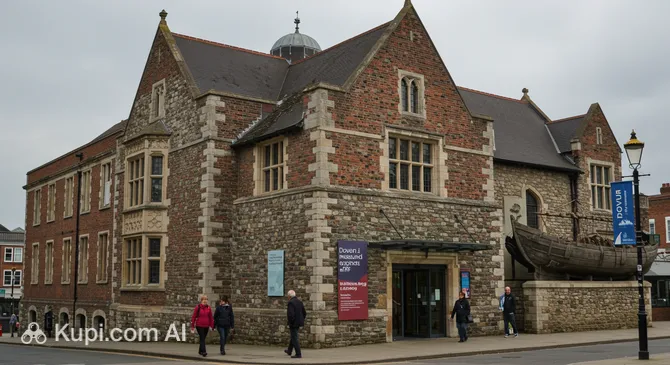
Dover Museum and Bronze Age Boat Gallery
Dover Museum and Bronze Age Boat Gallery. Иллюстрация. Источник: Kupi.com AI

The crown jewel of the collection is the famous Dover Bronze Age Boat, estimated to be over 3,500 years old. This wooden vessel, found by archaeologists in 1992, is considered the world's oldest known prehistoric seagoing craft. The gallery dedicated to this incredible find was officially opened by the Queen and has become a major landmark for tourists visiting a country like the United Kingdom.

The museum spans three floors, each dedicated to a specific era of the town's life. Here you can find everything from large-scale dioramas of the Roman conquest to detailed models of Dover's fortifications. Interactive exhibits make the visit engaging even for the youngest travelers, allowing them to literally touch the past of one of England's oldest ports.

Contacts

To contact the Dover Museum administration, you can use the details provided below. Staff members are always ready to answer visitor questions regarding current exhibitions or group visit arrangements.

Below is the contact information to help you plan your visit:

How to contactContact
AddressMarket Sq, Dover CT16 1PH, Великобритания
Phone+44 1304 201066
Websitewww.dovermuseum.co.uk

What to Do

The highlight of your visit will undoubtedly be the specialized gallery on the second floor, which houses the original Bronze Age Boat. Here, you can not only see the surviving fragments of the ancient oak hull but also use information panels and 3D reconstructions to understand exactly how such vessels were built and operated thousands of years ago. It is a rare opportunity to peer into the world of Britain's prehistoric mariners.

In the archaeology gallery, be sure to look for the impressive diorama depicting Emperor Claudius's entry into Richborough on the back of an elephant. Life-sized, realistic figures of Celts and Roman legionnaires create an immersive experience of the era of ancient conquest. Visitors can also view precious treasures from the Langdon Bay hoard, which was recovered from the seabed and contains numerous bronze artifacts.

For those interested in more recent history, the museum offers detailed displays about Dover Castle and the famous Cinque Ports. You can study ancient maps, navigational instruments, and documents that tell the story of how the town protected England's shores for centuries. Regularly updated temporary exhibitions add something new to every visit, highlighting private collections or local archaeological finds from the region.

Getting There

The Dover Museum and Bronze Age Boat Gallery is located in the heart of the town on Market Square, making it easily accessible for any traveler. If you arrive in Dover by ferry or train, a walk to the museum is a pleasant way to start your tour, as it is situated within the main pedestrian zone.

For those traveling by rail, the nearest station is Dover Priory. The walk from the station to the museum takes about 10–15 minutes at a leisurely pace. If you are coming from London, high-speed trains from St Pancras station reach Dover in approximately one hour. You can also reach Market Square by city bus, as most routes stop in the immediate vicinity of the museum entrance.

Drivers should keep in mind that the museum is located in a busy area. Parking can be found right on Market Square or at one of the multi-story car parks in the town center. For easy navigation, use the official address or GPS coordinates, which will lead you directly to the main doors of this historic building.

Ближайший город: Dover

History & Facts

The history of this site is inextricably linked to one of the most significant archaeological discoveries of the 20th century. In 1992, during roadworks in the town center, the Dover Bronze Age Boat was discovered. Dating back to approximately 1575–1520 BC, the vessel surprised scientists with its preservation: the oak planks, lashed together with yew branches, had remained buried for over three and a half millennia.

To properly present this unique artifact to the world, a dedicated gallery was created on the museum's second floor. It was officially opened by Queen Elizabeth II on July 20, 1999. Since then, the exhibition has become a national treasure, showcasing the remarkable maritime skills of the ancient inhabitants of the British Isles long before the Roman arrival.

The museum's collection itself spans a vast timeline. It houses evidence of the Roman invasion in 43 AD, when Emperor Claudius landed on these shores, as well as artifacts from the era of the Cinque Ports—a medieval confederation of coastal towns. The museum's exhibits have been gathered over decades to tell the story of Dover as a vital defensive and trading hub for England.

Time Needed

Visitors typically spend 1.5 to 2 hours exploring all three floors of the exhibition. This is usually enough time to carefully examine the Bronze Age Boat, view the Roman artifacts, and get acquainted with the models of the old town. The museum is designed very compactly and logically, so you won't feel fatigued from long walks between displays.

If you are traveling with family, you should set aside a bit more time—around 2.5 hours. Children often linger at the interactive stations and dioramas, and the chance to take part in educational quizzes or examine the detailed figures of knights and legionnaires usually brings them great delight.

Working Hours

The museum follows a standard schedule: doors are open to visitors from 09:30 to 17:00, Monday through Saturday. This convenient timing allows you to combine a visit to the gallery with a walk to Dover Castle or a stroll along the seafront.

It is important to keep seasonal changes in mind: between October and March, the museum is typically closed on Sundays. From April to September, it is open on Sundays as well, but on a reduced schedule—from 10:00 to 15:00. The museum is closed on public holidays such as December 25–26 and January 1, so it is recommended to check the official website for the most up-to-date opening hours before your trip.

DayWorking hours
понедельник09:30–17:00
вторник09:30–17:00
среда09:30–17:00
четверг09:30–17:00
пятница09:30–17:00
суббота09:30–17:00
воскресеньеЗакрыто

Nearby

After meeting prehistoric mariners and Roman warriors, it is worth spending time exploring other interesting sites located within walking distance. The center of Dover is rich in historical monuments that allow you to literally trace the development of British fortification and architecture through the centuries.

Many of these attractions are just a 10–15 minute walk from the museum, making it easy to create a feature-packed walking route:

NameDistance
Aspendos0.1 km
St James Retail and Leisure Park0.2 km
Dover Marina Hotel & Spa0.3 km
Western Heights of Dover0.4 km
The White Horse0.4 km
Dover Beach0.4 km
Secret Wartime Tunnels0.7 km

Reached the end of the page?

That means the route is fully explored