Support

Logan International Airport

Airports in the city

About the Airport

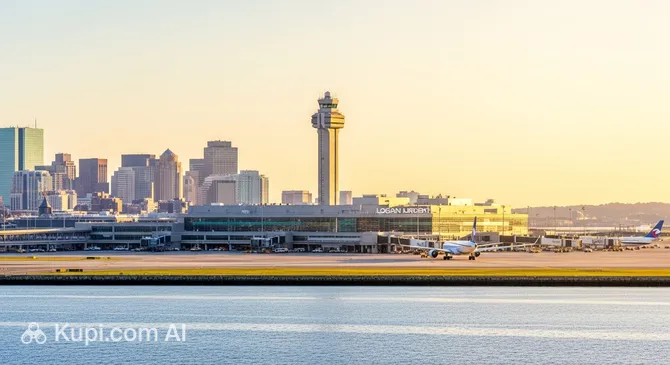
Logan International Airport. Source: Kupi.com Binoculars

Logan International Airport is not merely the air gateway to Boston and New England, but a unique transport hub situated directly on the shores of Boston Harbor. Its proximity to the city centre makes it one of the most convenient airports in the USA, allowing travellers to reach the heart of historic districts in mere minutes. Since its opening in 1923, the airport has grown significantly and is today one of the busiest in the country, combining historical significance with modern technology to serve millions of passengers.

For the convenience of travellers, essential information about the airport is presented below.

IATA Code BOS
ICAO Code KBOS
City Boston
Distance to Centre 5–8 km
Status International
Passengers per Year approx. 41 million (2023)
Popular Airlines Delta Air Lines, JetBlue Airways, American Airlines.
Schedule Online Flight Board "Logan International Airport"

Features and Advantages of the Airport

The main advantage of Logan Airport is its exceptional proximity to downtown Boston. This allows travellers to choose from a multitude of quick and convenient ways to reach the city. At your service are not only taxis and shuttles but also public transport: the free Silver Line bus will take you to South Station, from where you can transfer to the Red Line of the subway. You can also use the Blue Line of the subway from "Airport Station," which is connected to the terminals by free shuttle buses. And for those seeking unique experiences, a water taxi is available, which will whisk you to the Boston waterfront in just 7-10 minutes.

The airport consists of four terminals — A, B, C, and E, which are connected by walkways and shuttle buses for passenger convenience. Most international flights are handled in Terminal E, where customs and immigration services are located. The airport is constantly being modernized to make the passenger experience even more comfortable; for example, work is underway to create a unified security zone that will allow free movement between all terminals after passing screening. Additionally, located within the airport grounds is a memorial dedicated to the events of September 11, 2001, in memory of the passengers and crew of the flights that departed from Boston that day.

Contact Information

  • Official Website: www.massport.com/logan-airport
  • Information Phone: (800) 23-LOGAN (235-6426). This is a toll-free line available 24/7.
  • Address: Boston Logan International Airport, 1 Harborside Dr, Boston, MA 02128, USA
  • Email: A direct email address for general inquiries is not provided. It is recommended to use the feedback form on the official website for communication.
  • Social Media: Current information and news can be found on the airport's official pages on Facebook, X (formerly Twitter) (@BostonLogan), and Instagram.
  • Lost and Found: For items lost on the plane or checked luggage, you should contact your airline directly. If you left something in the terminal or at a security checkpoint, contact the Massport Lost and Found service via their website.
  • Passenger Support: For assistance and answers to questions, you can use the information phone line or the online chat on the airport's website.

How to Get to the Airport

Getting to Logan International Airport (BOS) from the centre of Boston can be done in several ways, each having its own advantages depending on your budget, time, and amount of luggage. The airport is located just a few kilometres from the city centre, but due to heavy traffic, travel time can vary significantly.

Public Transport (MBTA) — this is the most economical method. You have several options:

  • Subway (The "T"): The Blue Line will take you to "Airport" station, from where a free Massport shuttle runs to all terminals (routes 22, 33, 55). Another excellent option is the Silver Line bus (Silver Line SL1), which departs from South Station and goes directly to the terminals, stopping at each one. The trip on the SL1 from South Station to the airport is free.
  • Water Taxi: A unique and scenic way to avoid traffic jams. Several companies offer trips from the airport dock to various points in downtown Boston, including Long Wharf and Seaport. It is faster than a taxi during rush hour and offers magnificent views of the city.

Taxis, Ride-sharing, and Transfers. A trip by taxi or via apps like Uber and Lyft from the city centre will take from 15 to 40 minutes depending on traffic. This is a convenient but more expensive option, typically costing between 25-45 dollars. For large groups or families with a lot of luggage, a private transfer can be booked in advance.

By Car and Parking. If you are driving your own or a rental car, the airport has several parking options. The Central Parking Garage is located within walking distance of all terminals and is convenient for short-term parking. For longer trips, it is more cost-effective to use the Economy Parking, from where free shuttles run to the terminals. All car rental agencies are located in a unified centre (Rental Car Center), connected to the terminals by special buses.

Our Tip: If you are travelling light, the Silver Line (SL1) is the perfect balance of price and convenience. For those wanting a unique experience and to avoid traffic, the water taxi will be an unforgettable start or end to your trip to the USA. Always allow extra time for the journey, especially during morning and evening rush hours.

Additionally, there are other airports in the region that might be convenient depending on your route. Among them are Manchester-Boston Regional Airport (MHT), located approximately 71 km away, Rhode Island T.F. Green International Airport (PVD) in Providence (79 km), as well as airports in Worcester, Provincetown, and New Bedford.

Terminals and Map

Logan International Airport in Boston is a large and modern transport hub, the structure of which is well thought out for passenger convenience. The airport consists of four passenger terminals: A, B, C, and E. Each of them serves specific airlines and destinations, so it is important to check which terminal your flight departs from before your trip.

All terminals are arranged in a semicircle and are connected to each other both by pedestrian walkways (mostly before the security zone) and by free shuttle buses. Navigation inside the airport is intuitive thanks to numerous signs. Departure zones with gates and check-in counters are traditionally located on the upper levels, while arrival and baggage claim zones are on the lower levels.

Terminal Features:

  • Terminal A: Primarily used by Delta Air Lines. It consists of a main building and a satellite concourse connected by a convenient underground walkway.
  • Terminal B: The largest terminal, divided into north and south sections. Major carriers such as American Airlines, United Airlines, Air Canada, and Spirit are based here.
  • Terminal C: The main hub for JetBlue, also serving Aer Lingus and Cape Air flights. The terminal is known for its large selection of shops and restaurants.
  • Terminal E (John A. Volpe International Terminal): This is the international terminal serving most flights outside the USA (except for those with pre-clearance). It has been recently modernized and expanded.

To move between terminals, you can use the free shuttle buses, which run around the clock on several routes, connecting all terminals, the Blue Line subway station, the rental car centre, and the ferry dock. Additionally, Terminals A, B, and E are connected by pedestrian walkways after the security zone, which is convenient for certain transfers.

It is recommended to allow sufficient time for check-in and security screening. For domestic flights, you should arrive at the airport 1.5–2 hours before departure, and for international flights — at least 3 hours prior. During peak hours and holidays, waiting times may increase. To speed up the process, you can use the TSA PreCheck service if it is available for your flight.

Airport History

Logan International Airport (BOS) is not just a transport hub, but a true living history of aviation in the USA. Its story began back in 1923, when it was opened as a military airfield named Jeffery Field. Initially, it served as a base for the US Army Air Corps and the Massachusetts National Guard. A few years later, in 1927, Charles Lindbergh landed here after his famous transatlantic flight, which drew immense attention to the airfield.

The airport received its modern name in 1943 in honour of General Edward Lawrence Logan — a hero of the Spanish-American War hailing from Boston. After World War II, a period of rapid growth began: new terminals were built, runways were extended to accommodate the first jet liners, and in the 1950s, the airport began serving the first transatlantic flights, officially receiving international status.

A significant stage in development was the construction of the John A. Volpe International Terminal (Terminal E) in 1974, which significantly expanded the geography of flights. However, the airport's history is marked by the tragic events of September 11, 2001. Two of the four hijacked planes departed from Logan. This event forever changed the airport, leading to a radical review and strengthening of security measures, which became a model for air hubs around the world.

In the 21st century, Logan Airport has continued to modernize. In 2005, Terminal A was completely rebuilt, and other terminals underwent a series of renovations aimed at improving passenger comfort and operational efficiency. Despite its relatively compact territory, wedged between the city and the bay, Logan consistently ranks among the busiest airports in the country, serving as the key air gateway to New England and an important transatlantic hub.

Services and Amenities

Logan International Airport offers passengers a wide range of services to make waiting for a flight as comfortable and productive as possible. In the terminals, you will find numerous restaurants and cafes to suit every taste: from fast-food chains to cosy establishments with full menus where you can enjoy a leisurely lunch. For shopping enthusiasts, there are Duty-Free shops, boutiques of famous brands, souvenir stalls, and bookstores where you can purchase everything needed for your journey.

Free Wi-Fi is available throughout Logan Airport, allowing you to stay connected or work while waiting for departure. For charging electronic devices, there are numerous charging stations conveniently located in waiting areas and at boarding gates. For business travellers, business centres and conference rooms equipped for meetings may be available.

For those who value enhanced comfort, airline lounges and VIP lounges operate at the airport. They offer a secluded atmosphere, complimentary snacks, beverages, and other privileges. If you have a long layover or an early flight, you can stay at one of the hotels located directly on the airport grounds or within walking distance of the terminals.

Logan Airport also provides all necessary practical services. There are banks, ATMs, and currency exchange points. In case of illness, medical stations are available. For passengers with children, special nursing rooms and play areas are equipped. The airport is fully adapted for passengers with reduced mobility: wheelchairs are provided upon request, elevators and ramps are operational, and staff are trained to provide necessary assistance.

Where to Eat

Logan International Airport (BOS) offers a wide selection of establishments for every taste and budget, from a quick snack on the run to a leisurely dinner overlooking the runway. Most cafes and restaurants are located in the "airside" zone, meaning after passing security control, so you can eat peacefully while waiting for your flight.

Once in Boston, one cannot miss the chance to try the famous cuisine of New England. The flagship of local gastronomy at the airport is the Legal Sea Foods chain of restaurants, which can be found in several terminals. Here, it is worth ordering their legendary clam chowder or a juicy lobster roll. This is an excellent choice for a full lunch or dinner and an opportunity to experience local delicacies without leaving the airport.

The choice of establishments depends on your terminal:

  • Terminal A: Here you can find the Harpoon Tap Room, serving local beverages and classic casual dishes, or visit Currito for burritos and bowls.
  • Terminal B: This large terminal offers many options. Besides the aforementioned Legal Sea Foods, there is Stephanie's serving classic American cuisine, as well as Kelly's Roast Beef, where you can try famous roast beef sandwiches — another iconic taste of the region.
  • Terminal C: Try burgers from the local chain Wahlburgers or enjoy exquisite dishes at Davio's Northern Italian Steakhouse if you have enough time and are looking for something special.
  • Terminal E (International): Restaurants catering to an international audience are located here, for example, Vineyard Grille, offering American cuisine in a relaxed setting.

For those in a hurry, there are plenty of options for a quick snack in every terminal. This includes, of course, the ubiquitous Dunkin' (a true symbol of New England), Starbucks, as well as various grab-and-go cafes and kiosks where you can buy sandwiches, salads, and drinks. Regarding prices, be prepared that they will be slightly higher than in the city, as in most airports around the world. The cost of a snack starts from $10-15, while a full meal in a restaurant will cost $30-50 and up per person.

Travellers with special dietary needs will also find suitable options. Many restaurants offer vegetarian and gluten-free dishes — simply ask the waiter. In places like B.GOOD or Currito, it is easy to assemble a vegan salad or bowl. Finding certified Halal food may present a challenge, so it is best to check the specific ingredients of dishes at each establishment. The operating hours of most restaurants correspond to the flight schedule, but some fast-food outlets may operate around the clock or close late at night.

Travel Tips

To ensure your journey through Logan International Airport in Boston goes as smoothly as possible, make use of these proven tips. Proper preparation will help save time, money, and stress, making the start of your trip pleasant.

Arrival Time and Check-in. For domestic flights within the USA, it is recommended to arrive at the airport 2-3 hours before departure, and for international flights — 3-4 hours prior. Logan can be very busy, especially in the morning hours and during holiday periods. To save time, complete online check-in for your flight and print or save your boarding pass to your phone in advance.

Passing Security Control. Have your passport and boarding pass ready. Be prepared to remove laptops and other large electronics, as well as your bag of liquids, from your hand luggage. Remember the 3-1-1 rule: liquids in containers no larger than 100 ml (3.4 oz) must be packed in a single transparent bag with a volume of no more than 1 litre. To speed up the process, wear comfortable clothing and shoes that are easy to remove.

Seat Selection and Hand Luggage. When choosing a seat on the plane, consider your preferences: a window seat offers beautiful views during takeoff and landing, whilst an aisle seat allows you to stand up freely. Seats at emergency exits usually offer more legroom but may cost more. It is prohibited to take sharp objects, weapons, and flammable substances in hand luggage. Always check the current rules on your airline's website.

Tips for Connecting Passengers. Free Massport shuttles run between the terminals of Logan Airport. Study the airport map in advance to understand how to get to your required gate. If you have an international transfer to a domestic flight, you will need to pass border control, collect your luggage, pass customs, and then re-check your luggage at the counter for transit passengers.

Customs Control. Upon entering the USA, you will need to complete a customs declaration (often done electronically at kiosks). Be prepared to answer the border officer's questions about the purpose of your visit, duration of stay, and goods you are bringing in.

Saving Time and Money. To get to or from the airport, use public transport — the Blue Line subway or the Silver Line bus. This is significantly cheaper than a taxi. Bring an empty water bottle with you and fill it after passing security at one of the drinking fountains. Also, booking parking online in advance can save you a significant amount.

In Case of Flight Delay. First, contact your airline representative for information and possible options (for example, rebooking on another flight). Learn about your rights as a passenger — in some cases, you may be entitled to vouchers for food or hotel accommodation. Logan Airport has many cafes, shops, and rest areas to pass the waiting time.

Reached the end of the page?

That means the route is fully explored