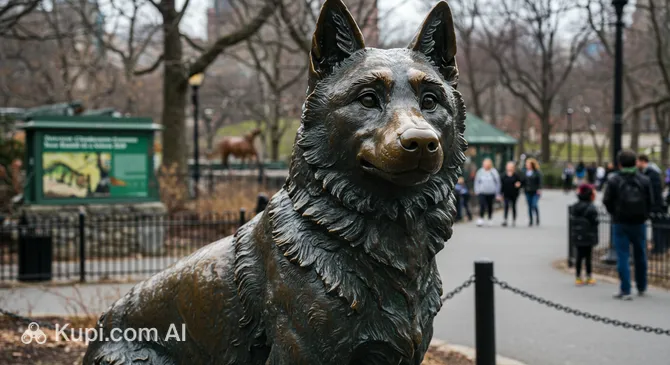
The Balto Statue is a touching bronze monument dedicated to the legendary Siberian Husky who became a national hero in the USA. Erected in 1925 in New York's Central Park, near the boundary with the Bronx, the monument immortalizes the feat of the sled dogs that saved an entire town from an epidemic.
The sculpture depicts Balto in his harness, poised on a rocky granite pedestal. His gaze is fixed forward, conveying the determination and endurance required of the dog and his musher during the famous "serum run" across snowy Alaska. Today, it is one of the most beloved and visited monuments in the park, attracting both adults and children.
Balto Statue. Illustration.
Source: Kupi.com AI
Traveler photos:
The statue's status as a symbol of loyalty and courage adds to its special value. The monument serves as a reminder of the deep bond between humans and animals, and of the boundless devotion capable of overcoming any natural element. The Balto Statue is not just a landmark, but a true legend cast in metal.
Contacts
Since the Balto Statue is an outdoor monument in a public area of Central Park, it does not have its own office or reception desk. For up-to-date information on visiting rules or events in this part of the park, it is recommended to refer to the official resources of the New York City Department of Parks & Recreation.
Before planning your visit, you should check the park's operating hours and any potential access restrictions to the monument on the official Central Park administration website.
Visiting the Balto Statue is, above all, an opportunity to touch a piece of living history. One of the kindest traditions here is rubbing the bronze dog's ears and back "for good luck." Over many decades, these parts of the sculpture have been polished to a golden shine by the hands of millions of visitors, making the monument feel exceptionally warm and "alive."
For tourists, this spot is an ideal location for photos. The monument looks particularly striking against the park's changing scenery—be it golden autumn foliage or snow-covered rocks in winter—perfectly capturing the spirit of northern adventures. Children often try to climb onto the pedestal to take a photo hugging the hero of the famous animated movie.
Furthermore, it is a wonderful stop during an educational walk. Many people come here to tell their children the real-life story of courage and mutual aid that stands behind this monument. Its convenient location allows you to combine a visit to Balto with a trip to the Children's Zoo or a relaxing break on the nearby lawns of Central Park.
Getting There
The Balto Statue is located on the east side of Central Park, near 67th Street. Although the data might mention the Bronx, the monument is actually situated in the heart of Manhattan, on a rocky outcrop right off East Drive. The Central Park Zoo, located just south of the monument, serves as an excellent landmark.
The easiest way to get there is by subway. The nearest stations are 5th Ave/59 St and 68th St–Hunter College. After exiting the subway, it is about a 10-minute walk through the park's scenic paths. City buses also provide convenient access to the park entrances along Fifth Avenue.
For those traveling by car, it is recommended to leave your vehicle at paid parking garages in the Upper East Side. Since private vehicle access to the park itself is restricted, the final part of the journey must be made on foot, following signs toward Willowdell Arch or the zoo.
Nearest city: Bronx
History & Facts
The bronze Balto monument was created by the renowned American animalier sculptor Frederick Roth. The statue was installed in 1925, just 10 months after the news of the dogs' heroic feat in Alaska reached the world. Remarkably, Balto himself was present at the unveiling ceremony, making this a unique case of an animal receiving such recognition during its lifetime.
The monument commemorates the legendary "Great Race of Mercy." During a harsh Arctic winter when air travel was impossible, a relay of dog sled teams covered more than a thousand kilometers to deliver life-saving serum to the city of Nome, where a diphtheria epidemic had broken out. Balto led the team on the final, most grueling leg of the journey through nearly zero-visibility conditions.
The inscription on the pedestal states that the monument is dedicated to the "indomitable spirit of the sled dogs." Over the decades, the statue has become not only a symbol of loyalty and endurance in the USA but also one of the most popular meeting spots in the park. Today, Balto is a cultural hero whose story has inspired numerous books and a famous animated film.
Time Needed
A quick visit to see the Balto Statue usually takes about 15–20 minutes. This is enough time to admire the details of the bronze casting, read the touching inscription on the granite base, and take a few commemorative photos.
However, given its location, a visit is rarely limited to the monument alone. If you plan to walk along the surrounding paths or visit the nearby Central Park Zoo, you should set aside about 1.5–2 hours. In winter, when the park is blanketed in snow, the atmosphere is particularly conducive to peaceful contemplation.
Working Hours
Since the Balto Statue is located in an open area of Central Park, access to it is governed by the park's general operating hours. The park is open to visitors daily from 6:00 AM to 1:00 AM.
There are no specific operating hours or closed days for the monument itself, so you can visit the legendary dog at any time that is convenient for you within the park's hours. In the evening, the area is illuminated, giving the sculpture on the rock a particularly solemn and majestic appearance.
6:00 – 1:00
Nearby
A stroll to the Balto monument is a great excuse to explore other iconic nearby spots. Its location on the east side of Central Park makes it easy to include a visit to the picturesque Bow Bridge, considered one of the most romantic places in New York thanks to its elegant design and lake views.
For those seeking cultural enrichment, the Museum of Arts and Design is within walking distance, offering a look at contemporary decorative works. Combining a fresh-air walk with visits to such diverse locations will make your day both fulfilling and memorable.