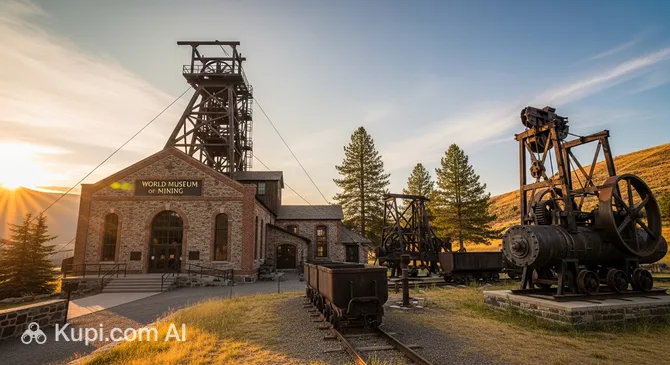
Imagine a place where time stands still in the era of the great "copper fever." The World Museum of Mining is a unique historical open-air complex sprawling across 22 acres in the city of Butte, USA. It is located on the site of the actual abandoned Orphan Girl mine, making it one of the most authentic museums of its kind in the world.
World Museum of Mining. Illustration.
Source: Kupi.com AI
Traveler photos:
The main highlight of this place is the incredible attention to detail. An entire 1890s mining town named Hell Roarin’ Gulch has been recreated here. Walking through its streets, you will see more than 50 buildings: from an old Chinese laundry and a bank to saloons and a schoolhouse. Each structure is filled with genuine artifacts, allowing you to literally touch the daily lives of the people who worked on the "Richest Hill on Earth."
Towering over the site is a majestic 100-foot steel headframe, which has become a symbol of the region's industrial might. Opened in 1965, the museum is now a major educational center that introduces guests to the technologies of copper, silver, and zinc mining, as well as the challenging fates of mining families in the early 20th century.
Contacts
For more details or to book a tour, you can use the museum's official contact information.
Begin your adventure with a stroll along the dusty streets of Hell Roarin’ Gulch. Pop into the local bank, pharmacy, or saloon—inside, everything looks as if the owners just stepped out for a moment. Be sure to notice the heavy industrial equipment: massive hoisting mechanisms and the cages used to lower miners into the dark depths of the earth.
The most thrilling experience awaits you underground. The museum offers tours of the Orphan Girl mine to a depth of about 100 feet (30 meters). You can see an actual silver vein, feel the cool air of the underground galleries, and hear fascinating stories from guides about a typical miner's workday. Important: these tours are best booked in advance as space is limited.
In addition to viewing the machinery, it is worth visiting the memorial for fallen miners to pay tribute to those whose labor built the prosperity of Montana. Since most of the exhibits are outdoors, wear comfortable shoes and dress for the weather. Incidentally, your admission ticket grants you access to the main grounds for two consecutive days, so there is no need to rush.
Getting There
The museum is located at 155 Museum Way in the western part of the city, right behind the Montana Tech campus. If the road appears to lead to a dead end behind the university buildings as you approach, don't worry—just follow your GPS, and you will arrive right at the entrance gates.
The most convenient way to get there is by car. The drive from the city center takes about 10 minutes via MT-1 West (Tyler Road). The site is located near the intersection of major highways I-15 and I-90, and there is ample free parking available on-site for visitors.
Public transportation in this area is limited, so for a comfortable trip, it is better to call a taxi or use a rental car. If you are already in the university area, the museum entrance is just a few minutes' walk away.
Nearest city: Butte
History & Facts
The history of this site began in 1875, when the Orphan Girl mine was first opened. Unlike most neighboring mines, it specialized not in copper but in silver, and later in zinc and lead. The mine was actively worked until 1956, reaching an impressive depth of 975 meters (3,200 feet).
The city became world-famous as the "Richest Hill on Earth." During the mining boom, immense fortunes were made here, and thousands of immigrants from all over the world created the region's unique cultural identity. The museum was founded in 1963 to preserve the memory of this era and pass the miners' legacy on to future generations.
The exhibits pay special attention not only to technology but also to social history. The memorial for fallen miners serves as a somber reminder of the human cost of extracting the earth's riches. Here, you can learn about the birth of the labor union movement and how engineering technologies transformed the life of the entire state over the course of a century.
Time Needed
To fully explore the exhibits, it is recommended to set aside 2 to 4 hours. The museum grounds are quite extensive, and just visiting the reconstructed mining town with its authentic interiors can take a significant amount of time.
If you plan to take an underground tour, be sure to budget extra time. Many tourists expect to drop in for half an hour but end up staying for half a day, fascinated by the domestic details and the sheer scale of the industrial machinery.
Working Hours
The museum's schedule changes significantly depending on the time of year. During the winter period (including February), the complex is typically closed on Mondays and Tuesdays. From Wednesday to Saturday, the gates are open to visitors from 11:00 AM to 3:30 PM. The museum is also closed on Sundays.
From April 1st until the end of October, the museum switches to daily operations from 10:00 AM to 5:00 PM. Please note that underground tours require separate booking (at least 72 hours in advance). Since 95% of the exhibits are outdoors, operating hours may be reduced in the event of extreme weather conditions, so it is a good idea to check the official website before your visit.
Day
Working hours
Monday
Закрыто
Tuesday
Закрыто
Wednesday
11:00–15:30
Thursday
11:00–15:30
Friday
11:00–15:30
Saturday
11:00–15:30
Sunday
Закрыто
Nearby
After immersing yourself in the world of mining, it is worth taking the time to see other interesting sites in the city. Butte is literally steeped in history, and many landmarks are just a short drive or even a walk away from the museum.
Exploring the surrounding area will allow you to see the magnificent mansions of former "Copper Kings," old memorials, and industrial monuments that still shape the unique silhouette of this mining region.