Support

UF Bat Houses

About

Imagine a place where the sky literally comes alive at sunset. The University of Florida Bat Houses (UF Bat Houses) are not just an animal shelter, but the world's largest artificial settlement for bats. Located in the city of Gainesville, these unique structures on the campus in the USA have become home to a colossal colony of up to 750,000 individuals.
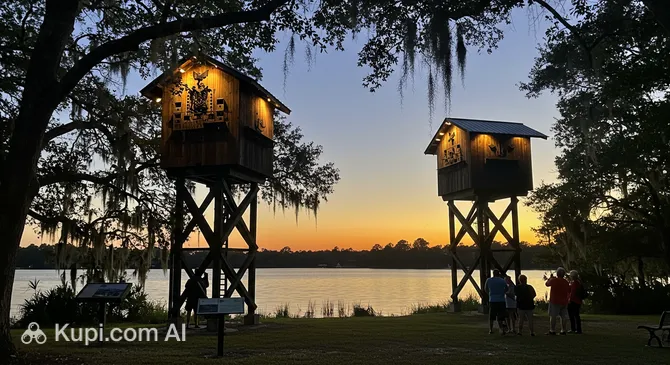
University of Florida Bat Houses. Source: Kupi.com AI

Three specially designed houses serve as a safe place for Brazilian free-tailed bats to overwinter and raise their young. These fascinating creatures play a key role in the local ecosystem: in a single night, the colony destroys tons of harmful insects, including mosquitoes. The interiors are designed with partitions that mimic natural caves, making them an important site for scientific research.

The main reason tourists flock here is the evening emergence. At sunset, thousands of bats leave their houses simultaneously, forming giant living spirals and dark "rivers" in the sky. This breathtaking natural show makes the UF Bat Houses one of the most unusual and memorable attractions in the state.

Contacts

For those who want to learn more about the lives of bats or clarify details before their visit, the site administration provides the following contact information:

Official website floridamuseum.ufl.edu/bats
Address Museum Rd, Gainesville, FL 32611, USA
Google Maps Open map

What to Do

The most important and unforgettable activity here is watching the emergence of the colony. About 15–20 minutes before sunset, hundreds of thousands of bats begin to leave their homes, creating incredible "living streams" in the sky. It is best to take a position on Museum Road in advance. The spectacle is completely safe: the bats use echolocation to fly around obstacles and are focused solely on finding their prey—insects.

While you wait for the right moment, we recommend a stroll to Lake Alice, which is right across the way. There you can often see alligators basking in the sun and slow-moving turtles. This place is perfect for families, as it combines elements of wildlife and educational leisure. Children are usually thrilled by the scale of the event and the chance to see wild animals in their natural habitat.

If your trip is planned for spring or summer, you will catch the colony's peak activity. It is also useful to check if your visit coincides with the Florida Bat Festival, where you can learn a lot of interesting facts about conservation and participate in themed events. Don't forget your camera—the spirals of bats against the sunset sky look incredibly cinematic.

Getting There

Finding the famous bat houses is easy: they are located on Museum Road, right across from the scenic Lake Alice on the University of Florida campus. If you are traveling by car, use the address Museum Rd, Gainesville, FL 32611. Parking is available nearby on campus, though keep in mind that spaces fill up quickly on popular evenings.

For those who prefer public transport, the Gainesville Regional Transit System (RTS) buses stop within walking distance of the university facilities. If you are staying in the city center or student quarters, the walk will take about 20–30 minutes.

Given the size of the campus, a taxi ride from the city center is the fastest and most convenient option. It is recommended to arrive at least 30 minutes before sunset to comfortably find a spot and avoid rushing before the natural show begins.

History & Facts

The history of this unique site began in 1987 with a dramatic event: a fire destroyed the Johnson Hall building on the university campus. This incident left about 5,000 Brazilian free-tailed bats homeless, and they chose the campus stadiums as their new shelter. The neighborhood proved to be noisy and not very fragrant, so university management decided to build special housing for the "displaced" bats further away from the stands.

In 1991, at the initiative of renowned biologist Merlin Tuttle, the first house was erected. The relocation process was not easy: the bats caught at the stadiums initially ignored the new building and flew away. It wasn't until January 1995 that the colony finally accepted the house as its home and began to grow rapidly. By 2009, the structure even failed to support the weight of the accumulated residents and partially collapsed, requiring urgent reconstruction.

Today, the complex includes the original renovated house and two additional structures called "bat barns," built in 2010 and 2017. This project has become more than just an animal shelter; it is an important platform for scientific research on bat behavior and migration in urban environments.

Time Needed

To fully enjoy the spectacle and atmosphere of this place, an average visitor will need about 1–1.5 hours. Most of this time is spent waiting for sunset and watching the colony emergence itself, which lasts about 45–60 minutes. It is best to arrive 20–30 minutes before sunset to secure a good viewing spot.

If you have extra time, add another 30–60 minutes for a leisurely walk to Lake Alice, located right across the road. This will turn a short observation into a full evening nature walk before the bats fill the night sky.

Working Hours

The observation area can be visited daily, though you should keep the specific nature of the site in mind. According to official data, the hours of highest activity and accessibility for spectators are as follows:

  • Monday – Sunday: 18:00 – 21:00

The bats come out to hunt strictly at sunset, so their appearance time may shift slightly depending on the season. Please note that in the event of heavy rain or a cold snap, the emergence may not occur, as the animals prefer to stay warm inside their houses.

Nearby

After watching the bats, it is worth spending time exploring other interesting sites on campus and the surrounding area. A stroll through the university grounds will allow you to get to know the cultural and historical life of the city.

Attraction name Distance (km)
34th Street Wall 0.9
Bull Gator 1.4
Century Tower 2.0
Bryan Hall 2.3
WATERBABY ADVENTURES 2.9
Gainesville Escape Game 3.5
Pleasant Street Historic District 3.5
Alachua County Courthouse Historical Marker 3.8
Historic Matheson House 4.2
Boulware Springs Water Works 6.0

Reached the end of the page?

That means the route is fully explored