Support

Historic Forks of the Wabash

About

If you are looking for a place where the history of early settlers and Native Americans comes to life, look no further than the Historic Forks of the Wabash. Located in the picturesque city of Huntington, this open-air museum park is situated in the state of Indiana, USA. This unique area at the confluence of the Wabash and Little Rivers served for centuries as a strategic transportation hub between the Great Lakes and the Mississippi basin.
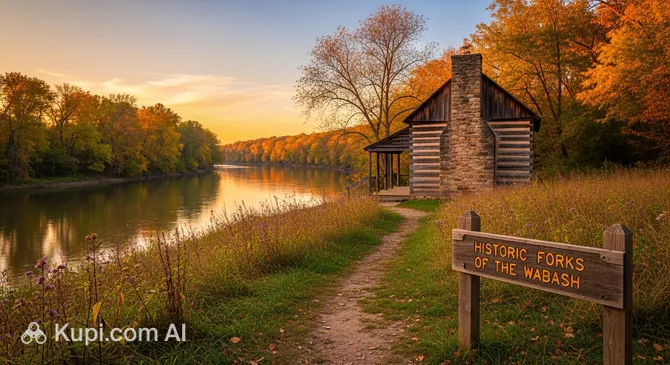
Historic Forks of the Wabash
Historic Forks of the Wabash. Иллюстрация. Источник: Kupi.com AI

Today, the complex is a combination of a museum center and a park area featuring restored historic buildings. Visitors can see the legendary Chief Richardville House, built in 1827, an old pioneer school, and log cabins from the mid-19th century. These sites allow you to literally touch the lifestyle of the Miami tribe, French fur traders, and the first white settlers who explored the wild lands of the Midwest.

In addition to architectural monuments, the Forks of the Wabash is famous for its nature trails and preserved sections of the Wabash-Erie Canal. This site is listed on the U.S. National Register of Historic Places, highlighting its significance for preserving the country's cultural heritage. Here, history doesn't feel frozen in textbooks—it surrounds you in the rustle of leaves by the river and within the walls of historic houses.

Contacts

To clarify visit details or organize a group tour, you can contact the complex's administration directly. It is recommended to check for the most current information before your trip.

How to contactContact
Address3011 W Park Dr, Huntington, IN 46750, США
Phone+1 260-356-1903
Websiteforksofthewabash.org

What to Do

A visit to this historic complex offers guests a unique balance between an educational walk and outdoor relaxation. Start your visit at the museum center, which houses rare artifacts, documents, and exhibits telling the story of the Miami Indians and the construction of the longest canal in the Western Hemisphere. Interactive elements will help children and adults better understand how the port functioned and how the region's transportation system developed.

Of particular interest is a tour of the historic buildings. You can peek inside the Chief Richardville House, restored to its 1846 appearance, visit an authentic 1880s Pioneer School with its austere interior, and see the Nuck Log House, a classic example of early settler housing. These structures create a unique atmosphere of the past that is hard to find in modern metropolises.

Outdoor enthusiasts will enjoy the hiking trails totaling about 2 miles. The routes run along the banks of the Wabash River and the old canal bed, where engineering traces of a bygone era can still be seen. It's an ideal spot for leisurely walks, birdwatching, or a family picnic surrounded by ancient trees, where the silence is broken only by the sounds of water and nature.

Getting There

The easiest way to reach the historic complex is by car. The site is located at 3011 W Park Dr in the city of Huntington. If you are coming from Fort Wayne, the trip takes about 30 minutes (approximately 25 miles) via US-24 West, after which you should turn south onto SR-9 and follow it to Park Drive. From downtown Huntington, the trip by car or taxi will take no more than 10 minutes.

For travelers using their own transport, free parking is provided on the grounds. If you prefer a taxi, you can easily call one through popular mobile apps from anywhere in the city. There is no direct public transportation service to the park entrance, so a car remains the most convenient option.

Outdoor enthusiasts might consider arriving by bicycle, as the complex is integrated into the local trail network. The site is also accessible for those traveling by motorhome (RV), thanks to convenient access routes from the main highways I-69 and IN-9.

Ближайший город: Huntington

History & Facts

The confluence of the Wabash and Little Rivers, known as the "Forks of the Wabash," was considered one of the most strategically important points in North America for centuries. It served as a key portage point, allowing goods to be carried between the Great Lakes and Mississippi River basins. In the 17th and 18th centuries, French traders actively used this route to transport furs from New France to New Orleans, paying a toll to the Miami tribe, who controlled these lands.

A special role in the region's history was played by Jean-Baptiste de Richardville (Chief Richardville), who became the wealthiest man in Indiana in his time. In 1827, he built a Greek Revival-style house here, which has survived to this day. It was on this territory that the crucial treaties of 1834, 1838, and 1840 were signed, determining the fate of indigenous lands and paving the way for the large-scale settlement of white colonists.

The era of change arrived in 1835 with the opening of a section of the Wabash-Erie Canal. This grand engineering project, 468 miles long, made the traditional portage less necessary but brought prosperity to the valley. Later, Chief Francis La Fontaine built his residence here, maintaining the status of this site as a decision-making center for the Miami tribe until the mid-19th century.

In 1985, the complex was rightfully included in the U.S. National Register of Historic Places under the name Chief Richardville House and Miami Treaty Grounds. Today, it is a living monument to two centuries of history, where the fates of Native Americans, French traders, canal builders, and early American pioneers are intertwined.

Time Needed

To leisurely explore all the key sites of the historic complex, an average tourist typically needs 2 to 3 hours. This is sufficient time to visit the museum exhibits, tour the preserved historic buildings, and walk the scenic trails.

If your goal is a deep dive into history with a visit to all buildings, including the Chief's House and the old school, as well as a full hike along the remains of the Wabash-Erie Canal, it is better to set aside about 4 hours. This format is especially recommended for families with children and photography enthusiasts, as the park territory offers many beautiful photo opportunities at different times of day.

Working Hours

The museum center and the historic buildings of the complex do not have a fixed daily schedule and most often open their doors by prior appointment or during special events and school tours. To get inside the houses and study the exhibits in detail, visitors are strongly encouraged to contact the administration in advance or check for current announcements on the complex's official website.

At the same time, the outer territory of the park and its scenic trails along the river and canal are generally open for self-guided visits daily during daylight hours. This allows tourists to view the facades of historic buildings and enjoy nature even on days when the museum itself is closed to visitors.

Nearby

After immersing yourself in the region's history at the Forks of the Wabash, it's worth taking time for other interesting locations in the city of Huntington. The surrounding area offers both historic monuments and cozy spots to relax and share your impressions of what you've seen.

Below are the nearest attractions and establishments that will help make your trip more fulfilling:

NameDistance
The Country Post2 km
Wings Etc.2.5 km
Brick House Grill3.2 km
Nick's Kitchen3.3 km
Homier Park4.4 km

Reached the end of the page?

That means the route is fully explored