Support

Koyuk Airport

About the Airport

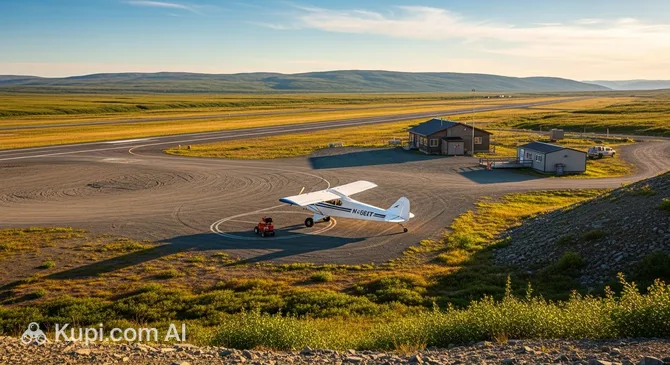
Koyuk Alfred Adams Airport (KKA) is not just a runway in the vast Alaskan wilderness, but a true aerial haven for the secluded settlement of Koyuk. Located on the coast of Norton Sound, it serves as a vital artery connecting this remote corner of the USA with the rest of the world. For travellers seeking authentic experiences, arriving here marks the first step into an exciting adventure through the wild and beautiful nature of the North.

Koyuk Airport. Source: Kupi.com Binoculars
IATA Code KKA
ICAO Code PAKK
City Koyuk
Distance to centre approx. 2 km
Status Domestic
Annual Passengers approx. 4,000 (based on 2022 data)
Popular Airlines Bering Air, Ryan Air Alaska, Wright Air Service

The main feature of the airport is its pivotal role in the life of the local community. It ensures the delivery of mail, cargo, and, of course, passenger transport, which is carried out by small aircraft of regional airlines. The airport has one unpaved runway and offers basic amenities, which is typical for air gateways in such remote areas. Despite its modesty, Koyuk Airport is the starting point for discovering indigenous Eskimo culture, observing wildlife, and participating in traditional fishing. It is a gateway to a world where time flows differently, and nature appears in all its pristine power.

Contact Information

Koyuk Airport (KKA) is a small regional airport serving local air routes. Most operational matters, including passenger service and baggage handling, are managed directly by the airlines. Below is the primary contact information.

  • Official Website: Currently, Koyuk Airport does not have a separate official website. Up-to-date information on flight schedules and services should be sought on the websites of the airlines operating flights to this airport (e.g., Bering Air, Ryan Air).
  • Helpline: There is no unified enquiry service at the airport. For information, it is recommended to contact your air carrier directly.
  • Address: The airport is located directly in the city of Koyuk, Alaska, USA (Koyuk, AK 99753, USA).
  • Email: A dedicated email address for passenger communication is not provided.
  • Social Media: The airport does not maintain official pages on social networks.
  • Lost Luggage Information: For all issues related to lost or damaged luggage, you must contact the representative office of the airline you flew with directly.
  • Passenger Support Contacts: Passenger support regarding tickets, check-in, and special needs is provided by the operating airlines.

How to Get to the Airport

Travelling to Koyuk, a small settlement in the state of Alaska, USA, requires a special approach to logistics planning. Koyuk Airport (KKA) is located in close proximity to the village, making the journey to it quick, but transport options here differ significantly from standard urban means.

Public Transport, Taxis, and Transfers

There are no traditional forms of public transport in Koyuk, such as buses, trains, or a metro. There are also no official taxi services. Movement around the village and to the airport is primarily carried out by private transport: in summer, these are quad bikes (ATVs) and pickup trucks, and in winter — snowmobiles. The most reliable way to get from or to the airport is to arrange a transfer in advance. Usually, this service is provided by local lodging facilities, guest houses, or private individuals whom you can contact before your trip. The journey from any point in the village to the airport will take no more than 5-10 minutes.

Car Rental and Parking

There are no standard car rental agencies in Koyuk. Travellers requiring transport may try to negotiate the rental of an ATV or snowmobile with one of the local residents, but this would be an informal arrangement. Regarding parking, the airport has a small unguarded area where a vehicle can be left free of charge.

On Foot

Given the compact size of the village, it is quite possible to walk to the airport. The distance from the central part of Koyuk to the runway is about 1-1.5 km. If you have light luggage, the walk will take approximately 15-25 minutes and will allow you to better explore the surroundings.

Key Recommendations

The main advice for anyone flying to Koyuk is to plan everything in advance. Be sure to contact your place of accommodation to organise a meeting at the airport. This will save you from unnecessary hassle and ensure a comfortable start to your journey in this unique and remote corner of Alaska.

Terminals and Map

Koyuk Airport (KKA) is a small regional airport serving the local community. Its structure is extremely simple and functional, making navigation intuitively clear even for first-time visitors.

In fact, the airport has only one small terminal, which is a single building. All zones necessary for the passenger are combined here: the waiting area, the check-in counter, and the baggage claim area. There is no division into separate terminals or complex multi-level complexes found in major airports. This means you will not have to worry about transferring between terminals.

The layout of the terminal is as simple as possible. Upon entering the building, you will immediately find yourself in the general hall. The airline counter is located here, where flight check-in and baggage drop-off take place. Departure and arrival zones are not strictly demarcated — passengers walk out onto the airfield and proceed to the aircraft directly from the waiting room. Similarly, arriving passengers enter the same building from the airfield and collect their luggage.

Thanks to the compact size and simple organisation, all pre-flight procedures, including check-in and screening, take a minimum amount of time. There are no long queues typical of large airports here. Nevertheless, it is always recommended to arrive at the airport in good time, in accordance with your airline's rules. The main navigation tip is simple: it is impossible to get lost at Koyuk Airport. All services are located in one room, within direct line of sight.

Airport History

The history of Koyuk Alfred Adams Airport (KKA) is not a chronicle of massive construction projects and records, but a narrative of a vital connection to the outside world for a remote settlement. Its development is closely intertwined with the daily life and well-being of the city of Koyuk in western Alaska, within the USA.

Like many small airfields in Alaska, the exact founding date of Koyuk Airport is not widely recorded. Its history likely began in the mid-20th century, when air transport became the primary means for isolated communities to receive mail, cargo, and transport passengers. Over time, it evolved from a simple landing strip into an officially maintained airfield with a gravel runway, capable of receiving small propeller aircraft at any time of the year, weather permitting.

Key stages in the airport's history are connected not so much with major reconstructions, but with the constant maintenance of its operability. The main event is its uninterrupted operation over decades. Periodic upgrades conducted by the Alaska Department of Transportation include levelling and strengthening the runway, updating navigation lights, and maintaining the small passenger pavilion. The historical significance of KKA lies in its role as a "road of life," providing residents with access to emergency medical care and a connection to the rest of the country.

One notable fact is that the airport is named after a local resident, Alfred Adams. This highlights the community's deep respect for aviation and the people who contributed to its development in this harsh region. Thus, the history of Koyuk Airport is a vivid example of how a modest air haven becomes the heart and support for an entire village, ensuring its existence and development for many years.

Services and Facilities

Koyuk Airport (KKA) is a small regional airport serving the settlement of the same name in the state of Alaska, USA. It is important to understand that it provides basic services for passengers, and its infrastructure meets the needs of a small local community rather than a major tourist hub. When planning a trip to Koyuk, one should be prepared for a minimal set of amenities.

There are no restaurants, cafes, or shops in the airport building. Passengers are advised to carry their own snacks and beverages. A small hall is provided for waiting for flights, but it lacks VIP zones or specialised lounges. It is a simple and functional space for a short stay before departure.

Typically, in such small airports, public Wi-Fi is absent. Opportunities for charging electronic devices may be very limited, so it is best to bring a portable charger (power bank) with you. ATMs and currency exchange points are not provided in the terminal; all financial matters should be settled in advance.

Specialised services at the airport are minimal. There is no medical point here, and in case of an emergency, city services are called. There are also no playrooms for children. Passengers with reduced mobility are recommended to notify their airline in advance of the need for assistance so that staff can prepare for their arrival and ensure basic accessibility.

There are no hotels or business centres on the airport territory. Accommodation options should be sought directly in the settlement of Koyuk, where small guest houses or lodges may be available. Given the remoteness and limited supply, accommodation must be booked well in advance of the trip. Conference rooms or services for business travellers are not provided at the airport.

Where to Eat

Koyuk Airport (KKA) is a very small regional airport serving the settlement of the same name in Alaska, USA. It is important to consider that due to its compact size and remote location, the infrastructure for passengers here is extremely limited and differs from what can be found in major aviation hubs.

In the terminal building of Koyuk Airport, there are absolutely no catering outlets: there are no restaurants, cafes, juice bars, or even vending machines with snacks or drinks. The airport is designed exclusively for the basic functions of receiving and dispatching passengers and cargo over short distances.

Travellers passing through this airport are strongly advised to take care of food and drinks in advance. The best solution is to bring everything necessary with you. Opportunities to purchase groceries can be found in the settlement of Koyuk itself, although the selection there will likely be limited to a small local store. Please plan your journey taking these features into account, especially if you require specific dietary options.

Traveller Tips

When planning a departure from Koyuk Airport, remember that this is a small regional aviation hub. Unlike large international airports, there is no need to arrive 3-4 hours before departure. Generally, arriving 60-90 minutes prior to the flight departure is quite sufficient to complete all formalities without rushing. The check-in and baggage drop-off processes in Koyuk usually proceed very quickly at your airline's counter.

Security checks are organised in accordance with standard rules but proceed significantly faster due to the low passenger flow. Sharp objects and liquids in containers larger than 100 ml are prohibited in hand luggage. All liquids must be packed in a single transparent bag. We recommend checking the current requirements on the official website of the Transportation Security Administration of the USA (TSA) in advance to avoid unpleasant surprises.

Flights from Koyuk are usually operated on small propeller aircraft. In such vessels, seat selection may be limited or unavailable — sometimes seating is arranged by the pilot for proper weight distribution. If you have the option to choose, feel free to take a window seat. You will be treated to incredible views of the harsh and beautiful nature of Alaska, which will become one of the vivid impressions of the trip.

Koyuk Airport serves exclusively domestic flights, so customs control is absent here. Most routes involve a transfer at larger hub airports in Alaska, such as Nome or Anchorage. When planning connecting flights, always allow extra time, as flights in this region are highly dependent on weather conditions, and delays are not uncommon.

To save money, try to book flight tickets in advance, especially if your trip falls during the peak season. Flight prices to remote areas of Alaska can be quite high. Time savings are achieved due to the compactness of the airport itself — all procedures take minimum time. It is also useful to travel light to avoid excess baggage fees, which can be substantial with small airlines.

In the event of a flight delay or cancellation, which often happens due to bad weather, contact your airline representative first for up-to-date information. Keep in mind that waiting facilities at the airport are limited. There are no large waiting lounges or cafes here, so it is worth having a book, a charged power bank for gadgets, and a small supply of snacks with you to wait out the bad weather in comfort.
Reached the end of the page?

That means the route is fully explored