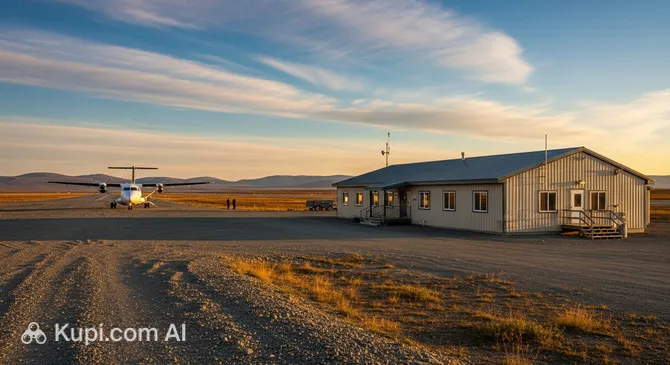
Source: Kupi.com AI
| Characteristic | Value |
|---|---|
| IATA code | ORV |
| ICAO code | PFNO |
| City | Noorvik |
| Country | United States |
| Time zone | America/Anchorage |
| Schedule | Online timetable |
| Characteristic | Value |
|---|---|
| IATA code | ORV |
| ICAO code | PFNO |
| City | Noorvik |
| Country | United States |
| Time zone | America/Anchorage |
| Schedule | Online timetable |
Getting to the Robert (Bob) Curtis Memorial Airport in the city of Noorvik is a task that differs from the usual travel across the mainland USA. Since Noorvik is not connected to the rest of Alaska by roads, the airport is the main entry point to this region. Logistics here are subject to harsh Arctic conditions and the lifestyle of a small community.
Transfer and Taxi: Local Flavour
Familiar taxi services such as Uber or city taxi fleets do not exist in Noorvik. The role of "taxis" here is performed by locals on All-Terrain Vehicles (ATVs) in the summer and snowmobiles in the winter.
The most reliable way to get from the airport to the settlement center is to arrange a meeting in advance. If you are flying for a visit or work, your host will likely meet you at the aircraft stairs. Locals are very helpful, and you can often ask someone to give you a lift to the necessary place for a nominal fee or simply out of kindness.
On Foot
The distance from the runway to the center of Noorvik is only about 1.6 km. In good weather during the summer, this distance can be covered on foot in 15–20 minutes, enjoying the views of the tundra. However, in winter, with extremely low temperatures and wind, walking can be dangerous without special equipment, so transport is preferable.
Public Transport
There are no buses, trains, or metro in Noorvik. The village is compact enough to move around on foot or by private transport (snowmobiles, ATVs, boats).
Car Rental
There are no car rental services in Noorvik. The road network within the village is limited to gravel paths that do not extend beyond it. Transport rental is not provided for tourists.
Parking
Near the small building acting as the terminal, there is an open area where locals leave their snowmobiles and ATVs before departure. Parking is spontaneous and free. There are no guarded parking lots in the traditional sense here.
Connection with Other Regions
Since Noorvik Airport is a local point, most flights arrive here from the regional hub — the city of Kotzebue. It is Ralph Wien Memorial Airport (OTZ) that serves as the main gateway for transferring to flights to Anchorage and other major cities.
For travelers planning a complex route through remote corners of Alaska, it is useful to know about other airfields in this vast region. For example, to the east lies Shungnak Airport, which also serves local small aviation flights. Further inland are Nulato Airport and Edward G. Pitka Sr. Airport, which are important hubs for neighboring districts. On the coast of the Chukchi Sea, significantly to the northwest, Point Hope Airport operates.
Recommendations for Travelers:
The terminal infrastructure of Robert (Bob) Curtis Memorial Airport (ORV) differs radically from the usual concepts of international or even large regional airports. Here you will not find multi-level buildings, jet bridges, or confusing gate maps. The entire airport complex is designed based on harsh necessity and the minimalism characteristic of remote Alaskan settlements.
Number and Purpose of Terminals
The airport has one small single-story building, which functions as a passenger terminal and cargo warehouse. This compact structure serves as a shelter from the weather for waiting passengers and a storage place for mail and parcels, which are vital cargo for the village.
Inside the building, you will usually find:
Airport Map and Service Zones
Navigation at Noorvik Airport is intuitive and requires no maps. The territory consists of one runway, a small gravel area for aircraft parking (apron), and the terminal building located in immediate proximity to where the aircraft stop.
Arrival and Departure Zones
There is no separation into arrival and departure zones here, as in large hubs.
Terminal Features and Amenities
The main feature of the ORV terminal is its "home-like" atmosphere. Everyone knows each other here, and the staff often consists of locals. Amenities are minimal: the building is warm and dry, but there are no shops, cafes, or ATMs. Travelers should take care of food, water, and cash in advance, before departing from a hub airport such as Ralph Wien Memorial Airport.
Check-in and Pre-flight Procedures
Processes at Noorvik Airport are quick and free of the formalities typical of the "mainland."
Navigation Recommendations
Since there are no transfers between terminals, it is impossible to get lost here. The only important navigation advice concerns moving around the airfield (apron). Be extremely careful: the surface can be slippery or uneven. Always follow the pilot's instructions and do not approach running engines or aircraft propellers, even if it seems you are at a safe distance. The noise of the wind in the tundra can drown out the sound of a running motor.
The history of Robert (Bob) Curtis Memorial Airport (ORV) is not a chronicle of grandiose constructions of glass and concrete, but a chronicle of courage and the exploration of the Arctic. The development of air communication in Noorvik is inextricably linked with the history of Alaskan "bush aviation" itself, when airplanes began to replace dog sleds and boats as the main means of communication with the outside world.
Foundation and Early Years
The airfield in Noorvik, like many others in this region, began to function actively in the mid-20th century. Initially, it was a simple leveled area, cleared of tundra vegetation, suitable for landing light piston aircraft primarily during daylight hours. The facility received official status as a state airport as Alaskan authorities began to systematize and improve the infrastructure of remote settlements to ensure the safety of regular mail and medical flights.
Honoring a Legend: Robert "Bob" Curtis
A significant event in the history of the air harbour was naming it after Robert (Bob) Curtis. Initially, the facility bore the simple geographical name "Noorvik Airport." The decision to rename it was made as a sign of deep respect for the memory of an outstanding local pilot and veteran of polar aviation. Bob Curtis was a man who dedicated his life to flying in the extreme conditions of the polar region, providing a vital link between the village and civilization. For local residents, he became a symbol of reliability and selflessness, delivering cargo and passengers even when the weather challenged the aviator's skill.
Modernization Stages
The evolution of the airport has always been aimed at improving flight safety and regional accessibility.
Interesting Facts
The infrastructure and services at Robert (Bob) Curtis Memorial Airport (ORV) correspond to the status of a remote regional Alaskan airfield. Here you will not find the usual attributes of large international hubs, such as duty-free shops or food courts. All service is focused on basic needs: shelter from the weather and flight safety.
Restaurants, Cafes, and Shops
There are absolutely no catering outlets or shops on the airport territory. You cannot buy coffee, sandwiches, water, or souvenirs here.
Travelers are strongly advised to bring a supply of food and water with them, especially if traveling with children or having special dietary needs. The nearest shops are only in the village of Noorvik itself (approximately 1.6 km away), but their opening hours may be limited. If you are flying in transit via Kotzebue, it is better to purchase everything you need there before flying to Noorvik.
Waiting Lounges and VIP Services
There is no separation into service classes at the airport. Separate VIP halls or business lounges are not provided. All passengers wait for the flight in a single common room of the terminal. The hall is small but heated, which is the main convenience in Arctic climate conditions. There are few seats, but they are usually sufficient for passengers of one small aviation flight.
Communication and Electronics
Public Wi-Fi in the terminal building is generally absent. Mobile coverage in the airport area may be unstable and depends on your operator (GCI coverage works best in Alaska). There are no specialized gadget charging stations. A free power outlet may be found in the waiting room, but one should not count on it — it is better to carry a fully charged power bank.
Financial Services
There are no ATMs, currency exchange points, or bank branches at the airport.
Important: Most settlements in the village, including payment for private transport from the airport, are made in cash. It is recommended to withdraw the necessary amount in US dollars in advance, while still in a major city (Anchorage or Kotzebue). Card terminals among locals are extremely rare.
Medical Services
There is no medical post or pharmacy in the airport building. First aid kits are available on board aircraft. In case of serious health problems, it is necessary to contact the Noorvik Health Clinic, which provides basic medical care. Air ambulance services are provided for emergencies.
Services for Passengers with Children
There are no specialized mother-and-child rooms or play areas in the terminal. Due to the lack of running water in some small Alaskan terminals, conditions for changing diapers may be spartan. Parents should carry a full supply of diapers, baby food, and warm clothes, as there will be nowhere to buy them locally.
Passengers with Disabilities
Infrastructure for citizens with limited mobility is limited by the structural features of the rural terminal. There are no special elevators (as the building is single-story) or jet bridges here.
However, the staff of local airlines (Bering Air and others) are known for their helpfulness and always provide personal assistance with boarding and disembarking. If you require help moving around the gravel apron or boarding via the stairs, be sure to inform the air carrier when booking your ticket.
Hotels and Accommodation
There are no hotels on the airport territory or in its immediate vicinity.
In the village of Noorvik itself, there is no developed hotel network. Accommodation is possible only by prior arrangement in the private sector or in institutions (for example, at the school for visiting employees), if agreed with the administration. Tourists without local connections are advised to plan their route so as not to stay overnight in Noorvik, or to stay in hotels in the city of Kotzebue, from where daily flights operate.
Business Services
Conference rooms, printing, or fax services are absent at the airport. This place is intended exclusively for transport communication, not for business meetings.
The issue of food at Robert (Bob) Curtis Memorial Airport (ORV) requires special attention and advance planning from travelers. Unlike standard airport terminals, there is no familiar infrastructure for a snack or a full lunch here.
Restaurants and Cafes
On the airport territory, including the terminal building and the apron area, there are absolutely no catering establishments. Here you will not find:
Where You Can Eat
Since the airport is merely a transit point, dining options are limited to the following strategies:
1. The "Hub" in Kotzebue
The best opportunity to eat before flying to Noorvik is to do so at the transfer hub airport. At Ralph Wien Memorial Airport (OTZ), the choice is also small, but there are chances to find vending machines or get to establishments in the city of Kotzebue during a long layover.
2. Village Store (Noorvik Native Store)
If you have already arrived in Noorvik and are hungry, the only option is to get to the settlement itself (about 1.6 km from the strip). In the local general store, Noorvik Native Store (AC Store), you can purchase:
Please note that store opening hours may vary, and food prices in remote Alaskan villages ("Bush Alaska") are usually 2–3 times higher than on the mainland due to complex delivery logistics.
Water and Drinks
There are no drinking fountains in the terminal. Tap water may be unavailable or require boiling. It is strongly recommended to carry a supply of bottled water purchased in advance.
Special Diets (Halal, Vegetarian, Vegan, Gluten-Free)
Due to the lack of service, it is impossible to find specialized food. Travelers with strict dietary restrictions, allergies, or a need for Halal food must carry all food with them in their carry-on luggage. Do not count on being able to buy the necessary products in the rural store — the assortment there is basic and oriented towards the universal needs of local residents.
Recommendation for Passengers:
Treat the trip to Noorvik as a small expedition. The most reliable option for a snack is to pack "dry rations" (sandwiches, nuts, energy bars, a thermos with tea) back in Anchorage or another major city before starting the journey.
Flying into and out of Noorvik via Robert (Bob) Curtis Memorial Airport (ORV) is an experience radically different from traveling on regular airlines on the "mainland." Here, small aviation ("bush flying") rules apply, where the main priorities are weight, weather, and safety in harsh conditions. To ensure your trip goes smoothly, use the following proven tips.
Optimal Arrival Time
Unlike large hubs, there is no point in arriving 2–3 hours early here. The terminal is small, and procedures are fast.
It is recommended to be at the airport 30–45 minutes before departure. This time is sufficient for cargo and passenger registration. However, do not be late: small aviation pilots value punctuality, and if all passengers are assembled, the plane may depart even 5–10 minutes ahead of schedule. If you are flying on the first morning flight, check the terminal opening time with the airline representative so as not to wait in the freezing cold.
Check-in and Safety: Step on the Scales
The main feature of check-in is total weighing. You will be asked to step on the scales together with your carry-on luggage, and checked baggage will be weighed separately. This is not a whim, but a safety requirement for balancing small aircraft.
There is no classic TSA screening zone with shoe removal and body scanners here. Screening is conducted visually by an airline representative or the pilot. Be ready to show the contents of your bags upon first request.
Seat Selection: Trust the Pilot
In aircraft such as the Cessna Caravan or Piper Navajo, there are no pre-assigned seats. Seating is arranged based on the "weight and balance" principle. The pilot will indicate a specific seat for you to evenly distribute the load on board.
Tip: If you want to sit by the window or next to the pilot (in some planes, a passenger is allowed to occupy the co-pilot's seat if it is free), politely ask about this during boarding. If the balance allows, the captain often accommodates such requests.
Carry-on Luggage: Compactness and Prohibitions
Space for carry-on luggage in the cabin is critically scarce. There are no overhead bins; items are placed under the seat or at your feet.
What to bring: Keep valuables, medicines, documents, and a camera with you in a small soft bag or backpack.
What is forbidden: It is strictly forbidden to carry bear spray, flammable substances, and fuel for burners in the cabin.
Important Warning: Noorvik, like many Alaskan settlements, may have strict restrictions or a total ban on the importation of alcohol (status of a "dry" or "damp" village). Attempting to transport alcohol in checked or carry-on luggage may lead to confiscation, fines, and legal prosecution. Be sure to check current local laws before flying.
Connections and Transit
Almost all flights to Noorvik go through Ralph Wien Memorial Airport in the city of Kotzebue.
If you are flying with different airlines (for example, arriving in Kotzebue on an Alaska Airlines flight and then flying Bering Air), your luggage will not be transferred automatically. You will have to collect it and check it in again at the local carrier's counter. Allow at least 2 hours for the transfer to have time to collect luggage and account for possible weather delays.
Customs Formalities
The airport serves only domestic flights, so customs and passport control are absent. However, you must always have an ID (passport or ID card) with you for verification before boarding.
How to Save Time and Money
Luggage: Baggage allowances here are stricter than on trunk routes (usually about 18-23 kg). Excess weight is paid at high rates per pound. Use light soft bags (duffel bags) instead of heavy rigid suitcases — they are lighter and easier to place in the cargo hold of a small plane.
Food: Bring food and water with you from the departure city. Buying food in Noorvik will be significantly more expensive, and there is nothing to buy at the airport itself.
If the Flight is Delayed
Delays due to fog, wind, or blizzards are common for Alaska.
What to do:
Have you reached the end of the page?
So the route has been studied inside and out