Support

Kivalina Airport

About the Airport

Kivalina Airport is not merely a runway at the edge of the earth, but a vital lifeline for the Inupiat village of the same name located on the coast of the Chukchi Sea. Situated on a narrow strip of a barrier island, it serves as the sole year-round link to the rest of Alaska and the wider world. For the residents and the rare guests of this remote corner of the USA, every takeoff and landing here is a significant event, ensuring the delivery of mail, provisions, and the opportunity to travel.
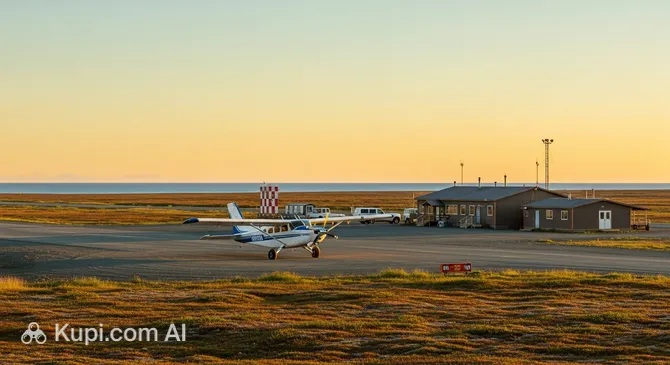
Kivalina Airport. Source: Kupi.com Binoculars
IATA Code KVL
ICAO Code PAVL
City Kivalina
Distance to centre approx. 2 km
Status Domestic
Annual Passengers approx. 6,000
Popular Airlines Bering Air

The main feature of Kivalina Airport is its vital importance to the isolated settlement. This is not an airport where you will find duty-free shops or business lounges. The infrastructure here is minimalist and functional, designed to service small propeller aircraft capable of landing on a short gravel strip. The airport is managed by the State of Alaska and serves primarily the needs of local residents, medical flights, and cargo delivery.

Travellers should note that the airport's operation is heavily dependent on the harsh weather conditions of the Arctic. Flights may be delayed or cancelled due to strong winds, snowfall, or fog. Nevertheless, for those wishing to experience the unique culture of the Inupiat people and witness the rugged beauty of the northern coast, the airport of Kivalina serves as the only gateway to this fascinating and hard-to-reach world.

Contact Information

Kivalina Airport (KVL) is a small regional airport serving the settlement of the same name in Alaska. Due to its size and specific nature, most services, such as ticket sales and baggage handling, are provided directly by the airlines. Below is the essential contact information.

  • Official Website: Kivalina Airport does not have its own official website. Up-to-date information on the airport's status can be found on the Alaska Department of Transportation (DOT&PF) resources or on the websites of the airlines operating flights.
  • Information Service Phone: There is no unified information desk at the airport. For all questions related to schedules, tickets, and flights, please contact your airline directly.
  • Airport Address: Kivalina Airport, Kivalina, Alaska (AK) 99750, USA.
  • Email: An official email address for passenger enquiries is not provided.
  • Social Media: The airport does not maintain official pages on social networks.
  • Lost Luggage Information: If your luggage has been lost or damaged, you must immediately contact the baggage tracing service of the airline you flew with.
  • Passenger Support Contacts: Passenger support, including assistance for people of determination (people with disabilities), is carried out by the air carriers.

How to Get to the Airport

Kivalina Airport (KVL) is located in a unique geographical point of Alaska — on the narrow spit of a barrier island, where the village of Kivalina itself is situated. Due to this proximity to the settlement, logistics for travellers here are extremely specific and differ from standard urban norms.

The most common way to reach the terminal from any point in the village is on foot. The distance from residential houses to the runway is minimal, amounting to just a few hundred metres. A walk from the "centre" of the settlement to the check-in counter will take from 5 to 10 minutes. This makes the airport one of the most accessible in terms of travel time.

Classic public transport, such as buses, trains, or a metro, is completely absent in Kivalina. There are no regular routes here, as there is no need for them due to the compact size of the island and the lack of a road network connecting the village to other cities in Alaska.

If you have heavy luggage or the weather is not conducive to walking, the role of taxis and transfers is performed by local residents using specific transport. In summer, these are most often quad bikes (ATVs), and in winter — snowmobiles. There are no official taxi services or apps like Uber here, so it is best to arrange help with luggage with your accommodation hosts or local acquaintances in advance. The cost of such a service is usually negotiable or symbolic.

Car rental is not available in Kivalina. Moreover, it is impossible to fly here and rent a car for a trip to other regions, as the village is isolated and has no exit to the continental road network. Cars here are used exclusively for local needs within the settlement.

Regarding parking, there is a small unequipped area near the airport where local residents can leave their ATVs or snowmobiles while meeting a flight. There are no specialised paid parking lots with security provided here.

To plan a complex route, it is worth noting that Kivalina is connected by air to larger hubs. The main transfer point for tourists is usually Kotzebue (Ralph Wien Memorial Airport), located approximately 126 km away. Other airfields also operate in the region, such as Point Hope Airport and the remote Nome Airport. For travel deeper into the territory, routes via Shungnak Airport or Nulato Airport might be relevant, however, direct flights between these points and Kivalina may be absent, and a transfer is required.

Recommendation for tourists: take into account the harsh weather conditions of the Arctic. Even a short walk to the terminal can be difficult in strong winds, so dress warmly and pack luggage in waterproof covers.

Terminals and Map

Kivalina Airport (KVL) differs radically from major international aviation hubs in its structure and scale. It is a regional airport typical for remote corners of Alaska, where infrastructure is extremely concise and functional. Tourists will not have to study complex maps or use internal transport — everything here is within direct line of sight.

The airport features just one passenger terminal, which is a small single-storey building. Essentially, it is a multi-functional room combining a waiting area, a check-in desk, and a baggage claim area. Navigation here is intuitive: the entrance to the terminal is from the village side, and the exit for boarding leads directly onto the runway.

The concept of "transfers between terminals" does not exist in Kivalina. Departure and arrival zones are located in a single space. After landing, passengers immediately enter the terminal building or exit the airfield grounds. The baggage claim process is also simplified: cargo is often handed out right by the aircraft or brought into the common room, where passengers collect it themselves.

Terminal features are dictated by the region's harsh climate. The building's main task is to provide warmth and protection from the wind. Inside, there is usually a minimal amount of seating and heating. Travellers should not expect shops, cafés, ATMs, or currency exchange points. This place is intended exclusively for short-term waiting for a flight.

Check-in and security procedures are much faster than in big cities. Since flights are operated by small general aviation aircraft, strict security control (like TSA in major hubs) may be absent or conducted in a simplified format. The main focus is on weighing passengers and luggage to properly balance the aircraft. It is recommended to arrive at the airport 45–60 minutes before departure to calmly process documents and check in luggage.

Navigation recommendations: since information screens may be absent, listen carefully to announcements from staff or pilots. In winter or during bad weather, try to stay inside the building until invited for boarding, as the wind on the open terrain can be extremely strong.

Airport History

The history of Kivalina Airport (KVL) is inextricably linked with the development of small aviation in Alaska and the survival of an isolated community in harsh Arctic conditions. Unlike major international hubs, this airfield did not have a lavish opening ceremony with ribbon-cutting. It formed as a vital necessity in the mid-20th century, officially entering the state aviation system registries in the early 1960s. Initially, it was a simple dirt patch cleared for the landing of light aircraft delivering mail and food.

A key feature of the airport's development history is its constant battle with the elements. Located on a narrow sandy spit between the lagoon and the Chukchi Sea, the airfield has repeatedly been under threat of disappearance. The main stages of its "reconstructions" were not associated with building glass terminals, but with heroic efforts to preserve the runway. Over various decades, engineers carried out work to compact the gravel surface and raise the level of the strip to protect it from tides and storm surges.

One of the most significant events in the facility's recent history was the construction of a massive protective rock revetment. This project, implemented with the participation of the US Army Corps of Engineers in the 2000s and 2010s, aimed to save the coastline from rapid erosion. The airport was literally a few metres from the water, and without this coastal reinforcement modernisation, its operation would have become impossible. This structure allowed the life of the air harbour to be extended.

From a technical point of view, an important milestone was the installation of modern lighting equipment. Given that Kivalina is located above the Arctic Circle, where the long polar night reigns in winter, the presence of high-quality runway lighting became a critical factor for ensuring the safety of medical evacuations and passenger flights. The runway, designated 12/30 and approximately 914 metres (3,000 feet) long, is regularly maintained to accept aircraft such as the Cessna Caravan and Piper Navajo.

Interesting fact: the history of Kivalina Airport is unique in that it may soon end in its current location. Due to global climate change and melting permafrost, plans have been under development for many years to completely relocate the entire village to a more stable section of the mainland. If this large-scale move takes place, the current airfield will go down in history as one of the examples of infrastructure that lost the battle with nature, and a completely new airport will be built for the residents at the new site.

Services and Facilities

Kivalina Airport (KVL) is a small regional transport hub serving a remote community in Alaska. Given its status and location, passengers should expect a very limited range of services. There are no restaurants, cafés, or shops typical of international airports here. Travellers are strongly advised to stock up on food, water, and necessary goods in advance, at the point of departure, as it may be impossible to buy them on site.

The waiting area consists of a small room designed to protect passengers from bad weather before departure. Specialised VIP lounges, business centres, or conference rooms are absent. Access to Wi-Fi and power outlets for charging devices is not guaranteed, so it is best to carry fully charged gadgets and power banks. There are no ATMs or currency exchange points on the airport territory; it is important for tourists to carry a sufficient amount of cash.

Infrastructure for passengers with special needs is minimal. Since boarding small aircraft often takes place directly from the airfield, passengers with disabilities and families with children should contact the air carrier in advance to organise necessary assistance during boarding and disembarking. There are no dedicated mother and child rooms in the terminal.

There are no hotels or inns in the immediate vicinity of the airport. Accommodation options in the village of Kivalina itself are extremely limited and are not "tourist" in the usual sense. Travellers planning an overnight stay must arrange accommodation with the local council in advance or look for lodging options in larger transport hubs, such as Kotzebue, before flying to Kivalina.

Where to Eat

Considering the remote location and modest size of Kivalina Airport (KVL), it is important for passengers to know that there are absolutely no food and beverage outlets on the terminal premises. There are no familiar restaurants, cafés, coffee shops, or even vending machines with snacks. The terminal performs solely the function of a shelter from bad weather before boarding a flight.

In this regard, the issue of meals requires preliminary planning. Travellers are strongly advised to take care of food and drinks in advance. It is best to have a substantial meal or buy food for the journey at the airport of departure (most often Kotzebue or Anchorage), where the infrastructure is significantly better developed.

For passengers observing specific dietary requirements (such as vegetarian, vegan, gluten-free, or Halal menus), self-catering is the only reliable option. A small local store operates in the village of Kivalina, but its assortment is limited to basic goods with a long shelf life, and finding specialised products there may be impossible. Furthermore, the store's opening hours may not coincide with the time of your stay.

Recommendations for travellers: nuts, protein bars, crackers, or dried fruits brought with you are ideal for a quick snack. If you require a full meal, it must be organised before arrival in Kivalina. It is also critically important to have a supply of drinking water, as it will not be possible to purchase it directly before departure in the airport building.

Tips for Travellers

Recommendations on arrival time: Since Kivalina Airport (KVL) serves small aviation flights, there are no long queues characteristic of major hubs here. However, the process of loading and preparing the aircraft requires precision. It is recommended to arrive at the boarding point approximately 45–60 minutes before departure. This time is sufficient for weighing luggage and passengers — a standard procedure for small aircraft necessary for the correct balancing of the vessel.

Check-in and security features: Check-in is carried out manually. The main attention is paid to weight. Be prepared for the fact that you may be asked to step on the scales together with your hand luggage. The screening procedure here is less formal than in large international airports, however, US flight safety rules apply strictly: it is forbidden to transport weapons, explosives, and dangerous items. All checks are usually conducted quickly and visually by airline staff.

Choosing a seat on the plane: On flights to Kivalina, there is usually no fixed seating upon booking. Seats are distributed by the pilot before departure based on the weight distribution (centre of gravity) of the aircraft. If the weight allows, ask for a window seat — the flight over the tundra and the coast of the Chukchi Sea reveals stunning views. Bear in mind that the planes are small, and legroom may be limited.

Hand luggage and baggage: In small aircraft (often Cessna or similar models), there are no standard overhead luggage bins.

  • Use soft bags or backpacks instead of rigid suitcases — they are easier to place in the limited luggage compartment.
  • Take only the essentials into the cabin: documents, medication, phone, and valuables.
  • Be sure to have warm clothing in your hand luggage, even in summer, as it can be cool in the cabin, and upon disembarking, you will be immediately met by the Arctic wind.

Transfers and connections: Flights from Kivalina generally head to the regional hub — Kotzebue (Ralph Wien Memorial Airport), from where flights to Anchorage and beyond are operated. When planning connections, allow a minimum of 3–4 hours, or better yet — an overnight stay at the transfer hub. Weather in the Arctic is unpredictable, and a flight delay from Kivalina of several hours or even days is a common occurrence.

Customs control: Since Kivalina accepts only domestic regional flights, customs and border control are absent here. If you are flying from abroad, you will go through all formalities at the first port of entry in the USA (usually Anchorage, Seattle, or Los Angeles) before transferring to local lines.

Saving time and money:

  • Strictly monitor luggage weight. Allowances on small vessels are very low, and surcharges for excess weight can be substantial.
  • Purchase tickets in advance. On local lines, fares can rise sharply closer to the departure date.
  • Do not count on buying anything at the airport — bring food with you to avoid spending on expensive snacks (if they can be found in the village at all).

Actions in case of flight delay: This is the most important tip for this destination. Due to fog and winds, flights are often cancelled or rescheduled. There are no information screens at the airport, so maintain contact with the airline representative by phone. Have a "Plan B" in case you have to stay in the village: find out contacts of local residents renting rooms or schools where they sometimes allow people to wait out bad weather, as there are no hotels or waiting halls with amenities here.

Reached the end of the page?

That means the route is fully explored