Support

Kobuk/Wien Airport

About the Airport

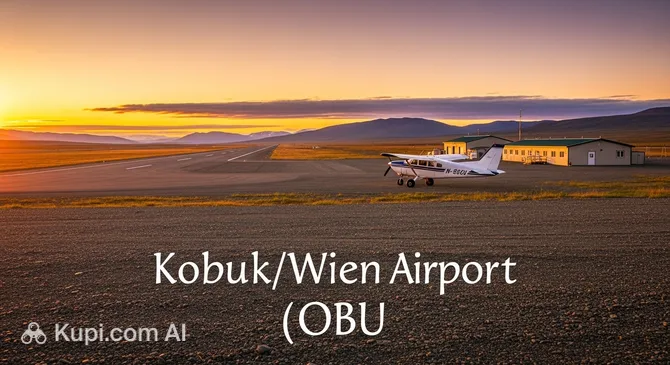
Kobuk/Wien Airport. Source: Kupi.com Binoculars

Kobuk Airport (also known as Wien) is not merely a transport hub, but a true "lifeline" for the residents of this remote corner of Alaska. Here, you will not find the usual hustle and bustle of giant terminals and gleaming shop windows: instead, travellers are greeted by a modest gravel strip surrounded by the vast expanses of northern nature. The air harbour serves as the main gateway to the village of the same name on the riverbank, providing the only reliable connection to the outside world amidst the harsh climate.

IATA Code OBU
ICAO Code PAOB
City Kobuk (USA)
Distance to centre < 1 km (within the settlement)
Status Regional / Domestic
Passengers per year Approx. 1,000 — 1,500
Schedule Check with regional carriers

Airport Features:

The airport represents a classic example of Alaskan "bush flying". Its infrastructure is minimalist: there are no refuelling complexes or permanently stationed staff here, and the runway has a gravel surface approximately 1,200 metres long. Pilots often perform landings visually, navigating by the features of the terrain.

Despite its modest size, the facility plays a critical role for the region. Mail, groceries, and medicines are delivered here, and tourists arrive en route to the Kobuk Valley National Park, famous for its sand dunes above the Arctic Circle. Due to the lack of lighting at night (unless activated by the pilot via radio) and complex weather conditions, flights can often be delayed or rescheduled.

Contact Information

  • Official Airport Website: The airport does not have its own dedicated web resource. Official information is posted on the Alaska Department of Transportation and Public Facilities (Alaska DOT&PF) portal.
  • Inquiry Service Phone: +1 (907) 451-2200 (Northern Region DOT&PF) or +1 (907) 442-3147 (District Maintenance Office in Kotzebue). Important: there is no permanent airport staff in Kobuk itself.
  • Airport Address: Kobuk Airport, Kobuk, AK 99751, USA.
  • Email: dot.ask@alaska.gov (General inquiries to the Department of Transportation).
  • Airport Social Media: There are no separate accounts; news is published on Alaska DOT&PF social media channels.
  • Lost Luggage Information: The airport does not have a terminal or a lost and found service. For all questions regarding missing items, you must contact the airline you flew with directly.
  • Passenger Support Contacts: Support is provided by the main carriers of the region:
    • Bering Air: +1 (907) 442-3187 (base in Kotzebue)
    • Wright Air Service: +1 (907) 474-0502

How to Get to the Airport

Transport accessibility in Kobuk differs radically from what residents of metropolises are used to. Since this settlement is a small village isolated from the Alaska road network, standard logistics rules do not apply here. Getting to the runway from any point in the settlement is a simple but specific task.

Public Transport

There is a complete absence of a public transport system in Kobuk. There are no bus routes, trains, or metro. Given the size of the village (the population is less than 200 people), there is simply no need for such modes of travel. All infrastructure is within walking distance.

Taxis, Transfers, and Local Methods of Transport

Common taxi services like Uber or local taxi fleets do not exist here either. However, this does not mean you will have to carry your luggage yourself if it is heavy. The main ways to get to the aircraft are:

  • On foot: The distance from the village centre to the runway is less than 1 kilometre. The walk will take from 5 to 15 minutes depending on your speed and weather conditions.
  • ATVs (Quad bikes) and Snowmobiles: This is the main "people's" transport in the region. Locals often use ATVs in summer and snowmobiles in winter to transport cargo and passengers. If you are staying with local hosts or heading to a lodge, you will likely be met or escorted on one of these vehicles.
  • Arrangement: Often, you can ask one of the locals to give you a lift to the strip for a nominal fee or as a gesture of hospitality.

Car Rental

There are no car rental points in Kobuk. The village is not connected by roads to other cities, and the internal network of dirt tracks is too small for the practical use of cars. Tourists will not need a car here.

Airport Parking

There is no specialised paved parking with markings and barriers at the airport. Near the runway, there are open areas where residents can temporarily leave their vehicles (snowmobiles or ATVs) while meeting cargo or passengers. Parking is free and unguarded.

Features and Recommendations

When planning a departure from Kobuk, consider the harsh nature of the terrain:

  • Arrive at the boarding area in advance, but be prepared for the fact that the plane may be delayed due to weather.
  • In winter, dress as warmly as possible: there is no waiting hall in the usual sense, and waiting in the wind can be uncomfortable.
  • If you have a lot of luggage, arrange help with transport to the plane with your host in advance.

Nearest Transport Hubs

Since Kobuk is the end point for many routes, it is important to know which hubs facilitate connections. The nearest neighbour is Shungnak Airport, located just 12 kilometres away; planes often make an intermediate stop there.

The main hub connecting the village with the "mainland" is Ralph Wien Memorial Airport in the city of Kotzebue (about 250 km away). It is from there that most small aviation flights depart for Kobuk. Also operating in the region are Edward G. Pitka Sr. Airport in Galena and Nulato Airport, but they are located significantly further away and are rarely used for direct connections by tourists. An even more remote option is Unalakleet Airport, located almost 400 km to the south.

Terminals and Layout

Speaking of the structure of Kobuk Airport (OBU), it is important to immediately adjust to the specifics of small Alaskan settlements. Here you will not see the familiar multi-level terminals, jet bridges, or confusing corridors. The airport represents an example of extreme minimalism, where all infrastructure is subordinated to one goal — to ensure the landing and take-off of small aircraft in harsh conditions.

Number of Terminals and Layout

In fact, Kobuk lacks a terminal in the classical sense of the word. There is no division into international and domestic sectors, Duty Free zones, or baggage belts. All "terminal" infrastructure is usually limited to a small area near the runway (apron), where passengers embark and disembark, and mail and cargo are unloaded.

In some cases, a small utility building or shed may serve as a waiting area where one can shelter from the wind, but most often passengers wait for the plane's arrival in the open air or in the vehicles of those seeing them off.

Airport Map and Navigation

Navigation at Kobuk Airport is intuitive and requires no maps or signs. The structure of the facility is extremely simple:

  • Runway: A gravel strip that is the axis of the entire airport.
  • Parking Area: A small widening next to the strip for turning aircraft and short-term parking.
  • Boarding Zone: The place of direct contact with the crew and the aircraft.

It is impossible to get lost here — all processes take place on a patch of a few dozen square metres. Transfers between terminals do not exist as a concept.

Departure and Arrival Zones

Arrival and departure zones are combined into one space. When the plane lands, arriving passengers step directly onto the ground and collect their luggage, which the pilot unloads from the cargo compartment by hand. Departing passengers wait until unloading is finished to take their seats.

Check-in and Screening Procedures

The check-in process in Kobuk differs strikingly from major hubs:

  • Check-in: Takes place directly at the aircraft side ("at the wing"). The pilot verifies your surname against the list and accepts luggage.
  • Weighing: This is the most important procedure. Since weight balance is critical for small aviation, the pilot may ask you to step on scales or state your exact weight, and will also weigh every bag.
  • Screening: There is no classic security screening (TSA) with frames and scanners in Kobuk. However, the pilot has the right to inspect luggage if suspicions arise or to refuse the transport of dangerous items.
  • Time: All formalities take literally 5–10 minutes. Nevertheless, it is recommended to arrive at the strip 20–30 minutes before the scheduled departure time, as small aircraft sometimes arrive slightly ahead of schedule if a tailwind aids the flight.

Features and Navigation Recommendations

Since there are no electronic boards or public address systems at the airport, all communication is built on visual contact.

  • Watch the sky: The sound of the engine is your main signal that landing is beginning.
  • Stay close to the pilot: They are the sole representative of the airline, the baggage handler, and the security officer all rolled into one. All instructions (where to stand, when to approach the plane) come only from them.
  • Be careful on the surface: Gravel can be slippery, especially in the off-season or winter. Be attentive when boarding the plane, as stairs are often small portable ladders.

Airport History

The history of Kobuk Airport (OBU) is a chronicle of the transformation of a makeshift landing site into a vital node of the Alaska transport network. The development of aviation in this region was dictated not by commercial gain, but by harsh necessity: the aeroplane often remained the only way to deliver a doctor, mail, or provisions.

From River Surface to First Strip

In the first half of the 20th century, when aviation was just beginning to explore the Arctic, an official airport in Kobuk did not exist. Nature itself played the role of the runway: in summer, seaplanes landed on the waters of the Kobuk River, and in winter, when the river froze, pilots used ski landing gear to land on the ice. The official date of the airport's activation as a ground infrastructure facility in FAA registries is often cited as 1963, however, flights to this area began significantly earlier. The construction of the first permanent gravel strip was a turning point, ensuring a connection with the "mainland" during the off-season, when the river is no longer suitable for boats, but the ice is still too thin for planes.

The "Wien" Legacy

The second name, which can sometimes be found in historical documents or heard from old-timers, is linked to the name Wien. This is a tribute to the legendary airline Wien Air Alaska and its founder Noel Wien, a pioneer of polar aviation. It was the pilots of this company who first established regular—as far as was possible—communication with remote villages above the Arctic Circle. For local residents, planes with the Wien logo became a symbol of hope and progress, so the name of the aviators became firmly entrenched in the history of the transport hub.

Large-scale Reconstruction of the 21st Century

A key stage in the recent history of the facility was the comprehensive modernisation carried out in the early 2000s under the auspices of the Alaska Department of Transportation. The old infrastructure ceased to meet modern safety requirements, so a decision was made to radically update the airfield. The main changes concerned the runway:

  • Runway Extension: The length of the runway was increased to 1,220 metres (4,000 feet). This critically important improvement allowed for the reception of larger cargo aircraft and increased the safety of landings in windy weather.
  • Surface Improvement: The gravel surface was levelled and compacted, which reduced the risk of damage to aircraft landing gear and fuselages by stones.
  • Lighting Equipment: A modern lighting system was installed, which pilots can control remotely via radio channel. This made it possible to carry out medical and emergency flights during the polar night.

Interesting Facts and Features

  • Gateway to the Desert: Kobuk Airport is unique in its geographical position. It serves as one of the starting points for expeditions to the Kobuk Valley National Park, where the Great Kobuk Sand Dunes—the northernmost desert on Earth—are located.
  • Climate Challenge: The airfield functions in a zone of extreme temperatures. Historical records note winter frosts below -50°C here, yet equipment and ground services (often consisting of local residents) continue to maintain the strip in working order.
  • Archaeological Context: The land on which the airport and settlement are located has a rich history. During earthworks in the vicinity, evidence of ancient human settlements has repeatedly been found; these people used the Kobuk River as a trade route thousands of years before the appearance of the first aeroplane.

Services and Amenities

Expectations regarding service at Kobuk Airport (OBU) should be adjusted considering that this is a remote airstrip in an Arctic village, not a familiar city air terminal. There is no commercial zone here, so passengers need to be completely autonomous and prepared for the conditions of "wild" Alaska.

Restaurants, Cafés, and Shops

There are absolutely no catering outlets on the airport territory. You will not find coffee shops, snack vending machines, or Duty Free shops here. The nearest place to buy groceries is the general store in the village itself (Kobuk General Store), which is within walking distance, but its opening hours can be unpredictable. It is strongly recommended to carry a supply of food and drinking water, especially if you are flying with connections or plan to head straight to the national park.

Waiting Areas and Connectivity

There are no specialised VIP lounges or heated waiting areas with soft chairs here. The "waiting room" is the open space next to the strip. In case of bad weather, one can only take shelter under the canopies of utility buildings or, by arrangement, in the homes of local residents.

  • Wi-Fi and Internet: There is no public Wi-Fi network. Mobile coverage in the region is unstable; reliable reception may only be provided by certain local operators (e.g., GCI), but internet speed will likely be low.
  • Charging Stations: There are no sockets for charging gadgets at the airfield. Be sure to bring fully charged power banks with you.

Financial Services

There are no ATMs or currency exchange points at the airport or in its immediate vicinity. In the village, opportunities to use credit cards are extremely limited. Travellers should withdraw cash US dollars in advance at major transfer hubs, such as Anchorage, Fairbanks, or Kotzebue, before flying to Kobuk.

Medical Services and Passenger Assistance

There is no medical centre or pharmacy at the airstrip. In emergencies, first aid can be provided by the pilot (who has a basic first aid kit) or staff at the local rural clinic located in the settlement. However, serious treatment requires evacuation by medical flight.

  • Passengers with Children: There are no mother and child rooms. Take care of warm clothes, food, and entertainment for children in advance.
  • Passengers with Disabilities: There is no special infrastructure (ramps, lifts, toilets for people with disabilities). Boarding small aircraft is done via small steps. If you require assistance, you must notify the airline when booking: pilots in this region always personally help passengers board and get settled.

Accommodation and Business Services

There are no hotels directly at the airport. Accommodation in the village of Kobuk itself is possible only through private arrangements (homestay), as there are no official hotels. Most tourists use this place as a transit point for camping in the Kobuk Valley National Park.

There are no conference rooms or business centres in this remote corner. This is a place for a complete "digital detox" and unity with nature, not for business negotiations.
Where to Eat

The situation with food at Kobuk Airport (OBU) requires complete autonomy from travellers. Due to the lack of a terminal and commercial infrastructure, there are no familiar food court zones, cafés, or even vending machines with snacks here. Passengers should plan their rations in advance, considering the specifics of a remote Arctic village.

Restaurants and Fast Food Outlets

On the territory of the airfield itself (both in the departure and arrival zones), catering establishments are completely absent. You cannot drink hot coffee before a flight or have a sandwich snack here. If your flight is delayed, there will be no opportunity to buy ready-made food on site.

Buying Groceries in the Village

The only alternative is the local general store, Kobuk General Store, located in the village itself. It is approximately a 10–15 minute walk from the runway.

  • Assortment: Mostly long-shelf-life products are sold here: canned goods, crackers, crisps, frozen foods, and sweet drinks. Fresh fruit and vegetables are rare and sell out quickly.
  • Price Range: Be prepared for very high prices ("Arctic markup"). The cost of basic products can be 2–3 times higher than prices in major US cities due to complex delivery logistics.
  • Opening Hours: The store's schedule may change and often depends on staff availability or the season. Do not rely on it as a guaranteed source of food before departure.

Special Dietary Requirements (Vegetarian, Gluten-Free, Halal)

Finding specialised products for people with strict dietary restrictions in Kobuk is practically impossible. The local store offers a limited range of goods, and the choice for vegans or people with gluten intolerance will be minimal (for example, only nuts or canned vegetables). Halal options are generally unavailable.

Recommendation: If you adhere to a special diet or require Halal food, be sure to bring your entire necessary supply of food with you from Anchorage or Kotzebue. Calculate the supply so that it is enough in case of a flight delay of 24 hours.

Water and Drinks

There are no drinking fountains at the airport. It is strongly recommended to carry your own water bottle or a thermos with tea, especially in winter, as there will be no opportunity to warm up with a hot drink on the strip.

Summary: Tips for Passengers

  • For a quick snack: keep energy bars, nuts, or chocolate in your hand luggage.
  • For a full meal: eat in advance at the transfer airport (usually Kotzebue) or bring a ready-made lunch box.
  • Do not count on buying food at Kobuk Airport — perceive it as a stop in the wild, not as a service centre.

Tips for Travellers

Travelling through Kobuk Airport is a unique experience that requires special preparation. The rules of large international hubs do not work here, and the success of the trip depends on your flexibility and understanding of the specifics of Alaskan small aviation. Here are some practical tips to help make your flight as comfortable as possible.

Arrival Time and Check-in

Unlike major airports, there is no need to arrive 2–3 hours early here. However, you should not be late either. The optimal arrival time at the strip is 30–40 minutes before departure. Note an important nuance: if all booked passengers are already on site and the weather begins to deteriorate, the pilot may decide to depart ahead of schedule. Your presence in advance guarantees that the plane will not leave without you.

The check-in procedure takes place right by the plane. Be prepared for the fact that you and your luggage will definitely be weighed. For small aircraft (like the Cessna Caravan or Piper Navajo), centre of gravity is critically important, so honesty regarding weight is the key to your safety.

Security and Luggage Features

There are no metal detector frames or shoe scanners in Kobuk, but safety rules are strictly observed here, albeit visually.

  • Hand Luggage: There is practically no space in the cabin. Overhead luggage bins are not provided. Everything you take with you (small backpack, camera) must fit on your lap or under your feet.
  • Prohibited Items: TSA rules apply here too. Pay special attention to bear spray. It is strictly forbidden to carry it in the aircraft cabin; the possibility of transport in the cargo compartment needs to be checked with the specific carrier in advance, as non-sealed canisters can explode with pressure changes.
  • Weapons: Hunters often fly through Kobuk. Firearms must be unloaded and in a case, with ammunition packed separately. Be sure to warn the pilot about transporting weapons before boarding.

Seat Selection

The concept of "seat selection during online check-in" does not exist here. Passenger seating is managed exclusively by the pilot, based on the weight balance of the aircraft. You may be asked to move forward or backward once inside the cabin. If a window view is fundamentally important to you for photography, politely ask the pilot about this before loading, but be ready to accept a refusal if it disrupts the balance.

Tips for Transit Passengers

Most travellers fly through Kobuk with a transfer in the city of Kotzebue or Fairbanks. The main advice is to allow for large connection intervals.

  • Never plan a departure from Kotzebue to Anchorage or Seattle with a short gap (less than 3–4 hours) after a flight from Kobuk.
  • The ideal option is to buy all flight segments on a single ticket (if possible) or plan an overnight stay at the hub. Weather in the Arctic changes instantly, and departure from the village can be delayed for several hours or even days.

Customs Control

Since Kobuk serves only domestic small aviation flights (mainly from Kotzebue), customs and border control are absent here. Passport control is also not conducted, but the pilot will definitely check your name on the passenger list against your ID or passport.

Economy and Preparing for Delays

Flight delays due to fog, wind, or blizzards are common for this region. To save your nerves and money, follow simple rules:

  • Food and Water: Always have a supply of high-calorie snacks and water with you. Buying food in the village is expensive, and at the airport, there is nowhere to do so.
  • Communication with Accommodation: If you are departing, do not leave your place of lodging (lodge or local home) until you are sure that the plane has taken off from Kotzebue towards you. Ask your hosts to contact the airline by phone — this will save you hours of waiting in the wind.
  • Warm Clothing: Even in summer, keep a windbreaker and hat handy. Waiting for a plane on an open, windswept area can be cold.

Reached the end of the page?

That means the route is fully explored