Support

Earthquake Fault

About

Located in the heart of Inyo National Forest, near the town of Mammoth Lakes, is a fascinating natural wonder — the Earthquake Fault. Contrary to its name, this isn't a typical fault where tectonic plates have shifted, but rather a deep volcanic fissure in a solid flow of rhyolite lava. It offers a vivid demonstration of the immense underground forces that once literally tore the bedrock apart.
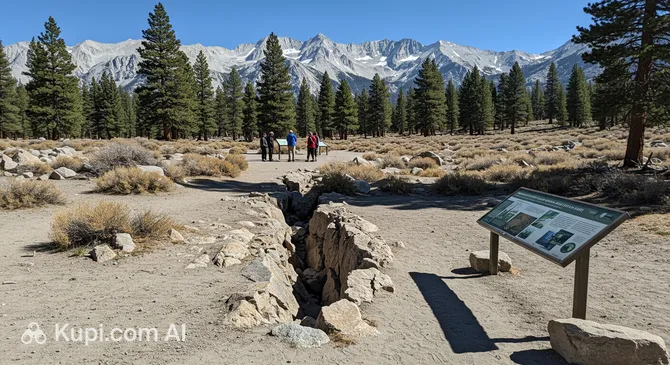
Earthquake Fault. Source: Kupi.com AI

The crack itself reaches up to 3 meters in width and plunges to an impressive depth of 18 meters. The walls of the fault are composed of glassy rhyolite — a rock formed thousands of years ago during the eruption of Mammoth Mountain. Situated at an altitude of about 2,400 meters above sea level, this landmark in the USA is an essential piece of the Long Valley Caldera's geological puzzle.

Tourists value this spot for the chance to stand at the edge of a silent abyss and see layers of ancient lava firsthand. Earthquake Fault is more than just a natural monument; it’s an outdoor geology textbook where tectonic processes, volcanism, and erosion have shaped a landscape that looks like a set from a science fiction movie.

Contacts

To check the latest information on trail conditions or weather in the Earthquake Fault area, you can contact the Inyo National Forest service.

Address 7 Minaret Rd, Mammoth Lakes, CA 93546, USA
Phone +1 760-873-2400
Website http://www.fs.usda.gov/

What to Do

The main activity here is observing and studying the unique geology. You can follow a specially equipped, marked trail in Inyo National Forest that leads directly to the edge of the massive fissure. Be sure to peer down to appreciate the 18-meter depth of the Earthquake Fault: you can often see snow here that doesn’t melt even in the hot summer months because direct sunlight never reaches the bottom.

For photography enthusiasts, this location offers plenty of opportunities. The textured rhyolite walls, ancient pines growing right at the edge of the chasm, and panoramic views of the surrounding Mammoth Lakes mountains provide an excellent backdrop for photos. The walk along the trail is considered easy and family-friendly, allowing you to enjoy the fresh mountain air and the quiet of the forest.

In winter, the location is transformed: the fissure may be partially hidden under a thick layer of snow, adding an air of mystery but requiring extra caution when moving around. A visit to the fault pairs perfectly with tours to Mono Lake or the Devil’s Postpile basalt formations, helping to create a complete picture of the volcanic power of this region.

Getting There

Getting to this unique place is quite simple: the Earthquake Fault is located at 7 Minaret Rd. From the center of Mammoth Lakes, the drive takes only 5–10 minutes. You need to head north on Minaret Road, following the signs toward the ski slopes. Free parking is provided at the trailhead, where the short route to the fissure begins.

Public transport is limited in this part of the region, so the most convenient option is to use a personal or rental car. If you are arriving at the local airport, the drive to the attraction will take about 15–20 minutes. In winter, the road may be covered in snow, so be sure to check the forecast and use tire chains if necessary.

The walking path from the parking lot to the edge of the fault is only 100–200 meters long. It is fairly flat and well-marked, making the walk accessible even for tourists with children. Remember the safety rules: do not wander off the marked path, as the edges of the volcanic rock can be unstable.

History & Facts

Despite its name, this deep rift in the earth's crust was not caused by a traditional earthquake. Scientists have determined that the Earthquake Fault formed approximately 600 years ago. Its appearance is linked to intense tectonic stresses caused by the movement of magma during eruptions of the nearby Inyo and Mono craters. The viscous rhyolite lava literally cracked under pressure from within.

The geological history of the region is much more extensive, dating back hundreds of thousands of years. The entire Mammoth Lakes area is part of the massive Long Valley Caldera, which formed following a catastrophic eruption about 760,000 years ago. Later, between 110,000 and 57,000 years ago, lava domes rose here, one of which became Mammoth Mountain.

Interestingly, the glaciers that covered the Sierra Nevada about 15,000 years ago significantly altered the landscape, exposing ancient layers of volcanic rock. Although a series of strong seismic tremors occurred in the area in 1980, the fissure itself remained virtually unchanged. Today, it serves as a living reminder of how active and dynamic the nature of this region is, where volcanism and tectonics continue to shape the face of the planet.

Time Needed

To explore the Earthquake Fault, 30 to 60 minutes is usually sufficient. This is plenty of time to take a leisurely stroll along the short trail from the parking lot, look deep into the fissure, and take some impressive shots against the backdrop of ancient volcanic rocks.

This format makes the site an ideal stopover during a busy day tour of the Mammoth Lakes attractions. You can easily combine a walk by the fault with a visit to nearby lakes or a trip to the famous Devil’s Postpile basalt columns.

Working Hours

As part of the Inyo National Forest territory, the Earthquake Fault is open to the public 24 hours a day, seven days a week. Admission is completely free, making it accessible at any time.

However, for your safety and to ensure high-quality photographs, it is recommended to plan your visit during daylight hours. In winter, access to the trail may be limited due to heavy snowfall, so it's worth checking the current road status on the official US Forest Service website before your trip.

Nearby

The area around Mammoth Lakes is rich not only in natural wonders but also in cozy places to relax after your walks. Exploring the attractions near the fault will help you better experience the atmosphere of this mountain resort.

Here you can find both active recreation spots and local breweries or coffee shops where it's pleasant to discuss what you've seen over a cup of aromatic coffee.

Name Distance (km)
Austria Hof Lodge 0.6
Woolly's Adventure Summit 0.7
Shelter Distilling 1.4
Mammoth Brewing Company 1.6
John's Pizza Works 2.4
Liberty Sports Bar and Grill 2.5
Black Velvet Coffee Roaster | Espresso & Wine Bar 2.6
Distant Brewing 3.4
The White Picket Fence at Old Mammoth 3.7
Mammoth Rock 4.3

Reached the end of the page?

That means the route is fully explored