Support

Opa-locka Executive Airport

Airports in the city

About the Airport

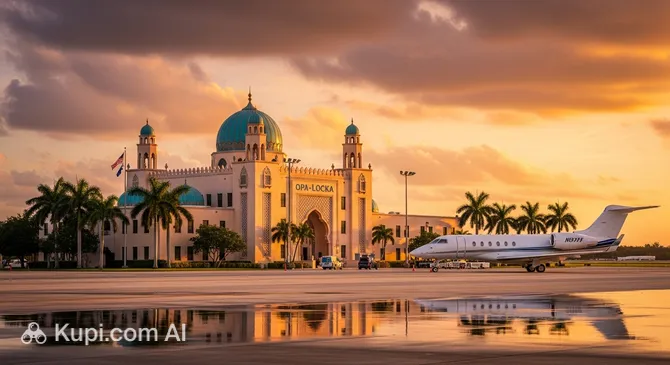
Opa-locka Executive Airport. Source: Kupi.com Binoculars

Opa-locka Executive Airport is a hidden gem in South Florida, where instead of endless queues and the bustle of main terminals, an atmosphere of exceptional comfort and privacy prevails. Located just a few minutes' drive from the shimmering beaches and the business centre, this hub serves as the main gateway for private jets and those who value their time above all else. Here, the history of the golden age of aviation intertwines with modern premium service, offering travellers instant access to the luxurious lifestyle of Miami.

IATA Code OPF
ICAO Code KOPF
City Opa-locka (Miami-Dade County)
Distance to Centre ~18 km to Miami city centre
Status International (Business Aviation)
Passengers per Year Over 145,000 operations (take-offs/landings) per year
Schedule Individual (charter flights)

Features and Advantages of the Airport:

Opa-locka Airport stands out as a major hub for business and general aviation in the region. Unlike the congested international giant MIA, there are no standard passenger terminals with crowds of tourists here. Service is provided through a network of private FBOs (Fixed-Base Operators)—luxurious complexes where the procedure from stepping out of the car to boarding the plane takes mere minutes. This is the ideal choice for those arriving in the USA on their own or a chartered jet.

A key advantage is its location. The airport is significantly closer to the northern districts of Miami Beach, Bal Harbour, and the Hard Rock Stadium than the city's main airport. Thanks to the presence of US customs control, Opa-locka accepts international flights around the clock, while ensuring maximum confidentiality for its guests.

Contact Information

If you need to contact the administration of Opa-locka Executive Airport (OPF), please use the following contact information. Please note that this is primarily a business and private aviation airport, so for questions related to a specific flight, you should first contact your air carrier or charter operator.

  • Official Website: Current information about the airport can be found on the Miami-Dade Aviation Department portal: www.miami-airport.com.
  • Help Desk Phone: For general inquiries, you can use the main line of the Miami-Dade Aviation Department: +1 (305) 876-7000.
  • Airport Address: 14201 NW 42nd Ave, Opa-locka, FL 33054, USA.
  • Email: A separate email address for general inquiries is usually not published. It is recommended to use the phone or contact forms on the official website for communication.
  • Social Media: Official news and updates regarding the Miami airport system, including OPF, are published on the Miami International Airport accounts (@iflyMIA) on major social networks.
  • Lost Luggage Information: For issues related to lost or damaged luggage, you must contact the airline that operated your flight directly.
  • Passenger Support Contacts: Support regarding tickets, schedules, and special services is provided by your air carrier or charter operator.

How to Get to the Airport

Opa-locka Executive Airport (OPF) primarily serves private and corporate aviation, acting as a key transport hub for business travellers and private jet owners in the Miami Beach area. It is located northwest of the city centre, and while there are several ways to reach it, their convenience varies significantly.

The most popular and fastest method is by car. A trip by taxi or via ride-hailing apps (Uber, Lyft) from downtown Miami or South Beach will take approximately 25–40 minutes, excluding traffic. The cost of such a trip is usually between 35–50 USD. For maximum comfort, you can book a private transfer or limousine service, which is particularly relevant for business aviation passengers. A driver will meet you at the designated location and deliver you directly to the private terminal.

Car rental is another convenient option, providing freedom of movement throughout South Florida. The route to the airport follows major highways such as I-95 and the Palmetto Expressway (SR 826). Opa-locka Airport offers convenient parking facilities for both short-term and long-term stays, allowing you to leave your car for the duration of your trip.

Using public transport to travel to Opa-locka Airport is the least practical option. There are no direct bus or metro routes to it. The journey would require several transfers and could take over an hour and a half, which is extremely inconvenient, especially if you have luggage. This method is not recommended for travellers who value their time and comfort.

It is important to remember that Opa-locka Airport does not serve scheduled commercial airlines. Most tourists flying into the region for holidays use the main air gateways—Miami International Airport (MIA) or the Fort Lauderdale–Hollywood International Airport (FLL) located slightly further north, which offer significantly more transport options for passengers.

Terminals and Map

Opa-locka Executive Airport (OPF) is a business aviation airport, and its structure differs significantly from large international airports oriented towards commercial flights. There are no large numbered terminals familiar to tourists here. Instead, the airport serves passengers through several ground handling operators (FBO — Fixed-Base Operator), each functioning as a separate, private terminal.

Each FBO is a modern building offering a full range of services for private and charter flight passengers. Inside, there are usually comfortable lounges, meeting rooms, showers, as well as counters for completing all necessary formalities. Departure and arrival zones are organised directly within the FBO building. Passengers arrive at the lounge, from where they are escorted directly to the aircraft. Customs and border control for international flights are also conducted here, but in a more private and expedited setting.

The airport layout implies that you know in advance exactly which FBO is handling your flight. Navigation is carried out by car directly to the address of the specific operator. Since FBOs are located in different parts of the airfield, there is no direct connection or walkways between them for passengers. All logistics are built around arriving at a pre-determined point.

The main advantage of this system is speed and comfort. Check-in and pre-flight procedures take a minimal amount of time, often no more than 15–20 minutes from arrival at the FBO to boarding. There are no long queues for security or check-in here. The main recommendation for travellers is to verify the name and address of the FBO handling your flight with your carrier or broker in advance to reach the correct location without issues.

Airport History

Opa-locka Executive Airport (OPF), located near Miami Beach, possesses a rich and multifaceted history that is closely intertwined with the development of aviation and key events of the 20th century. Its history began in 1927, when it was founded by legendary aviator Glenn Curtiss as part of his ambitious project to create the city of Opa-locka in a unique Moorish revival style, inspired by the tales of "One Thousand and One Nights".

With the outbreak of World War II, the airport was transferred to the US Navy and transformed into the Miami Naval Air Station. Thousands of pilots were trained here, including for aircraft carrier operations, making the base one of the most important training centres in the country. In the post-war years and during the Cold War, the airport continued to play a strategic role. One of the most tense moments in its history was the Cuban Missile Crisis of 1962, when the base became a key point for reconnaissance and patrol flights over Cuba.

In 1962, the airport was transferred to the jurisdiction of Miami-Dade County and began its transformation into a civil facility. It was renamed Opa-locka Airport and began to function as a "reliever" airport for Miami International Airport, specialising in cargo transport and private aviation. Subsequently, it received "executive" status, focusing on serving corporate and private jets.

Among interesting facts, it is worth noting that the US Coast Guard Air Station, one of the busiest in the world, is still located on the airport territory, performing search and rescue and law enforcement missions. Additionally, thanks to its unique history and proximity to Hollywood, the airport has repeatedly become a filming location for movies such as "Bad Boys" and "2 Fast 2 Furious". Today, OPF is a modern airport that harmoniously combines historical heritage with the role of an important business aviation centre in South Florida.

Services and Amenities

Opa-locka Executive Airport (OPF) specialises in serving private and corporate aviation, so the range of services here differs from standard commercial airports. Passenger service is concentrated in the terminals of private operators, known as FBOs (Fixed-Base Operators), which ensure a high level of comfort and confidentiality.

Passengers have access to luxurious VIP lounges offered by FBO operators. These lounges usually feature comfortable sofas, complimentary high-speed Wi-Fi, televisions, and current newspapers. Electronic device charging stations can also be found here. Regarding dining, the selection is limited: there are no large restaurants or food courts at the airport. However, FBO terminals may have small cafés, refreshment areas, or provide catering services by pre-order. Shops are generally absent.

For business travellers, FBOs offer well-equipped business centres and conference rooms for holding meetings. These premises are equipped with everything necessary for work, including office equipment and audiovisual hardware. Standard bank branches and currency exchange points are absent on the premises, but FBO staff can assist with arranging financial services upon request.

The airport is fully equipped to serve passengers with reduced mobility, and FBO staff provide individual assistance during boarding and disembarking. Although there are no specialised zones for children, such as playrooms, the comfortable conditions in private terminals are suitable for travellers with families. Medical assistance is limited to first aid and calling emergency services if necessary. There are no hotels directly on the airport grounds, but many accommodation options can be found in nearby areas such as Miami Lakes and Miami Gardens.

Where to Eat

It is important to understand that Opa-locka Executive Airport (OPF) is primarily an airport for private and business aviation, not a large commercial hub with public terminals. Therefore, you will not find the usual food courts, restaurants, and dining halls for the general public here.

Dining for passengers departing from or arriving at Opa-locka is organised mainly through ground handling operators (FBO — Fixed-Base Operator). These companies provide exclusive lounges for their clients, where all services are concentrated.

In FBO lounges designed for private flight passengers, complimentary beverages (coffee, tea, water) and light snacks—such as pastries or fruit—are generally offered. This is a convenient option for a quick bite before departure in a comfortable setting.

For a full lunch or dinner, passengers can utilise premium catering services by ordering in advance through their FBO operator. The menu can be virtually anything—from exquisite gourmet dishes to specific dietary requests, including vegetarian, vegan, Halal, or gluten-free meals. It is important to consider that these are premium segment services, and their cost depends directly on the specific order. Since the airport operates around the clock, catering is also available 24/7 by prior arrangement.

There are no public restaurants or cafés on the territory of the airport itself or within walking distance. All nearby dining establishments are located in the city of Opa-locka and adjacent areas, which must be reached by car. Thus, the best solution would be either to use catering services by agreeing on the order in advance or to have a meal on the way to the airport.

Tips for Travellers

Travelling through Opa-locka Executive Airport (OPF) to Miami Beach offers a completely different experience compared to large commercial hubs. This is a business aviation airport, so most processes here are faster and more comfortable. To ensure your journey through the USA begins and proceeds smoothly, use these tips.

Arrival Time and Check-in. Unlike commercial flights, you do not need to arrive 2-3 hours before departure. Your charter operator or FBO (Fixed-Base Operator — business aviation terminal) will inform you of the exact time, but arriving 30-60 minutes before departure is usually sufficient. Check-in takes place in a private setting in the FBO lounge, without queues or bustle.

Security and Customs. Security screening and customs control procedures (for international flights) are mandatory but are conducted in an expedited and private mode. You will not have to stand in long lines. Security and customs officers often come directly to you in the lounge or at the aircraft. Nevertheless, the rules for carrying liquids (up to 100 ml in containers) and prohibited items in hand luggage remain standard.

Comfort on Board and Luggage. On private flights, the concept of "seat selection" is flexible—you can sit where you find it comfortable. Luggage allowances are generally more generous than on commercial airlines, but it is worth verifying in advance with your air carrier. Pack valuables, documents, and medication in your hand luggage.

Transfers and Flight Delays. If you have a transfer to a commercial flight at another airport (for example, at MIA), allow sufficient time for the journey, taking Miami traffic into account. In the event of a flight delay, you will wait in a comfortable FBO lounge, where staff will provide you with personal updates and ensure your comfort.

Saving Time and Money. The main advantage of business aviation is saving time. To make the trip even more efficient, book ground transport (taxi or private car) in advance, which will wait for you right at the terminal. Compare offers from different charter operators to find the optimal option in terms of cost. Additionally, FBO services, such as catering or transfer organisation, are best ordered in advance to avoid unnecessary expenses on-site.

Reached the end of the page?

That means the route is fully explored