Support

Peach Springs

About

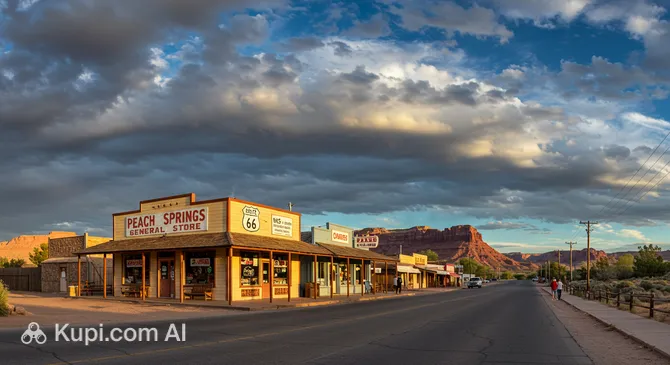
Peach Springs is a small but colorful town in the state of Arizona, located on the legendary historic Route 66. Situated in the USA, this place attracts travelers with its authentic atmosphere and status as the capital of the Hualapai Indian Reservation. Despite its modest size and population of only about 229 people, the settlement possesses a special coziness and plays an important role in the region's tourism life.

Peach Springs. Illustration.
Source: Kupi.com AI

Its geographical location makes the town an ideal starting point for exploring natural wonders. It is from here that the path opens to Grand Canyon West—one of the most breathtaking parts of the famous canyon. The local history of Peach Springs is inextricably linked to the culture of indigenous peoples and the development of the Wild West's transport arteries, allowing guests to get acquainted with the unique traditions and customs of the local residents.

Outdoor enthusiasts will find plenty of opportunities for adventure here. Proximity to the Colorado River allows for unforgettable rafting trips, while the surrounding landscapes beckon photographers and lovers of the desert's rugged beauty. If you want to take a break from the city bustle and immerse yourself in the unique world of Arizona, Peach Springs should be a mandatory stop on your travel itinerary.

Weather Overview

The climate in Peach Springs is characterized by noticeable seasonal contrasts typical for this region of Arizona. Summers here are truly hot: in July, the warmest month, the average temperature is about 28°C, and daytime highs often exceed 34°C. This period also sees the highest number of wet days (up to 7–8 per month). Winters bring cool weather: in January and December, average temperatures drop to 5–6°C, and light frosts with temperatures just below zero are possible at night.

Spring and autumn are considered the most pleasant times to visit, when the air warms up to a comfortable 15–19°C. To plan your travel wardrobe wisely, we recommend checking what the forecasted weather in Peach Springs is for your dates. Expect a hot summer with occasional precipitation and cool, predominantly dry winters.

Average monthly temperature

Average monthly precipitation

Interesting Facts

Peach Springs is not just a point on the map, but a place holding amazing stories and unique geographical features. Beyond the well-known tourist routes, there are facts that will make you look at this town in a new way:
  • Prototype for "Cars." Urban legend has it that Peach Springs served as one of the main inspirations for the fictional town of Radiator Springs in the popular animated film "Cars." The atmosphere of historic Route 66 is preserved so authentically here that it's easy to feel like a character in the movie.

  • Unique access to the river. This is one of the rare places where a road exists that leads directly to the bottom of the Grand Canyon to the banks of the Colorado River. It is from here, via Diamond Creek Road, that tourists set off on exciting rafting adventures with the Hualapai River Runners, conquering the turbulent waters of the famous river.

  • Dry Caverns. The nearby Grand Canyon Caverns are a geological phenomenon—they are the largest "dry" caverns in the country. Due to the lack of moisture, stalactites do not form in the usual way, but the air is so clean and dry that it perfectly preserves the history of the underworld for centuries.

  • Cultural Heart of a Nation. Peach Springs is the administrative capital of the Hualapai Tribe, whose name translates to "People of the Tall Pines." The town serves as a center for heritage preservation: festivals and events are held here where travelers can gain a deeper understanding of the traditions, crafts, and lifestyle of Arizona's indigenous inhabitants.

How to Get There

Peach Springs is located in a secluded part of Arizona, so planning your trip requires attention to detail. Since there are no direct international flights to the settlement itself, travelers will need to combine a flight with a car journey. You can find all the ways to get to the city to choose the most convenient route for your trip along historic Route 66.

There is no airport in the town of Peach Springs itself, but you can fly into Laughlin-Bullhead International Airport (IFP) in Bullhead City, which is about 110 km from Peach Springs. This is one of the nearest civilian airports receiving regular flights. The drive from there in a rental car or taxi will take about 1 hour and 30 minutes, allowing you to enjoy the desert landscapes along the way.

Another popular option, especially for those combining their trip with visits to national parks, is Flagstaff Pulliam Airport (FLG). It is located in the city of Flagstaff, approximately 165 km from your destination. This is an important regional hub with good connections. Travel time by car from Flagstaff to Peach Springs will be about 2 hours.

It is also worth mentioning Grand Canyon National Park Airport (GCN), located in the Flagstaff area (near the park entrance), at a distance of about 125 km. While it primarily focuses on tourist and charter flights, its proximity makes it a convenient starting point. The trip from here to Peach Springs will take approximately 1 hour and 45 minutes.

For clarity, here is a summary of the main airports:

AirportPassenger trafficDistance
Laughlin Bullhead International Airport240 000111 km
Grand Canyon National Park Airport75 000125 km
Prescott Airport48 116134 km
Flagstaff Pulliam Airport304 454165 km
Sedona167 km

There is no direct rail service to Peach Springs, as there is no active passenger station in the settlement. The nearest major Amtrak station is in the city of Kingman, located to the west. Most tourists prefer to rent a car in one of the major cities of Arizona or neighboring Nevada (for example, Las Vegas) and travel to Peach Springs via legendary Route 66, which is an exciting adventure in itself.

Main Attractions

Despite its modest size, Peach Springs is the starting point for amazing natural and historical discoveries. The main attractions here are related to Arizona's geological wonders and indigenous heritage, making this town an important stop for travelers exploring the Wild West.

One of the most famous locations in the vicinity is the Grand Canyon Caverns. These are the largest dry caverns in the United States, located at a depth of more than 60 meters underground. Tourists are attracted by the opportunity to take an elevator down into cool subterranean halls, where the air is so dry that geological formations remain virtually unchanged. Tours of varying difficulty are held here, and for thrill-seekers, there is even an option for an overnight stay in an underground suite or a "ghost tour."

For those dreaming of seeing the canyon's majesty from an unusual perspective, Diamond Creek Road is a must-visit. This unique route starts in Peach Springs and is the only road that allows you to drive a car to the very bottom of the Grand Canyon, right to the waters of the Colorado River. The path follows a dirt road through impressive cliffs, and although a special permit from the Hualapai Tribe is required for travel, the views and the sense of solitude by the turbulent river are well worth the effort.

The center of the town's social and tourist life is the Hualapai Lodge. This is not just a hotel, but a place where you can connect with the culture of the local tribe. It is here that travelers purchase permits to visit tribal lands, book rafting tours on the Colorado River, and can try local cuisine. The building, decorated in a traditional style, serves as an excellent base for resting before long trips along historic Route 66.

Local Cuisine

The gastronomic scene in Peach Springs, despite the town's modest size, offers travelers a unique experience that combines the classics of the American West with the culinary traditions of the indigenous people. You won't find fine dining restaurants or noisy food courts here, but you can try simple, hearty, and authentic food that has sustained desert dwellers for centuries.

The basis of the local menu consists of traditional Hualapai Tribe dishes. Tourists should definitely try bison meat dishes—this could be anything from a juicy burger to a steak prepared according to old recipes. Also popular are turkey and stews made from local products, which are prepared using ancient methods of processing grain and meat. These treats allow you not only to satisfy your hunger but also to touch the history of the region through taste.

As for drinks, the choice is dictated by Arizona's hot climate. Iced tea and lemonades are popular in local establishments, providing great refreshment after a trip through the desert. In the morning, travelers following Route 66 invariably order strong American coffee. The alcohol list is usually standard for the American heartland; however, it is worth remembering that special rules for the sale of alcohol may apply on reservation territory.

The food culture in Peach Springs is centered around a few cafes and the main restaurant at the hotel, where a homey atmosphere prevails. Street food and farmers' markets are practically non-existent here, so tourists and locals prefer to dine at tables in the cool indoors. Cultural festivals of the Hualapai Tribe become special gastronomic events: it is during these celebrations that you can try rare ceremonial dishes that are not usually found on the everyday menu.

Travel Tips

Peach Springs is a unique place where the spirit of historic Route 66 intertwines with the ancient traditions of the Hualapai people. To ensure your journey to this remote and colorful corner of the USA goes smoothly and safely, we have prepared a list of important practical recommendations.

  1. Clothing and Gear. The climate here is desert-like, so the best strategy is to dress in layers. In summer, a wide-brimmed hat, sunglasses, and high-SPF sunscreen are mandatory as the sun is extremely intense. In winter and in the evenings, it can be cold, so a windbreaker or fleece jacket is necessary. If you plan to descend to the river or walk through the canyons, bring sturdy trekking shoes with good ankle support.
  2. Transport Issues. There is no public transport within the settlement, and taxi services (Uber, Lyft) practically do not work here due to the remote location. The only reliable way to get around is a rental car. If you plan to drive on Diamond Creek Road to the bottom of the canyon, it is highly recommended to rent an SUV or a crossover with high ground clearance, as the road is unpaved and challenging in places.
  3. Finances and Payment. The currency is the US Dollar (USD). The Hualapai Lodge and the gas station accept cards, but we advise always carrying cash in small denominations. This will come in handy for buying souvenirs from local artisans or in case of terminal connection failures. There are very few ATMs in town, so it's better to withdraw cash beforehand in Kingman or Seligman. Tipping in cafes and for guides is customary at 15–20%.
  4. Health and Safety. Peach Springs is in a desert area, so the risk of dehydration is high—always carry a supply of drinking water (at least 3-4 liters per person). The nearest major hospital and 24-hour pharmacies are in Kingman (about 80 km away), so be sure to pack a personal first-aid kit with everything you need. The area is safe, but you should watch your step in nature due to possible encounters with snakes or scorpions.
  5. Communication and Navigation. Mobile service in the town itself is usually stable, but as soon as you drive into the canyons, the signal disappears. English is the primary language of communication. Wi-Fi is available in the hotel lobby and some public areas. It is critically important to download offline maps of the region (Google Maps or Maps.me) beforehand, as the navigator may lose its connection at the most inconvenient moment.
  6. Local Etiquette. You are on the territory of the sovereign Hualapai Indian Reservation. Respect local laws and customs. Always ask for permission before photographing local residents or their private property. Be polite and restrained; calm and respectful communication is valued here.
  7. What to Avoid. Categorically avoid driving off authorized roads and entering closed territories without a special permit. Tribal lands are protected, and unauthorized tourism is strictly prohibited here. Also, do not attempt to take rocks, plants, or artifacts from the canyon territory—this is considered a serious violation.
  8. Important Tip. The center for all tourist logistics is the Hualapai Lodge. This is where you need to buy permits for hiking, camping, or driving to the Colorado River. The office works on a specific schedule, so it's best to take care of buying permits in the morning to avoid violating the rules of staying on tribal lands.

Following these simple rules will help you avoid unpleasant surprises and allow you to focus fully on Arizona's majestic beauty. Peach Springs is a place where time flows differently, and proper preparation will be the key to your unforgettable Wild West adventure.

Entertainment & Nightlife

Nightlife in Peach Springs is fundamentally different from what tourists are used to seeing in major metropolises. Here you won't find noisy nightclubs, neon disco signs, or 24-hour bars. An evening in the capital of the Hualapai Tribe is a time for silence, contemplation, and cozy dinners in the company of fellow travelers journeying along legendary Route 66. Most activity centers around the town's only major hotel and roadside establishments, where life quiets down quite early.

The hub of evening leisure in the town is the Diamond Creek Restaurant, located inside the Hualapai Lodge. This is the main meeting place for tourists and locals after sunset. A relaxed, almost family-like atmosphere prevails here. The interior is designed in a rustic style with elements of Native American decor. The menu offers a mix of classic American cuisine and traditional Hualapai dishes, such as stew with frybread. This is the only place in the settlement itself where you can sit comfortably in the evening, discuss the day's impressions, and use the Wi-Fi.

If you are willing to drive a bit further along Route 66 (about 10-15 minutes east), it's worth visiting The Caverns Grill at the Grand Canyon Caverns complex. This establishment is steeped in the spirit of the 1960s and classic road romance. In the evenings, history and geology buffs gather here. Occasionally, they host themed nights or live performances by country musicians, though this is more of a pleasant exception than a rule. The bar menu is standard, but it is worth remembering that alcohol sales rules may be stricter than in other parts of the state.

Practical tips for evening relaxation are very important here. Life in Peach Springs winds down early: most establishments close their kitchens by 8:00 PM or 9:00 PM, so plan your dinner in advance. The dress code everywhere is completely casual and democratic—comfortable travel clothing is appropriate anywhere. The average check for dinner will be around $15–$25 per person. Since there is no public transport or ride-sharing services (Uber/Lyft) at night, you will have to get around exclusively by your own car or on foot if you are staying at the lodge.

From a safety standpoint, Peach Springs is a quiet place; however, night walks have their peculiarities. Street lighting is minimal to avoid disturbing the natural darkness of the sky, so having a flashlight is essential. The main "danger" at night is not people but animals: wild donkeys (burros) or elk often wander onto the roads, so be extremely careful while driving. The most exciting "nightclub" here is the sky itself: thanks to its distance from big cities, the stars shine incredibly brightly, and many tourists spend their evenings simply contemplating the Milky Way.

During the day, Peach Springs offers entirely different entertainment. The town serves as a base for rafting on the Colorado River with the Hualapai River Runners and a starting point for off-road trips into the canyons. History lovers can visit the tribal cultural center to learn more about indigenous heritage before the quiet desert evening sets in.

Parks & Museums

In Peach Springs, the concept of a traditional city park with manicured lawns gives way to the majestic natural landscapes surrounding the settlement on all sides. Cultural life here is concentrated not in vast galleries but in intimate spaces that preserve the memory of ancient indigenous traditions and the golden era of automobile travel across the USA. This is a place where geography and history themselves serve as the main open-air exhibits.

Natural Zones and Landscapes

The main natural attraction, serving as a substitute for city squares for locals and tourists alike, is Peach Springs Canyon. This is a natural system of faults and valleys that slopes gently down to the Colorado River. Unlike closed reserves, this zone (with a permit from the tribe) is available for exploration. Here you can see unique desert flora: from giant saguaro cacti to rare species of wildflowers that bloom in the spring. A walk or drive through this territory allows you to feel the scale of Arizona without the crowds of tourists typical of national parks.

Another significant natural site is the area around the Grand Canyon Caverns. Although the caverns themselves are underground, the territory surrounding them represents a typical high-altitude desert landscape. Small picnic areas and walking trails are set up here, offering panoramic views of the vast expanses of the plateau. It's a great place to enjoy the silence and observe local birds in their natural habitat.

Museums and Cultural Heritage

The heart of the town's cultural life is the Hualapai Cultural Center. This is more than just a museum; it is a living archive of the history of the people who call themselves the "People of the Tall Pines." The exhibit includes magnificent examples of traditional basket weaving, historical photographs of tribal leaders, and everyday items used for centuries. Here, tourists can learn about the complex Hualapai language, their struggle for land, and their spiritual beliefs. The center often hosts workshops and meetings with elders, making a visit here a deeply personal experience.

An equally important historical site, functioning as an architectural monument, is the John Osterman Shell Station. Built in 1929, this building is listed on the National Register of Historic Places. While it does not function as a museum in the classic sense, its unique architecture with slanting walls and preserved facade attracts Route 66 history buffs. It is a "silent witness" to the era when the road was America's main artery and a great location for atmospheric photos.

As an insider tip: be sure to check out the gift shop at the Hualapai Lodge. Often, work by contemporary tribal artists and craftspeople that doesn't make it into large museums is displayed there. By purchasing beaded jewelry or pottery there, you not only get an authentic souvenir but also directly support the preservation of local masters' cultural traditions.

Getting Around

The public transport system in Peach Springs has its own specifics, dictated by the settlement's size and its distance from major metropolises. It is important for tourists to understand that the usual urban infrastructure like subways, trams, or an extensive network of city buses does not exist here. The town is a small community located along historic Route 66, and most movement here is done by personal or rental transport.

The only type of regular public connection is the Hualapai Transit bus service. These buses connect Peach Springs with the nearest large city, Kingman. The route is primarily aimed at local residents who need to get to work, hospitals, or shops, but tourists can also use it. Trips are typically made several times a day from Monday to Friday, and on weekends, service may be limited or non-existent.

The fare payment system on local buses is as simple and conservative as possible. They do not use contactless transport cards, mobile apps, or complex transit passes. Payment is made in cash to the driver upon boarding. It is highly recommended to have small bills and coins for the exact fare (US dollars), as the driver may not have change. The cost of travel between settlements is quite democratic, but it is better to check current rates directly before the trip on information boards at the stop or in the local hotel lobby.

For tourists planning to visit natural attractions, specialized transport exists. The Hualapai Lodge organizes transfers and shuttles for tour participants, such as those heading for rafting on the Colorado River. These trips are usually included in the tour price or paid for separately at the hotel reception. This is the most reliable way to reach hard-to-access locations, such as the descent to the river via Diamond Creek Road, without using your own 4x4 vehicle.

As for alternative means of transport, taxi services and ride-sharing (Uber, Lyft) practically do not operate in Peach Springs. Due to the remote location, waiting for a car can stretch into hours, or the order may not be accepted at all. Bicycle rentals in the settlement itself are also not developed. Therefore, a rental car remains the main and practically only means of transport for a comfortable journey through the region. Within the settlement itself, distances are small, and you can easily move between major sites (hotel, shop, and cultural center) on foot.

Accommodation

Accommodation in Peach Springs has its own unique characteristics, dictated by the town's status as a small settlement in the heart of the reservation. Tourists should not expect a wide choice of hotel chains, luxury resorts, or budget hostels here. The housing market is primarily represented by mid-range hotels and motels that preserve the spirit of historic Route 66. The main advantage of local accommodation is its authenticity and immediate proximity to natural attractions.

The concept of "neighborhoods" in a town with a population of just over 200 people is quite relative. All available lodging options are concentrated along the main transport artery—Route 66. This is maximally convenient for travelers: you are always in the center of things, near the only shop, the cultural center, and the turn-off for the road leading to the Grand Canyon. Living here means being immersed in the silence of the desert right outside your room.

The central and most popular place to stay is the Hualapai Lodge. This is not just a hotel, but a true tourist hub for the town. It serves as the starting point for all official tribal tours, including rafting. The rooms here are modern and comfortable, decorated with elements of local culture. Another iconic option, located slightly away from the town, is the inn at the Grand Canyon Caverns (Grand Canyon Caverns Inn). This place is perfect for fans of a retro atmosphere and unusual experiences, as you can spend the night in a historic motel or even in a suite underground.

There is one critical piece of booking advice: book your accommodation in advance. Due to the extremely limited number of rooms (effectively only one large hotel in town), spaces fill up quickly, especially during the peak tourist seasons (spring and autumn) and on tribal festival days. If you plan a trip on the day of arrival, there is a high risk of not finding a free room and being forced to drive to the neighboring town of Kingman for over an hour.

The price range in Peach Springs can be described as medium. Prices here are higher than in typical roadside motels due to the exclusivity of the location and lack of competition, but they remain accessible to most tourists. Booking is best done through official hotel websites or major online platforms. Campgrounds for auto-travelers located in the vicinity are also popular, but staying overnight there may require a special permit from the tribal administration.

Nearby Cities

For those looking to explore the surrounding area, Peach Springs serves as an excellent starting point for day trips to several interesting nearby locations:

Prescott Valley. Located about 144 km to the south, this Arizona town offers a change of scenery and climate. It is a great destination for outdoor enthusiasts: here you can walk along scenic trails, visit Watson and Lynx Lakes, or explore the historic center of the neighboring city of Prescott, known for its Victorian-era architecture and cowboy culture.

Henderson. Situated in the state of Nevada, about 150 km from Peach Springs, Henderson is the gateway to the famous Lake Mead and Hoover Dam. The city is famous for its parks, botanical gardens, and a more relaxed atmosphere compared to bustling Las Vegas, although it is located right next to it.

Paradise. If you are up for a longer trip (about 168 km), Paradise is where the famous Las Vegas Strip is located. Here, world-class shows, casinos, fine dining restaurants, and neon lights await travelers, creating a bright contrast to the silence of Arizona's canyons.

CityPopulationDistance
Grand Canyon West61 km
Kingman32 20468 km
Supai208103 km
Bullhead City41 064109 km
Bagdad2 000109 km

These nearby destinations provide an insight into the region's diverse culture and landscapes, complementing the experience of visiting the Grand Canyon.

Shopping & Souvenirs

Shopping in Peach Springs has its own unique characteristics, dictated by the settlement's size and its location on an Indian reservation. This is not the place to go for fashion brands or major sales. The shopping sphere here is oriented toward travelers crossing the USA via historic Route 66 and those who want to connect with the culture of the indigenous population. The range of stores is limited to souvenirs, essential items, and unique handmade goods.

All the town's commercial activity is concentrated along its main and only major artery—Route 66. There are no specialized shopping districts or pedestrian streets here. Stores are typically built into the infrastructure of hotels, gas stations, or cultural centers. Due to the town's compactness, you can walk to all the interesting points in literally half an hour.

Major shopping centers and malls are completely absent in Peach Springs. The nearest chain supermarkets and clothing stores are in the city of Kingman, located about 80 kilometers to the west. Tourists who need to restock serious gear or groceries are recommended to do so in advance, before arriving in the settlement.

Classic markets in the usual sense are also absent here. However, the Hualapai Cultural Center often fulfills the role of a marketplace for local masters. Here you can find unique items created by reservation residents rather than mass-produced products. Sometimes small, improvised sales are organized during tribal holidays or festivals, where you can buy food and crafts directly from the artisans.

The main goal of shopping in Peach Springs is authentic souvenirs. First and foremost, pay attention to Hualapai crafts. These could be traditional woven baskets, which are famous for their quality and complex patterns, beaded jewelry, or silver with turquoise, as well as pottery. The second popular category of goods is Route 66 memorabilia: magnets, T-shirts, caps, and retro signs reminiscent of the golden era of automobile travel.

The operating hours of retail outlets here are quite conservative. Souvenir shops at the Hualapai Lodge and the Cultural Center are usually open from 8:00 or 9:00 AM to 5:00–6:00 PM. Small private shops may close earlier or work on a flexible schedule. Regarding payment, official tourist locations (hotel, gas station) accept credit cards without problems. However, to purchase items from private masters or at small kiosks, it is highly recommended to carry US dollars in cash in small denominations.

The Tax Free system as it exists in Europe does not apply in the USA, and Peach Springs is no exception. Prices on price tags are indicated without sales tax, which is added at the checkout, and tourists cannot claim a refund on it.
Reached the end of the page?

That means the route is fully explored