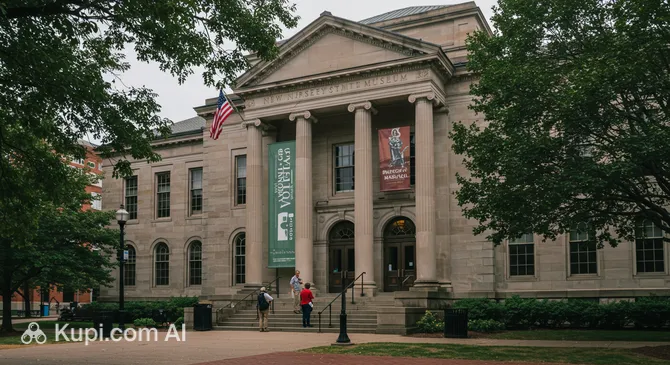
The New Jersey State Museum is a major cultural and educational hub located in Trenton. As one of the premier attractions in the USA, the museum offers a unique combination of history, art, and natural science, all brought together under one roof to educate and inspire visitors.
New Jersey State Museum. Illustration.
Source: Kupi.com AI
Traveler photos:
The museum complex features impressive galleries dedicated to archaeology, ethnography, and the state's industrial growth. Visitors can see everything from dinosaur skeletons to a magnificent fine art collection. The impeccable cleanliness of the facilities, modern elevators, and well-placed rest areas make it a comfortable destination for tourists of all ages.
The museum building is situated by the scenic Delaware River, adjacent to the State Capitol. A key feature is that admission to the museum is free (with the exception of planetarium shows), making it a "hidden gem" of Trenton accessible to every traveler.
Contacts
To check for information regarding special exhibitions or to book seats in the planetarium, you can use the official communication channels. The museum administration provides up-to-date details on its website.
A diverse program awaits visitors in the halls of the New Jersey State Museum. Make sure to visit the Natural History department, which features the exciting “Jaws: The World of Sharks” exhibition and a real paleontology lab where you can watch work in progress through a glass partition. Children will love the displays featuring dinosaurs and animals native to the region.
One of the museum's main draws is its state-of-the-art planetarium. Its shows are very popular, especially on weekends, so it is advisable to book tickets in advance. Art enthusiasts should visit the Fine Art gallery, which showcases works by masters like Romare Bearden and Jacob Lawrence, as well as a unique collection of colonial-era furniture.
The history section of the museum offers a deep dive into the past: from a collection of Civil War flags to a moving exhibition dedicated to the events of September 11. Interactive areas for children and regularly updated temporary exhibitions ensure that every visit offers something new to discover.
Getting There
Getting to the museum, located at 205 W State St, is quite simple. If you are traveling by car from New York or Philadelphia, the most convenient routes are via I-95 or the NJ Turnpike. A nice bonus for drivers is the free parking in the adjacent lots, which is available on weekends.
For those who prefer public transport, the main hub is the Trenton Transit Center, served by Amtrak and NJ Transit trains. The museum is about 1.5 km from the station—a distance that can be covered in a 20-minute walk along historic State Street, or by taking a local bus or taxi.
Travelers arriving by air will find it easiest to use Philadelphia (PHL) or Newark (EWR) airports, both about an hour's drive away. From the nearby regional Trenton-Mercer Airport (TTN), the museum is just a 15–20 minute taxi ride.
Nearest city: Trenton
History & Facts
The museum's history is inextricably linked with Trenton itself, which officially became the state capital in 1790. The city was founded by Quakers in 1679 and played a pivotal role in the formation of American statehood. It was here in December 1776 that the famous Battle of Trenton took place, following George Washington's legendary crossing of the Delaware River, a turning point in the Revolutionary War.
Interestingly, in 1784, the city briefly served as the capital of the United States. The museum building is located in immediate proximity to the historic State House, built in 1792. The museum's exhibits carefully preserve the memory of these eras, showcasing artifacts ranging from early European settlements to the region's period of rapid industrial development.
The museum also highlights the evolution of relationships between the indigenous Lenape people and the first colonists. Collections focused on the industrial era emphasize Trenton's status as a major manufacturing center, whose contribution to the nation's history is significant.
Time Needed
To fully explore the New Jersey State Museum, it is recommended to set aside 3 to 5 hours in your travel plan. This is ample time to see the main historical and scientific exhibits without rushing and to enjoy a show at the planetarium.
Families with children might need a full day. The wealth of interactive zones and the captivating dinosaur exhibits often keep young explorers occupied for a long time in each hall. If your time is limited, it is best to choose your priority galleries in advance so you don't miss the highlights.
Working Hours
The museum operates on a regular schedule from Tuesday through Sunday. The doors are open to visitors from 9:00 AM to 4:45 PM. This schedule is convenient for tourists, allowing them to balance a cultural visit with other city sightseeing.
Please note that Monday is a closing day, and the museum is entirely closed to the public. Additionally, the planetarium may have its own specific show schedule, which is best checked on the official website immediately before your visit.
Day
Working hours
Monday
Closed
Tuesday
9:00 – 16:45
Wednesday
9:00 – 16:45
Thursday
9:00 – 16:45
Friday
9:00 – 16:45
Saturday
9:00 – 16:45
Sunday
9:00 – 16:45
Nearby
Exploring the area surrounding the New Jersey State Museum can greatly enrich any visitor's experience. Located in the historic heart of the city, the museum is surrounded by iconic architectural landmarks and memorials that reveal different facets of American history.